


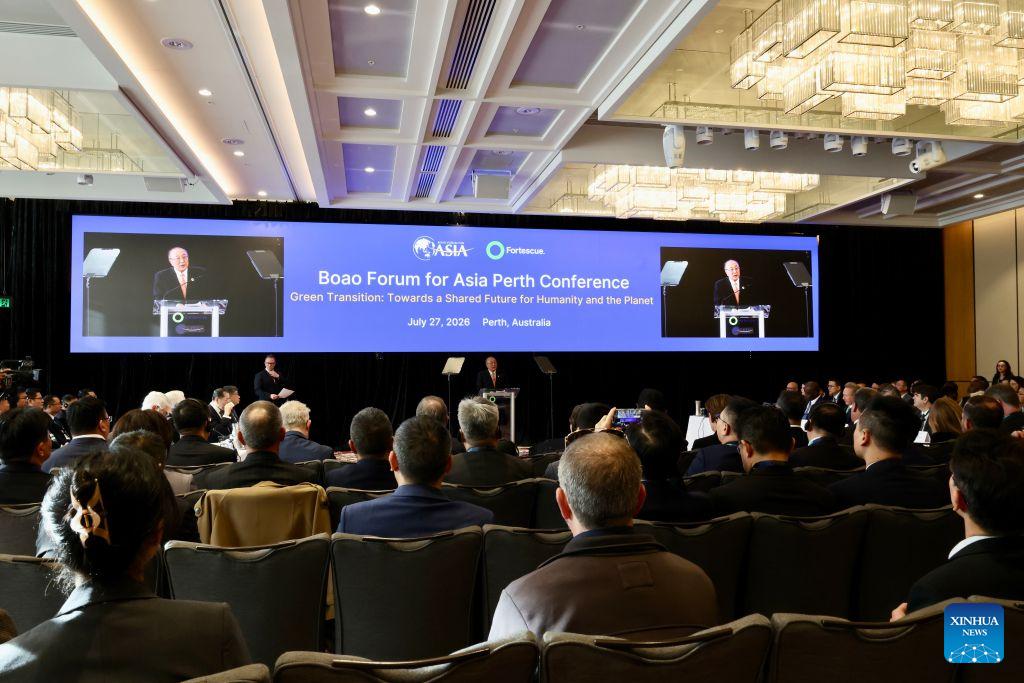
People attend the opening ceremony of the Boao Forum for Asia (BFA) Perth Conference in Perth, Australia, July 27, 2026. A high-level meeting has brought together experts, policymakers and industry leaders in the capital city of Western Australia on Monday, with a spotlight on the global green transition. Around 200 representatives from governments, businesses and academic institutions across Asia, Oceania and Africa have gathered at the Boao Forum for Asia (BFA) Perth Conference, sharing their insights under the theme "Green Transition: Towards a Shared Future for Humanity and the Planet." (Photo: Zhou Dan/Xinhua)
PERTH, Australia, July 28 (Xinhua) -- A high-level meeting has brought together experts, policymakers and industry leaders in the capital city of Western Australia on Monday, with a spotlight on the global green transition.
Around 200 representatives from governments, businesses and academic institutions across Asia, Oceania and Africa have gathered at the Boao Forum for Asia (BFA) Perth Conference, sharing their insights under the theme "Green Transition: Towards a Shared Future for Humanity and the Planet".
In his opening remarks, Zhang Jun, secretary general of BFA, pointed out that the global green transition, led by energy transition, can inject fresh impetus into addressing global challenges.
To accelerate the advancement of the green transition, it is imperative to adhere to an action-oriented approach, foster international cooperation, improve global governance, and advance a just transition, Zhang said.
Liu Zhenmin, China's special envoy for climate change, said China attaches great importance to the green transition and development in the Asia-Pacific, calling on all stakeholders to maintain momentum, pursue the green transition spearheaded by energy transformation, uphold regional energy security, boost regional sustainable economic growth, and deliver vital contributions to global climate governance.
PARADIGM
"I'm incredibly impressed with the transition that China is making," Christine Holgate, CEO of Team Global Express, told Xinhua.
Holgate was one among the many delegates who noted that China's remarkable achievements in green development provide valuable experience for the world's green transition and sustainable development.
"Let's look to China to see some of the lessons why they were so successful. The Chinese government made a very determined effort. They reduced taxes, they waived license plate fees, and they actually invested heavily into the infrastructure to adopt for electric charging. We've got some way to go in Australia," she said.
Tim Buckley, founder and director of Climate Energy Finance, argues that China has delivered stellar performance in sectors including batteries, wind power and photovoltaic energy.
Against the backdrop of global climate change, he said China's endeavors, ranging from investment layouts to strategic visions, have been hugely inspiring him.
Buckley also observed that China's high-speed rail network, spanning more than 50,000 km, is "just one massive achievement in low emissions industries of the future that China is leading on."
"Its shift to a green economy is significant for the whole globe," said David McElrea, CEO of Smart Energy Council, the peak body for solar, storage and smart energy in Australia.
"The future of the world has to be green because there is no alternative. We have no option but to follow the lead that China is setting for the rest of us," he added.
According to Liu, during the 2021-2025 period, China's exports of wind and photovoltaic products have helped other countries reduce carbon emissions by approximately 4 billion tonnes cumulatively.
PARTNERSHIP
"Working together, we can be the rebuilders" of "the next sources of prosperity, power and partnership," said Andrew Forrest, executive chairman and founder of Australian mining giant Fortescue.
Australia and China can cooperate on facilitating the green transition of industries including mining, steel and cement, said Forrest.
"Partnership" was a keyword frequently heard throughout the conference. Some Australian delegates noted that there is broad prospect for Australia-China cooperation on green development.
Rhys Roberts, national president of the Australia China Business Council, also expressed his optimism in collaboration between the two countries. "China's move towards the green economy helps Australia, because we use Chinese solar panels, Chinese batteries, Chinese vehicles. And it's been wonderful to push the Australian economy forward with Chinese technology and development."
Buckley holds the view that Australia boasts enormous potential in renewable energy, while China enjoys strengths in supply chains and infrastructure development capacity. The two countries can forge complementary partnerships to jointly expand their industrial footprint.