


BRUSSELS, July 30 (Xinhua) -- Seasonally adjusted gross domestic product (GDP) grew 0.4 percent quarter-on-quarter in the euro area and 0.5 percent in the wider European Union (EU) in the second quarter (Q2) of 2026, Eurostat, the EU's statistical office, said in a preliminary flash estimate released on Thursday.
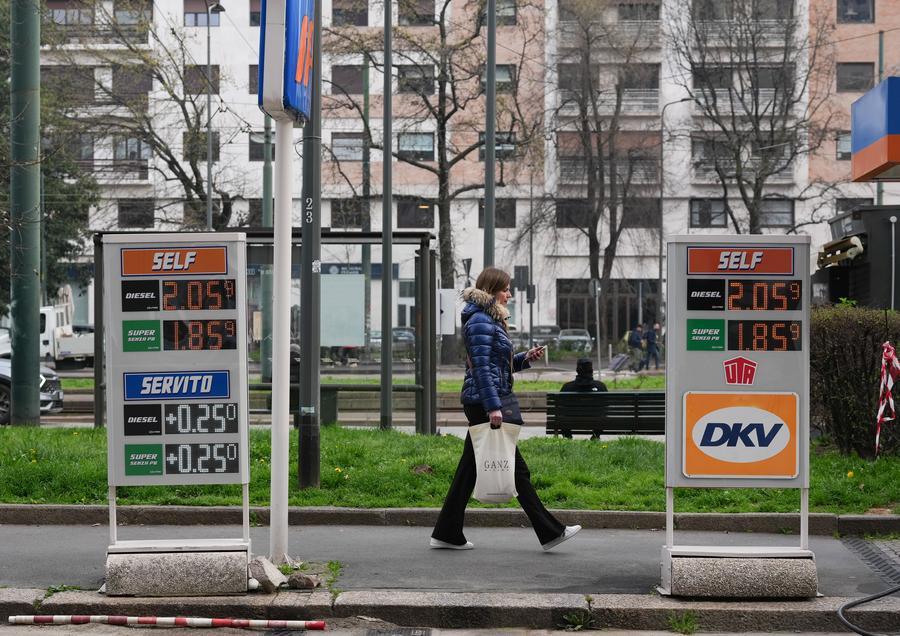
A woman walks past a gas station in Milan, Italy, March 11, 2026. (File photo: Xinhua/Li Jing)
On a year-on-year basis, GDP expanded by 1.0 percent in the euro area and by 1.2 percent in the EU, up from 0.5 percent and 0.8 percent respectively in the previous quarter.
Among members with available Q2 data, Ireland recorded the strongest quarter-on-quarter growth at 3.9 percent, followed by Lithuania at 1.7 percent and Sweden at 1.4 percent. Belgium and Austria recorded the lowest growth rates, both registering no growth.
According to the economic research firm Pantheon Macroeconomics' calculations, the rebound in Ireland alone added 0.1 percentage points to headline eurozone growth.
For the euro area's largest economies, economic growth slowed to 0.2 percent in Germany in the second quarter, after a 0.4 percent growth in the first quarter. GDP in France reversed the contraction in the first quarter and climbed by 0.2 percent quarter on quarter. The Italian economy advanced by 0.2 percent, slightly down from the first quarter when the GDP soared by 0.3 percent.
Among the major economies in the EU, Spain posted stronger growth in the second quarter compared with the first quarter with an increase of 0.7 percent.
The latest figures followed a flat first quarter of 2026, when GDP remained stable in the euro area and increased by 0.1 percent in the EU, pointing to a rebound in the second quarter.
Bert Colijn, chief economist for the Netherlands at ING, said the conflict in the Middle East currently represented the main downside risk to the euro area economy.
However, unless the conflict undergoes a prolonged and significant re-escalation, euro area GDP could continue to grow at a solid, though unspectacular, pace in the coming quarters, he said.
The European Central Bank (ECB) decided last week to keep its three key interest rates unchanged, saying its Governing Council remained well positioned to navigate the uncertainty caused by the Middle East conflict.
The ECB also warned in its monetary policy statement that uncertainty remained high and the full inflationary impact of the energy shock had yet to materialize.
The central bank noted that inflation expectations over shorter horizons remained elevated, while forward-looking indicators pointed to only modest economic growth in the near term as the energy shock and related uncertainties continued to weigh on activities.