


Israeli strikes killed at least four people, including two children, in the Gaza Strip on Thursday, health officials said, as mediators held new talks with Hamas leaders in Cairo to work towards full implementation of a US-brokered Gaza peace plan.
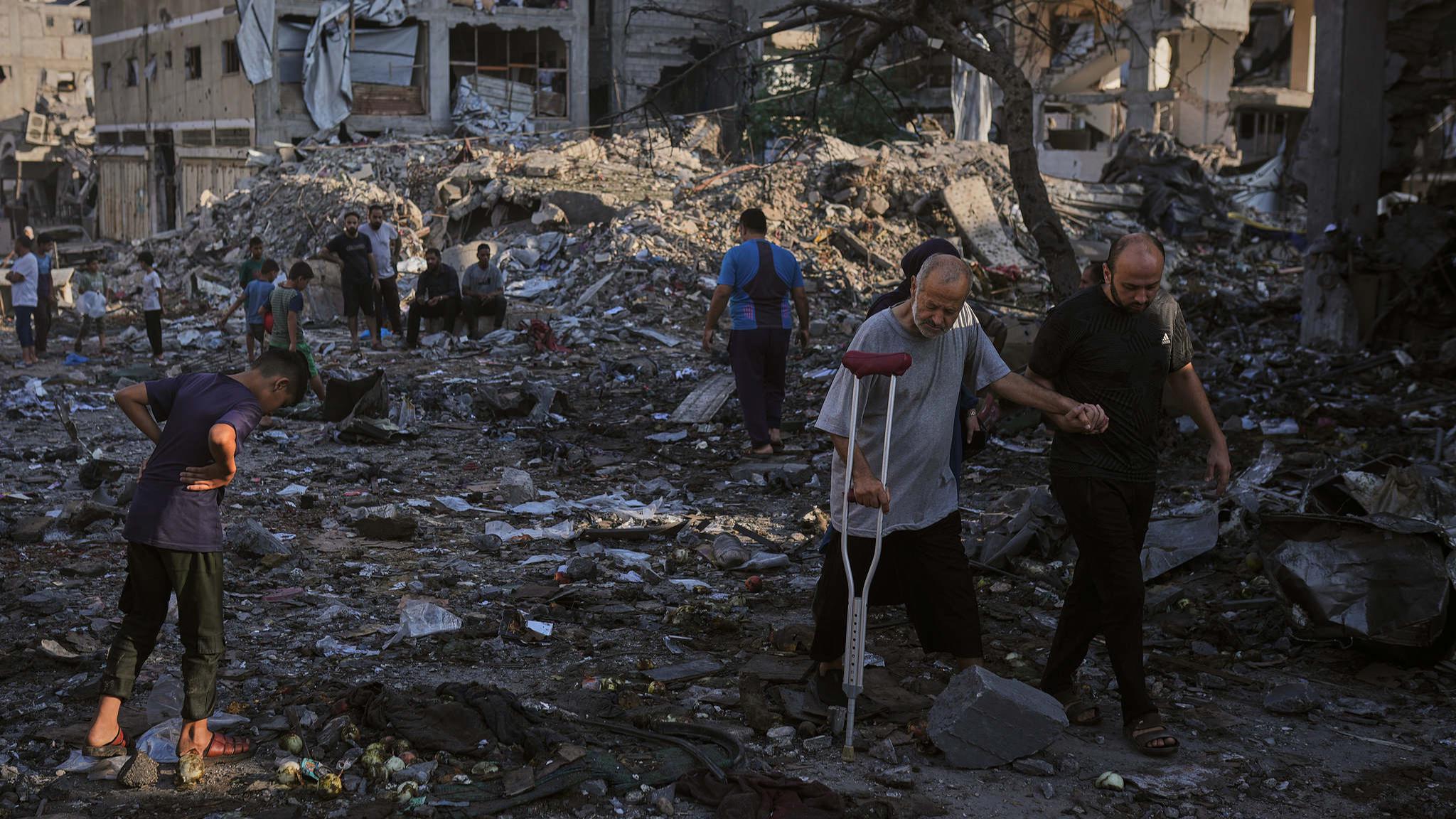
Palestinians inspect the rubble of a building and tents destroyed in an Israeli airstrike in Gaza City, July 30, 2026. (Photo: VCG)
A Hamas official and a diplomat close to the Cairo talks with mediators said discussions were "positive" and "making progress." The official added that the progress made would be tested by whether Israel would accept it to allow a broad agreement to be reached.
The diplomat said the negotiations were ongoing and making progress toward a roadmap that would see all heavy and light weapons in Gaza decommissioned.
Meanwhile, medics said an Israeli airstrike on a tent encampment in Khan Younis, in the south of the enclave, killed a man and an eight-year-old girl.
In the Bureij refugee camp in the central Gaza Strip, an Israeli airstrike hit a house, killing an 18-month-old child and wounding at least eight people, medics said.
Another Israeli strike targeted a Palestinian man on a bike near a tent encampment housing displaced families in Gaza City, killing one person and wounding 10 others.
The Israeli military said the strikes targeted Hamas militants, without providing further detail.
The latest deaths add to a toll of more than 1,200 Palestinians, mostly civilians, killed by Israeli attacks since the ceasefire took effect, according to Gaza health officials.
Hamas does not usually disclose its losses.
The truce halted full-scale fighting but has not ended near-daily Israeli strikes. Four Israeli soldiers have been killed by militants in Gaza since.
Cairo talks
In Cairo, Hamas leaders were holding talks with mediators from Egypt, Qatar and Türkiye, over the implementation of the second phase of President Donald Trump's Gaza plan, as presented to them by his Board of Peace, which oversees its implementation.
The plan called for a surge in humanitarian aid, governance by a civilian Palestinian administration, the disarmament of Hamas, the withdrawal of Israeli forces from Gaza and the deployment of an international force to help maintain security.
But progress has stalled in previous months.
On Thursday, a Hamas official said the group was coming with a "positive and good" response, but he did not say whether the group had agreed to fully disarm — a key sticking point in the talks over the past four months.
Hamas wants Israel to commit to ending attacks on Gaza and withdrawing its forces.
Sources close to Hamas said the group was willing to "confine and store" heavy weapons under a Palestinian body, not hand them over to Israel. Hamas did not comment on the matter.
It is not yet clear what will happen regarding light or personal weapons or whether the new Hamas stance would be accepted by Israel and the Board of Peace.
The diplomat involved in the talks said the roadmap under discussion in Cairo, in addition to seeing all heavy and light weapons in Gaza decommissioned, would see authority transferred in phases to the US-backed National Committee for the Administration of Gaza (NCAG), with "no exceptions" and under the principle of "one authority, one law, one weapon".
The diplomat said the plan includes the elimination of tunnels, weapons stockpiles and weapons production facilities, adding that by the end of the process there would be no remaining militant infrastructure in Gaza.
The diplomat described the roadmap as being based on reciprocal steps rather than trust.
So far, the reality on the ground in Gaza remains far from this roadmap.
The Israeli military has continued to expand its military occupation of Gaza, with Prime Minister Benjamin Netanyahu saying that Israel intends to expand the area under its control to 70% of the enclave.
So far, NCAG has been based in Cairo without announcing a timeline for its entry into the strip.
It remains unclear how many forces would be available to deploy with the ISF, and whether Israeli troops would withdraw from the enclave.
In Cairo, two Egyptian sources said Hamas had agreed to several contentious points, including the handover of weapons, but requested changes to the document regarding the definition of the infrastructure to be dismantled.
Discussions on those requested amendments are under way in an effort to reach a mutually acceptable formula with the Board of Peace, the sources added.
The Board of Peace declined immediate comment on the Cairo talks.
Israel wants Hamas to cede power completely in Gaza and to fully disarm. Hamas dissolved a de facto Gaza government last month but maintained a caretaker body to provide vital services to residents.
Israel effectively controls an estimated 64% of the tiny coastal Gaza Strip, bombed to ruins in its two-year military assault following a 2023 Hamas attack on southern Israel.
Nearly all of Gaza's 2 million people now live on a sliver of land on the coast, mainly in makeshift tents or damaged buildings and facing dire living conditions, under Hamas control.