


U.S. President Donald Trump said on Monday that talks with Iran are "going on right now," calling it Tehran's "last chance" for a deal to end the five-month war. Iran, however, denied that any negotiations were taking place or planned.
Trump made the remarks after canceling previously authorized "massive strikes" on Iran on Saturday -- a move that continues his pattern of issuing threats before ultimately pulling back, a dynamic that has recurred since the launch of "Operation Epic Fury."
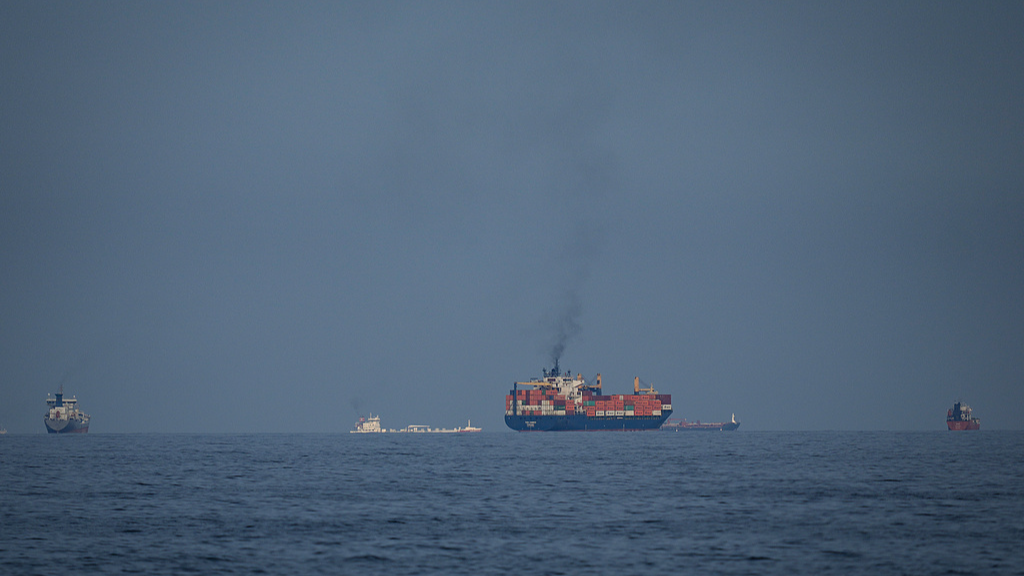
Oil tankers and cargo ships line up in the Strait of Hormuz as seen from Khor Fakkan, United Arab Emirates, March 11, 2026. (Photo: VCG)
Whether or not talks are actually underway, the latest developments suggest that a diplomatic resolution to the conflict remains unlikely in the near term.
CONTRADICTORY STATEMENTS
Trump announced on Sunday that renewed talks with Iranian representatives would commence Monday, though he did not specify the location or participants.
"We're talking and we're talking at the request of Iran, backed by Saudi Arabia, backed by UAE (the United Arab Emirates) and backed by Qatar in particular, but others also," Trump told reporters at the White House Oval Office.
"This is a last chance for them (Iran) to sign a good document," Trump continued.
He said the talks are focused on reopening the Strait of Hormuz, which could happen "literally by tomorrow," and on Iran's denuclearization, which he noted might "take a little while."
The Iranian side, however, struck a different note, insisting that no negotiations with the United States are occurring and none have been scheduled. Iranian Foreign Ministry spokesman Esmail Baghaei said Monday that Iran is currently not engaged in any negotiations with the United States, and the only talks under way were discussions with Oman over the management of the strait.
Trump hit back on Truth Social later on Monday, calling Iranian leaders "unbelievably duplicitous."
"They ask for a meeting, some would say 'beg,' talks begin, with more scheduled in the immediate future, and they say, openly and proudly, that they're not having any discussions, that nothing is being talked about, and they're only dealing with 'Oman,'" he wrote in a post on his social media platform.
According to a CBS News report on Monday citing U.S. officials, there are no new or extraordinary negotiation plans. Instead, the U.S. and Iranian negotiating teams are simply continuing their existing consultations via mediators.
HORMUZ STANDOFF
The Strait of Hormuz remains a key obstacle to ending the war. Since a ceasefire broke down in July, Iran has resumed a blockade of the waterway that it first imposed early in the war.
Iran's Foreign Ministry said Monday it was in talks with Oman to establish a safe, temporary transit route for vessels passing through the strait, a crucial maritime chokepoint through which around 20 percent of the world's crude oil and liquefied natural gas supplies normally flow.
Iranian Foreign Minister Abbas Araghchi told state media that negotiations with Oman were "nearing completion and in their final stages."
Meanwhile, Trump said the Strait of Hormuz is "already completely controlled by the United States Navy."
"Nothing gets through to Iran unless we want it to, and nothing will get through unless a deal, or total surrender, is accomplished," he wrote on Truth Social.
The U.S. Central Command (CENTCOM) said Monday that U.S. forces continue to "strictly enforce" the U.S. blockade against Iran.
"As of Aug. 3, CENTCOM has redirected 44 commercial vessels, disabled 2, and boarded 2," it posted on X.
Tensions in the region remained high after a cargo vessel reported being struck by an unidentified projectile off the coast of Oman early Tuesday local time, according to the United Kingdom Maritime Trade Operations (UKMTO).
A UKMTO advisory said the incident occurred in waters about 20 nautical miles northeast of Al Khasab, Oman, near the eastern entrance to the Strait of Hormuz.
Analysts say the crisis has left a lasting impression on governments and businesses alike regarding supply chain risks.
"Even if the Hormuz crisis ends tomorrow, its legacy will remain. Countries will continue looking for more resilient transport networks instead of relying on a single maritime route," said Ali Oguz Dirioz, an associate professor at TOBB University in Ankara specializing in trade and energy corridors.