


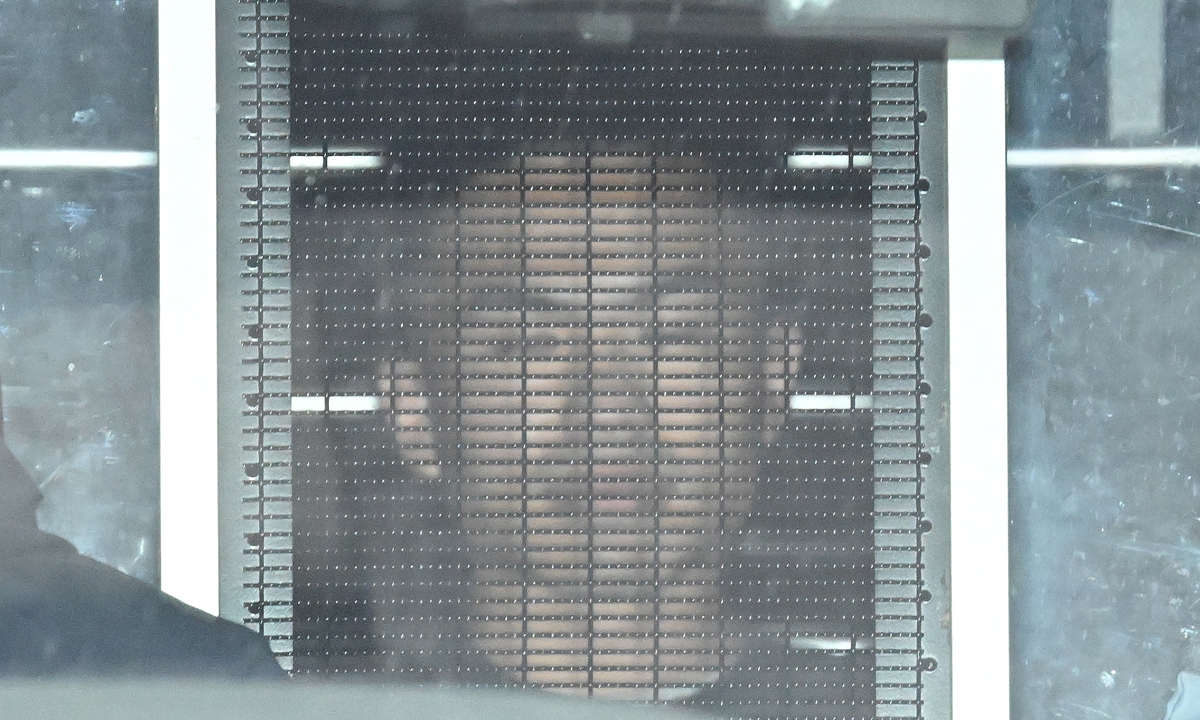
The rearrested Japan Ground Self-Defense Force second lieutenant Kodai Murata (Photo: VCG)
A Japan Ground Self-Defense Force officer charged over a knife-carrying intrusion into the Chinese Embassy in Tokyo appeared at a detention hearing at the Tokyo District Court on Wednesday, where he said he "reflects on and regrets" his actions. However, some Japanese media, including Kyodo News, hyped up suspect's claim that his motive was to force a change in China's so-called "hardline" foreign policy.
A Chinese observer noted that the delayed judicial process and selective media narratives that downplay key facts surrounding the SDF officer's intrusion into the Chinese Embassy are more than an isolated criminal case, reflecting deeper problems in Japan's social governance, military oversight and media narratives.
Second lieutenant Kodai Murata, 24, assigned to the SDF's Camp Ebino in Miyazaki Prefecture, made the remarks during a detention reason disclosure hearing at the Tokyo District Court, per the report. He faces charges of building intrusion, violation of the Firearm and Sword Control Law, and intimidation stemming from the March 24 incident.
Murata appeared calm throughout the proceedings. He described the views that drove him as "not something that can easily be changed," but stressed that he would never cause such an incident again. "I am reflecting on my actions and regret them," he said. Meetings with his parents and correspondence with his older brother while in detention had moved him, he added, noting that he had caused great trouble for his family and workplace and intended to take responsibility without attempting suicide or fleeing, per Kyodo News.
When reporting on the case, some major Japanese media outlets sensationalized the suspect's alleged motive of forcing a change in China's "hardline" foreign policy, with Sankei Shimbun, NHK and Nippon News all featuring the claim prominently in their headlines.
Lü Chao, an expert at the Liaoning Academy of Social Sciences, told the Global Times that such coverage reflected a broader tendency among some Japanese media to whitewash the suspect's actions by portraying him as a sympathetic figure who allegedly failed to fulfill a so-called "historical mission." Lü said the claim that the suspect sought to force China to change its "hardline" foreign policy was essentially an attempt by Japanese public opinion to justify the crime and absolve the perpetrator, creating a misleading narrative that was unacceptable to the Chinese people.
On March 24, Murata climbed over a wall and forcibly entered the Chinese Embassy in Japan while carrying a knife with an 18 cm blade. The incident was shocking and extremely serious in nature and impact. Japanese police had previously arrested him on suspicion of unlawful entry into a building, according to the Xinhua News Agency.
On July 27, the Tokyo District Public Prosecutors Office formally indicted Kodai Murata on charges including building intrusion, violation of the Firearm and Sword Control Law, and intimidation. His defense lawyer had applied for bail, but the request was rejected, according to China Central Television (CCTV).
The facts of the case are clear and its nature is grave, yet the prolonged delay in delivering a verdict has objectively downplayed its seriousness, Lü said, adding that as a party to the Vienna Convention on Diplomatic Relations, Japan is obligated to ensure the security of foreign diplomatic missions. Japan must conduct a thorough investigation, take corrective measures and efforts to address the root causes to fulfill its obligations under international law and close existing security loopholes.
"This should not be treated as merely an isolated criminal case. The suspect's status as an active-duty Self-Defense Forces officer points to shortcomings in the ideological oversight of SDF personnel and the infiltration of extremist thinking. Japan should look beyond prosecuting the individual suspect and address the institutional failures behind the incident," Lü stressed.
Previously, responding to a related question, Chinese Foreign Ministry spokesperson Lin Jian stated on July 28 that it had been four months since Kodai Murata illegally entered the Chinese embassy in Japan with a knife. Despite China's stern protests, the Japanese side repeatedly prolonged investigation and handling of the case with so-called "psychiatric evaluation" or other pretexts, and delayed justice. China strongly deplores this.
For some time, vicious incidents threatening the security of Chinese diplomatic missions in Japan continue to occur. Many with insights in Japan and beyond highlighted the deep-seated problems in Japan revealed by a series of dangerous trends—the worsening right-wing impact and the suppression of rational voices, the serious lack of education on true history, the ongoing push for a more offensive and expansionist defense policy and failure in supervising the SDF and maintaining discipline inside the forces, Lin noted.
Any attempt by Japan to downplay the case only greenlights more of the same and leads to immense harm on Japan itself and the region at large. The international community must remain highly vigilant. We once again urge the Japanese side to thoroughly probe the incident and its root cause, repent for and correct its policy and behavior, and fully account for the incident, said the spokesperson.