


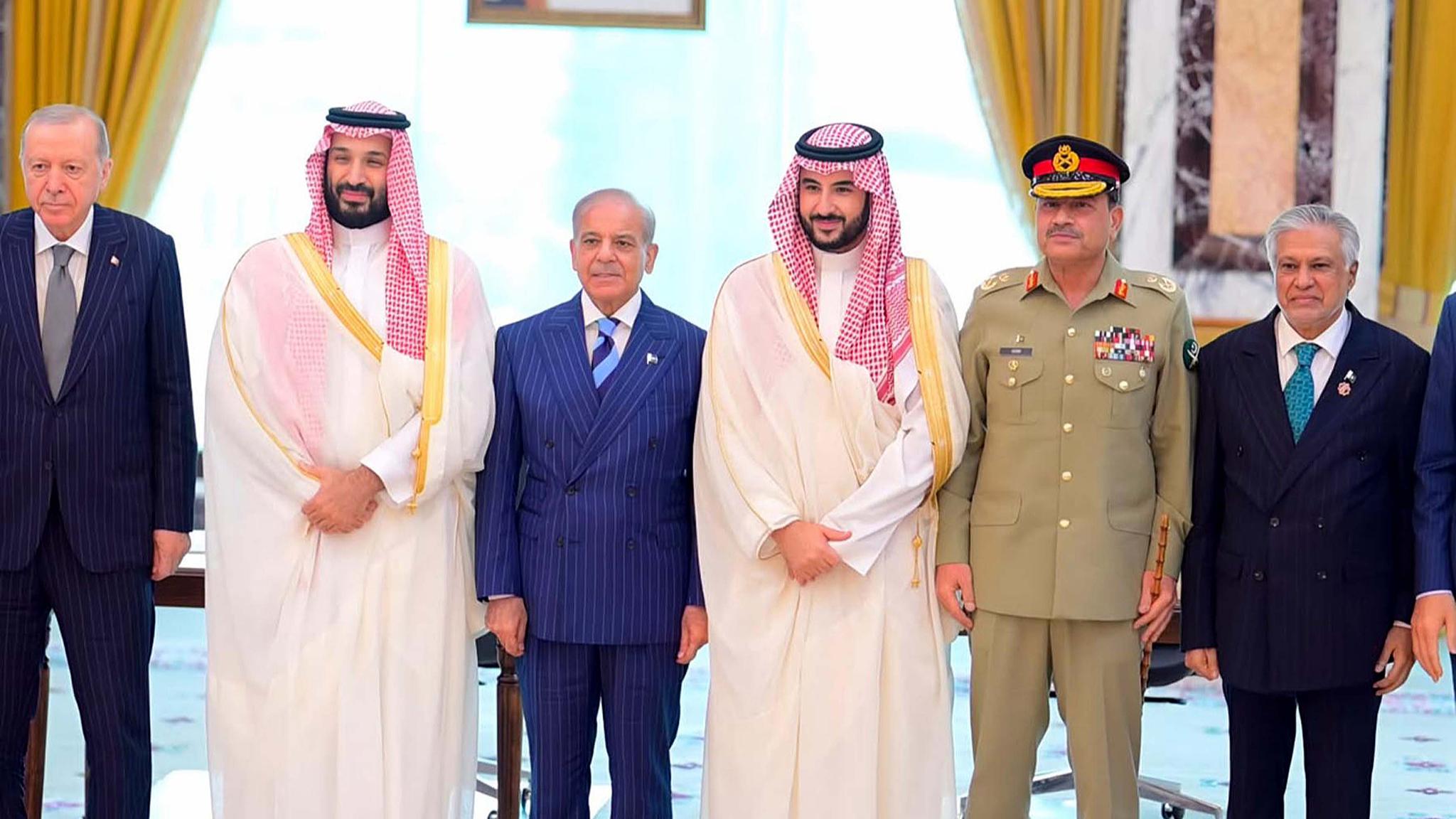
Prime Minister of the Islamic Republic of Pakistan Muhammad Shehbaz Sharif, Prince Mohammed Bin Salman Bin Abdulaziz Al Saud, crown prince and prime minister of Saudi Arabia, and Recep Tayyip Erdogan, president of the Republic of Türkiye, pose for a group photo after signing the Makkah Joint Defense Agreement in Makkah on Friday, August 7, 2026. (Photo: VCG)
Türkiye on Friday rejected claims circulated on social media that its newly signed trilateral defense agreement with Saudi Arabia and Pakistan conflicts with NATO's Article 5.
In a statement posted on the social media platform X, the Center for Combating Disinformation of Türkiye's Communications Directorate described the allegations as "entirely unfounded" and "a clearly orchestrated attempt to create a false perception."
The center said the defense agreement does not conflict with Türkiye's NATO commitments.
NATO's Article 5 enshrines the principle of collective defense, stipulating that an armed attack against one member state shall be considered an attack against all members.
Leaders of Saudi Arabia, Türkiye and Pakistan gathered on Friday in the Saudi city of Makkah and signed the Makkah Joint Defense Agreement, which stipulates that any armed attack against one of the three countries will be considered an attack against them all.
However, few details have been made public so far regarding the specific commitments assumed by each country, and it remains unclear to what extent the pact would require them to take concrete military action in defense of one another.
Rayed Krimly, Saudi deputy minister for public diplomacy, said in a social media post that the agreement reflects the depth and longstanding nature of the strategic relations among the three countries, and represents the culmination of detailed negotiations conducted over a number of years.
"The agreement does not represent an effort to establish a military axis or a sectarian bloc. Nor is it linked to any nuclear ambitions or arms race, rather it is focused on building sustainable capabilities," he said.
Pact shaped by growing Mideast tensions
Analysts argue that the decision to sign the pact at this particular moment cannot be separated from the shifting geopolitical landscape in the Middle East.
The agreement's short-term goal is to address the immediate crisis of disrupted shipping through the Strait of Hormuz and heightened regional security risks amid the US-Iran conflict, said Li Zixin, a Middle East expert at the China Institute of International Studies.
In the medium to long term, it aims to build an autonomous security architecture led by defense and security cooperation among regional countries, Li said.
The regional security landscape facing the three countries, particularly Saudi Arabia, has become increasingly challenging since the US and Israeli strikes on Iran in February.
Saudi Arabia was reportedly targeted several times amid Iran-US conflict. Meanwhile, Saudi Arabia's already strained ties with Yemen's Houthi group have sharply deteriorated, as the group has intensified attacks on Saudi targets and declared a ban on Saudi ships transiting the Bab al-Mandab Strait.
To navigate growing geopolitical pressures, Saudi Arabia has pursued a range of measures in recent months. Last week, the kingdom announced the formation of a multinational maritime defense alliance designed to safeguard vital shipping routes in the Red Sea, the Bab al-Mandab Strait and the Gulf of Aden.
Despite the strong collective-defense clause, the pact's immediate operational implications remain unclear.
Baris Doster, a professor of international relations at Istanbul's Marmara University, told Xinhua that he did not expect the three countries to conduct joint military maneuvers or patrols in sensitive areas such as the Strait of Hormuz, saying such a move could unnecessarily antagonize Tehran.
Noting on the deal's broader impact on both the regional security and geopolitical landscapes, Li said regional countries will not return to an era of complete reliance on US protection. Instead, they are are using institutionalized mechanisms to hedge against the uncertainty of US security commitments.
Bringing Pakistan into the Middle East security framework through a formalized framework also shows that regional security is no longer confined to the Middle East, but is expanding into a broader network spanning the Gulf, the Red Sea, the Arabian Sea and South Asia, Li added.