


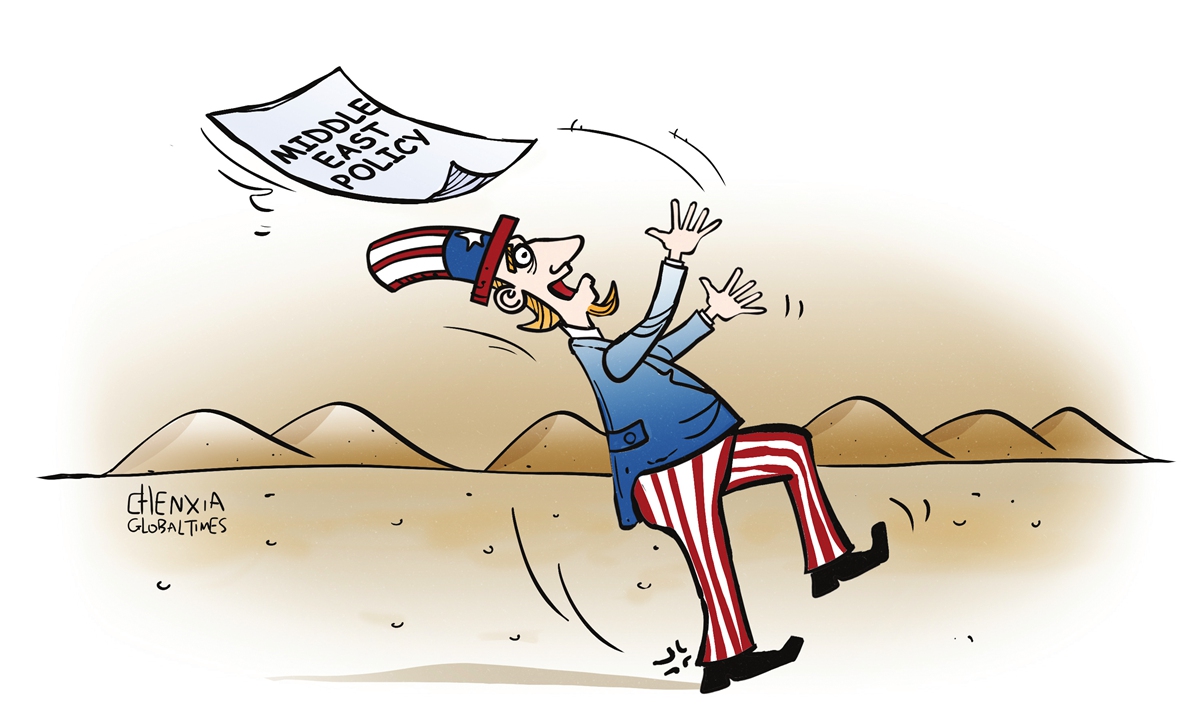
Illustration: Chen Xia/GT
On Friday in the holy city of Mecca, Saudi Arabia, Pakistan and Turkey signed a major deal that is already shaking up global public opinion.
Some Western media wasted no time slapping a familiar label on it: the "NATO-style" pact. The Mecca Joint Defense Agreement is intended to strengthen collective deterrence against any act of aggression and stipulates that an armed attack against any one of the three would be regarded as an attack on all, according to Reuters.
Yet, comparing this agreement to NATO is way too soon. As Ding Long, a professor at the Middle East Studies Institute of Shanghai International Studies University, told the Global Times, the Mecca Agreement remains, for now, a framework of political intent, since it lacks the integrated military command structures, joint logistics, and institutional machinery that define a true, battle-tested alliance like NATO.
“The term ‘NATO-style’ is more of a rhetorical label that reflects both the strategic wariness of the West and some other non-Muslim countries regarding the first-ever appearance of such collective defense provisions in the Islamic world, and the narrative intent to frame it as a tool for confrontation between specific blocs,” he added,
Scratch beneath the surface, however, and the true weight of the agreement becomes impossible to ignore. As the Associated Press laid out, this trio brings together an oil-rich country (Saudi Arabia), a nuclear power (Pakistan) as well as NATO’s second-largest army and a rapidly growing defense industry (Turkey).
Amid the ongoing conflicts in the Middle East, the trilateral defense agreement is essentially a turbocharged evolution of last year's mutual defense pact between Riyadh and Islamabad. The defense pact is open to other regional countries, and it remains to be seen how many will join in the future.
Granted, this blueprint is bound to redraw the regional map. It pushes Gulf capitals away from rigid, single-pole dependence and toward a multi-source balancing act, while giving Turkey a fast-track path from peripheral NATO member to core security architect in the Islamic world. At the same time, although it throws up a much-needed shield against Iran, it also risks cornering Tehran into far more unpredictable countermeasures.
Step back, and a much bigger picture comes into focus: As Middle East conflicts spiral, regional countries are waking up to the fact that they can no longer rely solely on US security guarantees, even if an alliance with the US is unlikely to crumble in the near future.
For decades, the playbook in the Gulf was simple and almost transactional: write big checks, outsource your survival, and let a superpower across the ocean keep the peace. But when real war finally came knocking, that safety net turned out to be an illusion. Instead of getting shielded, Gulf states watched US forces scramble just to save their own skin, all while dragging the entire neighborhood deeper into the crossfire. This brutal reality has left US allies across the region fundamentally questioning the traditional security paradigm of relying on Washington for security.
For Washington, the message coming out of Mecca is a bitter pill. The trust deficit that’s been brewing for years has finally cracked wide open. Rather than keeping its faith in a US umbrella that leaks whenever it storms, Riyadh has decided to hedge its bets by stitching together an independent security arrangement with Ankara and Islamabad – a blunt, public verdict on just how much the US security umbrella is truly worth today.
This leaves Washington backed into a classic geopolitical dilemma: Double down with ironclad security guarantees, and the US completely torpedoes its own strategy of military retrenchment. Look the other way and shrug, and its remaining grip on the region slips through its fingers, leaving the US to watch a multi-polar Middle East spin permanently out of reach.
Then again, Washington might just have to get used to the view. A multi-polar world is the stubborn reality of an age where major regional players refuse to be treated as disposable pawns on someone else's chessboard. When the very “protector” you relied on becomes the source of risk, you stop putting your faith in empty promises and start keeping your security in your own hands.
The Mecca agreement is merely the latest shockwave of such a global shift rippling across the Gulf. With the deal now signed in Mecca, the pendulum of Middle East geopolitics has officially swung toward self-reliance and multi-polarity.