


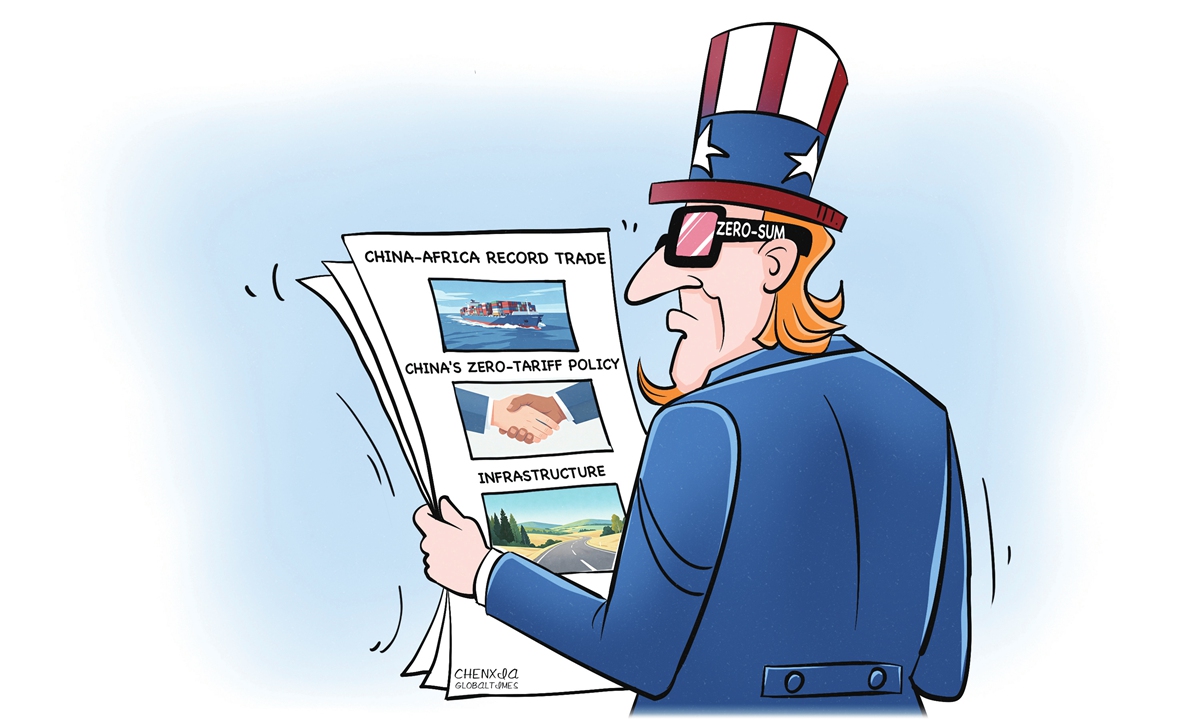
Illustration: Chen Xia/GT
"The China shock has arrived in Africa, and America's economic relationship with the world's fastest-growing continent is at stake." This is the opening line of a commentary titled "The China shock comes to Africa," published by two researchers from the Foundation for Defense of Democracies. It came just three days after the Congressional Research Service issued a report, "China-Sub-Saharan Africa Ties and US Policy," on August 6.
Both documents echo an increasingly urgent call in Washington policy circles: The US must move quickly to shape the rules of the African Continental Free Trade Area (AfCFTA) before China does, and it must expand financing tools - such as the newly announced US-Africa Strategic Investment Program - to compete for influence on the continent.
Read that opening sentence again. It frames the US relationship with Africa not as a partnership to be built, but as a stake to be defended against a rival. This is a zero-sum calculation from the very first word, and it explains almost everything about the anxiety animating this policy conversation.
The anxiety is not baseless in scale. By late July, China-Africa two-way trade totaled 1.41 trillion yuan (about $ 208 billion). Beijing's zero-tariff policy for all African countries with diplomatic ties, in effect since May 1, has only accelerated that momentum. Trade between China and Africa grew 25-fold since 2000 to 2024 - from $10.6 billion to $295.6 billion - while US-Africa trade over the same period grew a comparatively modest 88 percent, from $39 billion to $73 billion.
Washington sees these numbers and panics. Its instinctive response is to pour in more money and more "strategic investment" - with one implicit goal: to squeeze China out of the picture.
The logic is straightforward: zero-sum thinking. If China is in, the US is out, and vice versa. But this is precisely why the strategy is unlikely to succeed. Africa is not a fixed pie to be divided between two great powers. It is 1.4 billion people and 54 sovereign states pursuing their own industrialization.
No amount of American capital aimed at displacing China will change that basic fact - nor will it actually displace China, whose infrastructure financing, trade volume and diplomatic relationships across the continent are too deeply embedded to be dislodged by a single investment program.
What actually matters is not how much money Washington commits, or whether it can outspend Beijing. What matters is whether that money helps African nations chart their own development path - building the manufacturing base, the regional trade rules and the institutional capacity they need on their own terms.
China's investment has at least been driven by tangible infrastructure delivery: ports, railways, power plants. However, if American engagement with the AfCFTA is designed primarily as a tool for crowding China out, it will fail on its own terms, and Washington's anxiety will only deepen as it keeps failing.
The commentary's closing line captures the stakes precisely: "The first China shock reshaped America's politics, economics, and even society. Its aftershocks will determine Africa's economic future." That sentence is worth taking seriously - but perhaps not because of what its authors want to convey. The real determinant of Africa's economic future should not be which great power "wins" the contest for market share. It should be whether outside engagement, American or Chinese, expands the choices available to African governments, workers and entrepreneurs.
How Washington chooses to respond to China's Africa strategy will be the deciding factor - not for who "wins" Africa, but for whether the US can offer something other than a zero-sum game.
If American engagement means more genuine development financing, more market access, more technical partnership on terms Africa itself helps write, it could be valuable regardless of what China is doing. If it means merely trying to outcompete Beijing for the sake of preserving American primacy, it will remain trapped in the same anxious, reactive posture that produced this commentary in the first place.
This is the hegemony's dilemma: A power accustomed to shaping the rules of the game struggles to accept that development, unlike geopolitics, is not necessarily zero-sum - and that the anxiety of losing ground may be self-defeating precisely because it mistakes competition for the goal, rather than treating Africa's own development as the purpose.