


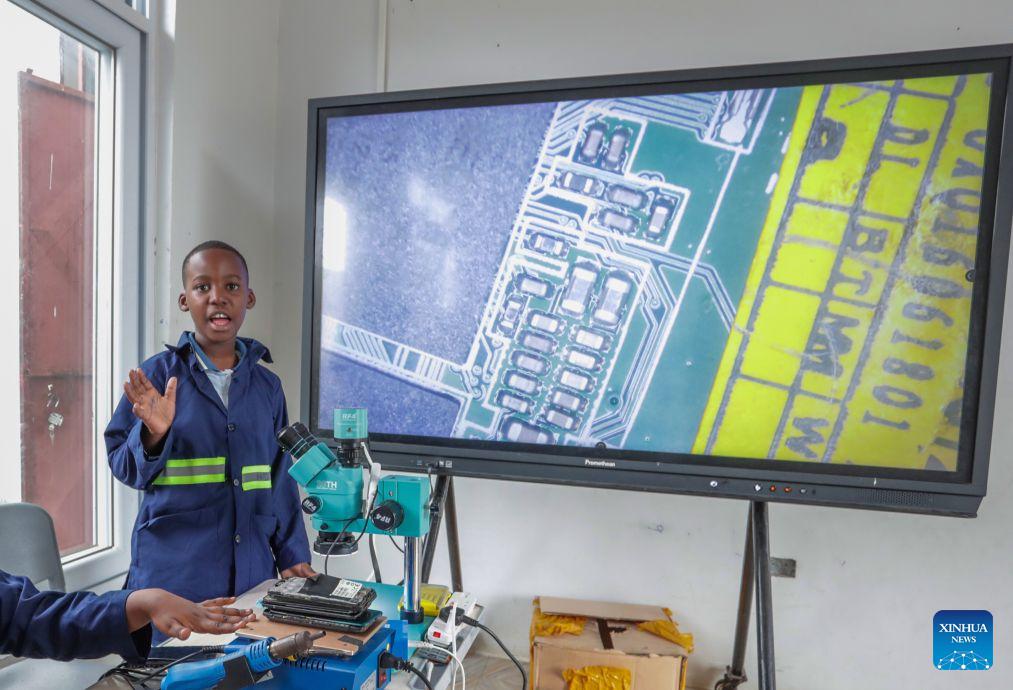
A student explains circuit board features using a large electronic screen connected to a microscope during a practical skills class at De'kayra Pre and Primary School in Bagamoyo, Tanzania, Aug. 7, 2026. (Xinhua/Emmanuel Herman)
DAR ES SALAAM, Aug. 10 (Xinhua) -- At a primary school in Tanzania's coastal town of Bagamoyo, children are learning to look beyond textbooks and examinations, developing practical skills from an early age to help them prepare for the future.
"The future of the world is in this room," reads a bold inscription on the classroom wall at De'kayra Pre and Primary School. Inside the brightly lit classroom, the message is already coming to life.
Five-year-old pupils Lightness Peter and Careen Aggrey stood confidently before a desktop computer, pointing out its basic components,including the monitor, keyboard and central processing unit,and explaining how they work together.
"My aim is to become a fully qualified computer technician in the future," Peter said with a smile.
In another classroom, Brainier Lambert, 10, and Judith Mwaria, 11, leaned over a dismantled mobile phone, identifying its internal parts and explaining their respective functions.
At De'kayra, such ambitions are encouraged from an early age. The school has developed a teaching approach that combines conventional academic learning with hands-on practical skills development, reflecting its broader philosophy of learning by doing.
Academic lessons take place in the morning, while afternoons are devoted to hands-on activities, including mechanics, tailoring, carpentry, computer studies, and agriculture.
According to the school's founder and chief executive officer, Peter Peter Junior, the idea took shape more than two decades ago, following his travels abroad, particularly to China.
"I went to China in 2005 with the aim of promoting the historic town of Bagamoyo as a tourist destination and to attract more Chinese visitors as I was working in tourism," he recalled.
"What impressed me most was how education combined theory with practical skills. Their rapid technological development is rooted in hands-on learning, vocational training, and a strong emphasis on information and communication technology," Junior said.
During his time in China, he visited schools in Shanghai and Hong Kong as well as rural areas, observing how educational institutions adapted their programs to local needs and future employment opportunities, ranging from agriculture and construction to technology and leadership.
"I saw that education was not one-size-fits-all," he said. "Students were guided early to develop practical skills and specialize in areas they were passionate about. I realized that if we could adapt such an approach in Tanzania, it could transform how young people prepare for the future."
That experience eventually inspired the establishment of De'kayra's educational model.
Younger pupils begin with basic computer and English skills before being introduced to a wider range of practical disciplines. By Grade Four, they choose four areas of interest; by Grade Five, they narrow their choices to three; and by Grade Seven, they focus on two specialties as they prepare to move on to secondary education.
"We want every child to leave primary school already able to do something practical," Junior said.
The approach is already producing tangible results. Some Grade Seven pupils can diagnose mechanical faults, design simple computer applications, or sew garments, while others have contributed to developing the school's website.
The approach has attracted recognition from local education authorities and growing support from parents, many of whom increasingly value practical skills alongside academic achievement.
For Junior, however, the ultimate goal goes beyond cultivating pupils who perform well in examinations. It is about nurturing young people who can contribute to society, create value, and pursue opportunities with confidence.
"We want them to become productive members of society," he said. ■
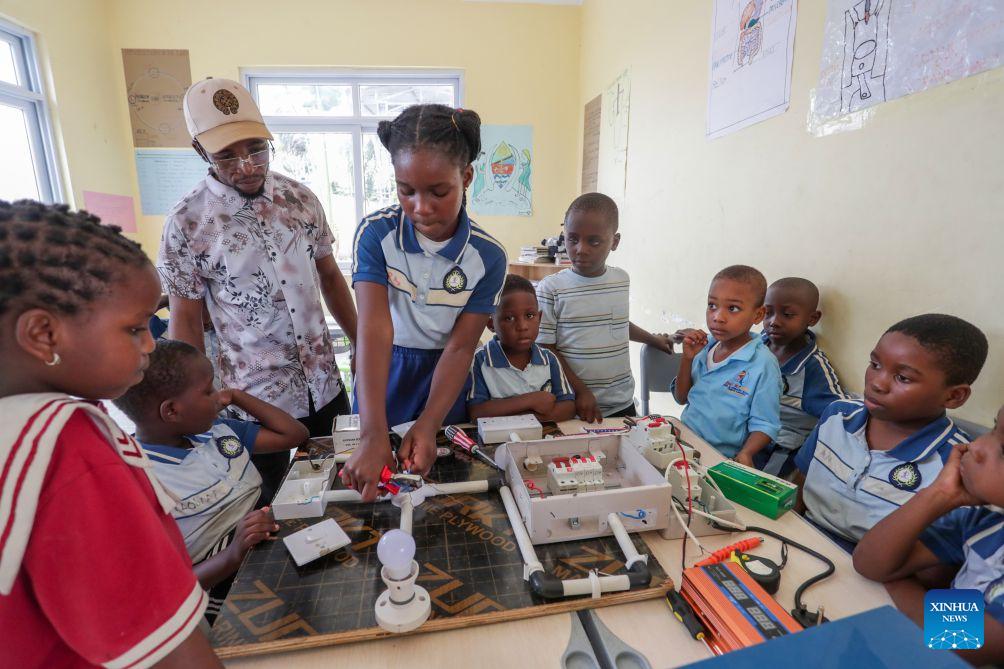
Students learn basic electrical skills during a practical skills class at De'kayra Pre and Primary School in Bagamoyo, Tanzania, Aug. 7, 2026. (Xinhua/Emmanuel Herman)
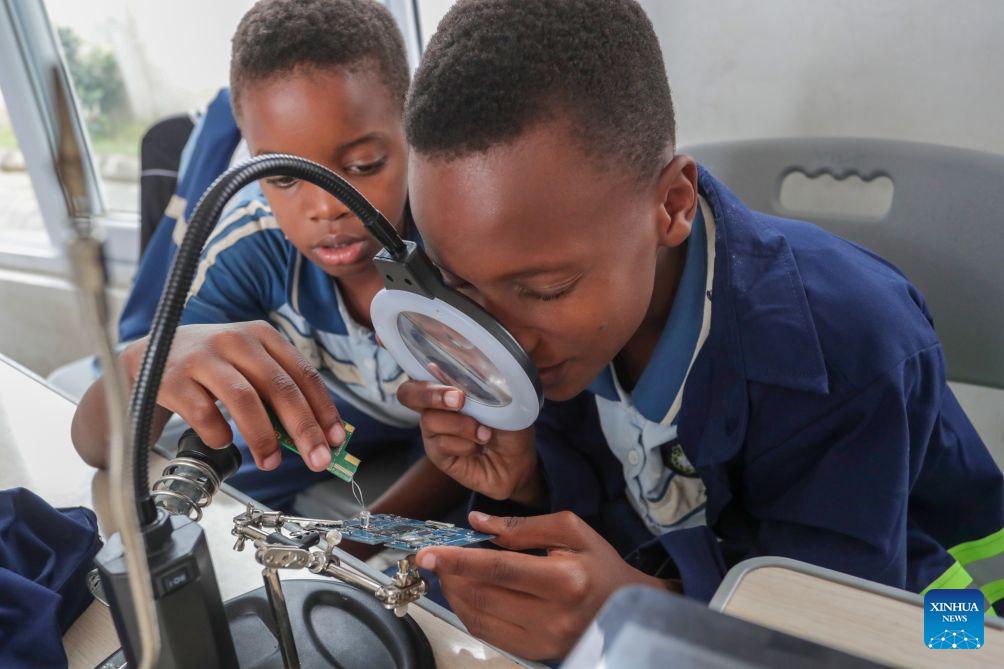
Students inspect circuit boards using a magnifying glass during a practical skills class at De'kayra Pre and Primary School in Bagamoyo, Tanzania, Aug. 7, 2026. (Xinhua/Emmanuel Herman)
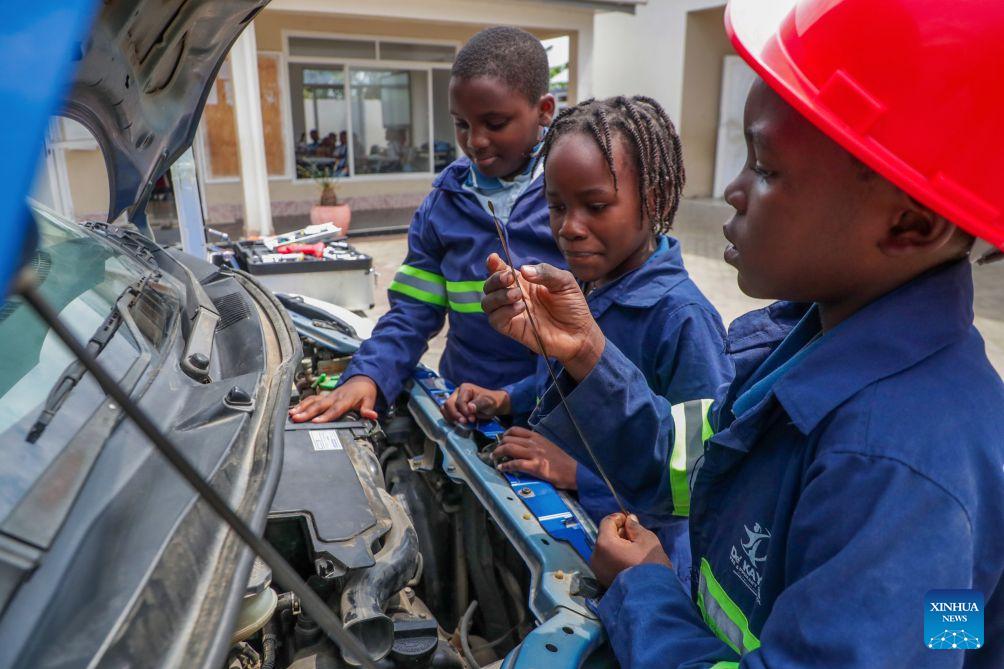
Students gather to inspect a car during a practical skills class at De'kayra Pre and Primary School in Bagamoyo, Tanzania, Aug. 7, 2026. (Xinhua/Emmanuel Herman)
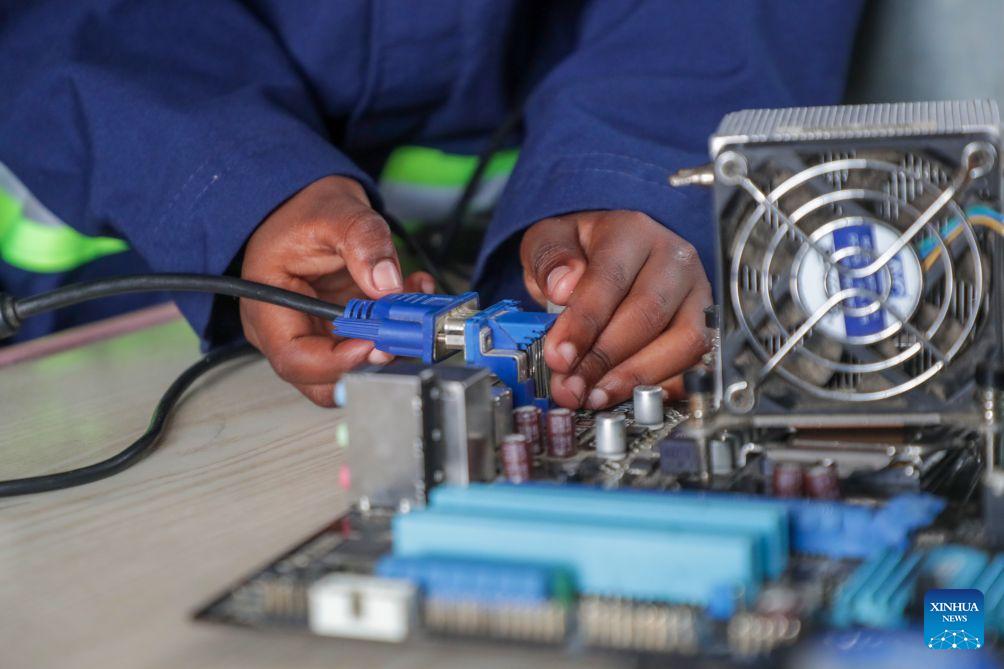
A student connects a monitor cable to a computer motherboard during a practical skills class at De'kayra Pre and Primary School in Bagamoyo, Tanzania, Aug. 7, 2026. (Xinhua/Emmanuel Herman)