


Scientists have confirmed the discovery of the first carnivorous plant in the Saxifragales order — a group of non-woody flowering plants widely spread across temperate and cold mountain regions. The breakthrough validates a prediction made by British naturalist Charles Darwin in 1875.
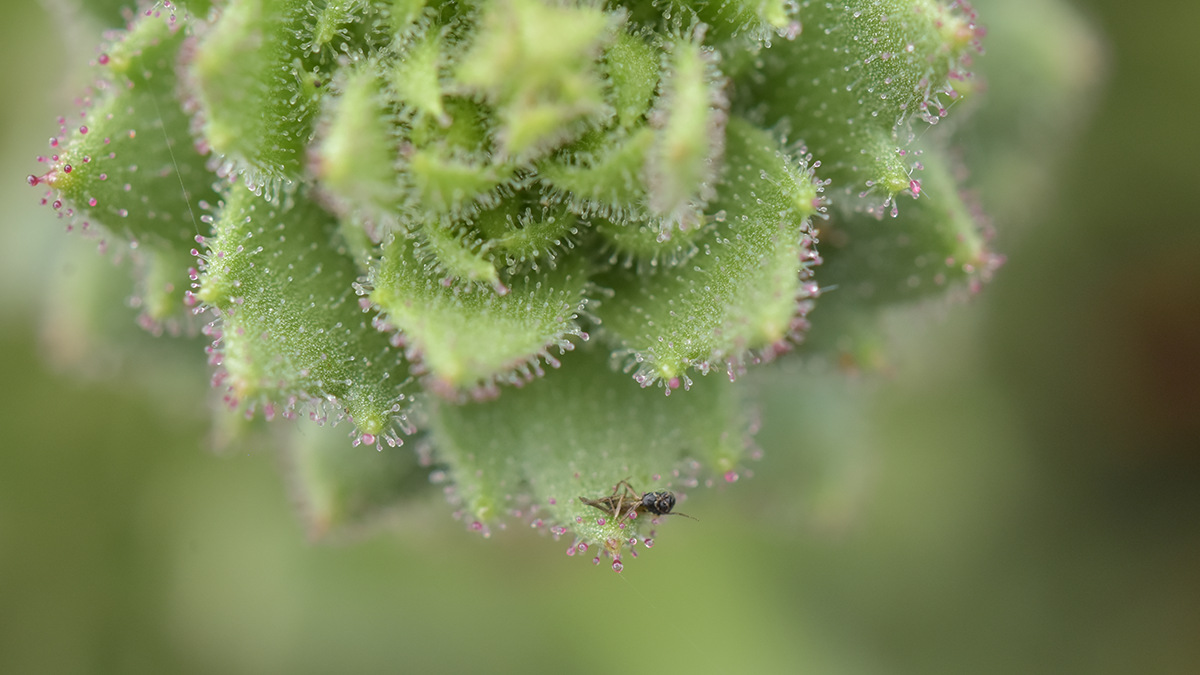
The plant, Saxifraga candelabrum, feeds on insects. (Photo provided to chinadaily.com.cn)
The findings were published in the international journal Nature Communications on Aug 4. The study was conducted by a joint team of researchers from the Kunming Institute of Botany of the Chinese Academy of Sciences in Yunnan province, the CAS Wuhan Botanical Garden in Hubei province, Jishou University in Hunan province, and the University of Florida in the United States.
The plant, Saxifraga candelabrum, grows in rock crevices between 2,500 and 3,300 meters above sea level across the Hengduan Mountains on the southeastern edge of the Qinghai-Tibet Plateau. Its entire body is covered in dense, sticky hair-like structures called glandular hairs that trap small insects.
In his 1875 book Insectivorous Plants, Darwin studied two European species from the same family and noticed their sticky hairs could catch insects. He suggested that some species in the group might actually feed on their prey. However, the analytical tools of his era were not advanced enough to test his theory, leaving the question unanswered for nearly 150 years.
The discovery began during fieldwork in Shangri-La, Yunnan province, when researchers noticed Saxifraga candelabrum's sticky hairs were packed with bugs — averaging 71 insects per plant.
To prove that insect trapping was a permanent evolutionary trait rather than an accidental event, the team surveyed 45 historical plant samples collected between 1888 and 2016. A total of 43 of them still had insects stuck to their hairs, proving the plant has been preying on insects for well over a century.
Scientists also discovered that the plant uses floral scents to lure insects. However, its sticky traps mostly catch midges — small flies that do little to help fertilize the plant. Larger and more effective pollinators, such as hoverflies and wild bees, rarely get stuck. This smart tactic allows the plant to hunt for food without accidentally killing the insects it relies on to reproduce.
Many plants use sticky hairs purely to keep harmful bugs away. To prove Saxifraga candelabrum actually digests its catch for nutrients, researchers tested for digestion-aiding proteins. They found phosphatase — an enzyme that breaks down animal matter — right inside the plant's sticky hairs. They then used chemical tracking with nitrogen isotopes (special elemental markers) to confirm that the plant absorbs nitrogen from the digested bugs to fuel its flowering and fruit growth.
In addition, the research team mapped out a complete high-precision genome (the full genetic blueprint) of the species. By comparing it with other insect-eating species like pitcher plants and sundews, they discovered that these unrelated species independently developed similar genes to secrete sticky fluid and digest prey — a process known as convergent evolution.
Zhang Xinjian, first author of the study and a postdoctoral researcher at the Kunming Institute of Botany, noted that the findings challenge long-held botanical assumptions.
Zhang explained that while most known carnivorous plants use dramatic, specialized traps like pitchers or snapping jaws, this discovery serves as a reminder that quieter insect-eaters exist in nature. Sticky hairs traditionally viewed as simple self-defense mechanisms may actually double as feeding tools.
This suggests that insect-eating behavior among flowering plants may be far more common than previously realized, opening the door for many more carnivorous species to be discovered in the future.