


MOSCOW, Aug. 14 (Xinhua) -- Russian President Vladimir Putin on Thursday made his first visit to the Southern Kuril Islands, known as the Northern Territories in Japan, and made tough comments on Russia-Japan relations.
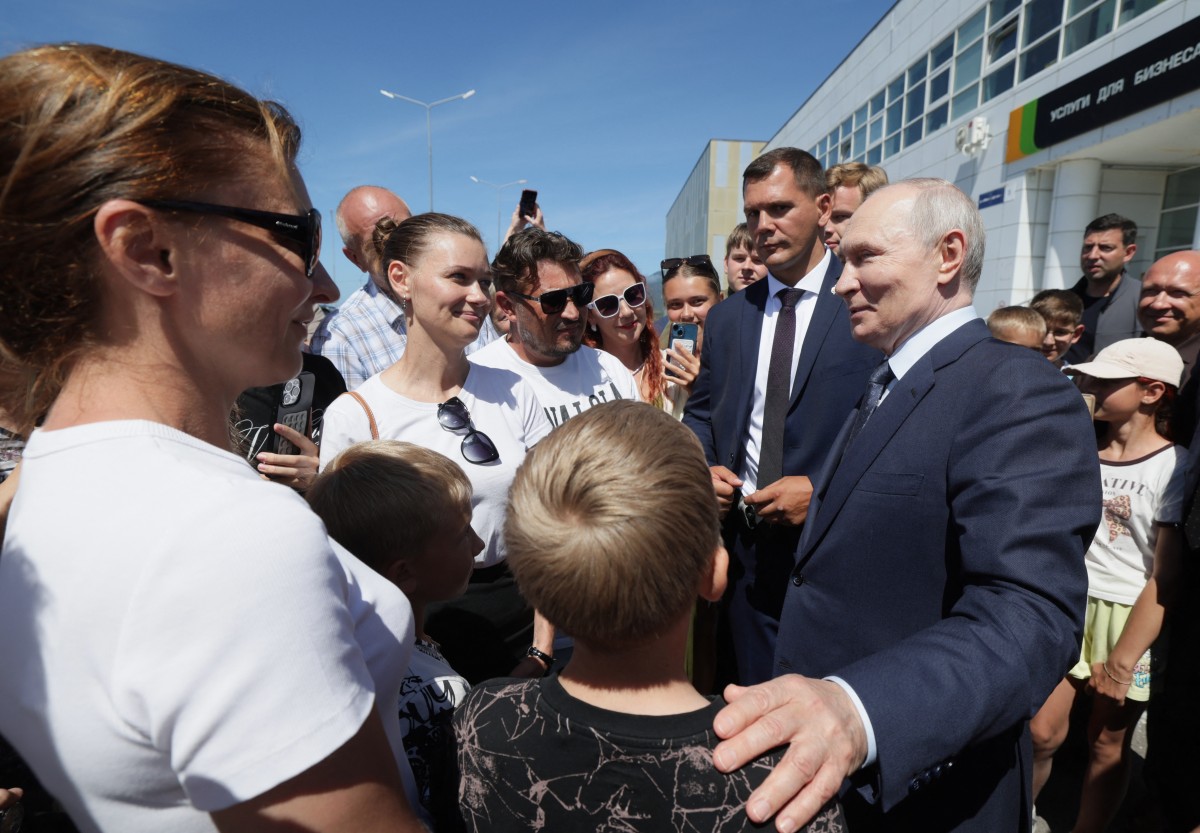
In this pool photograph distributed by the Russian state agency Sputnik, Russia's President Vladimir Putin interacts with local residents on Iturup island, one of four islands in the contested chain known as the Kuril Islands in Russia and the Northern Territories in Japan, on August 13, 2026. (Photo by Gavriil Grigorov / POOL / AFP)
What did Putin do during the visit? What considerations lie behind his trip? How has Japan responded, and what does the visit mean for the future of Russia-Japan ties?
WHAT HAPPENED
Putin is on a tour of Russia's Siberia and Far East regions. On Wednesday, Putin boarded the Varyag, the Pacific Fleet's flagship missile cruiser, in Yuzhno-Sakhalinsk, the administrative center of the Sakhalin region, where he attended the final stage of the Pacific Fleet drills and met with senior fleet commanders.
On Thursday, Putin landed on Iturup, the largest island of the Southern Kuril Islands. He visited a fish processing plant, a local school and a hospital. Kremlin-released footage shows Putin also speaking with residents and commenting on "fine weather."
During a meeting with Sakhalin Governor Valery Limarenko, Putin reviewed the region's economic development, including the impact of fluctuations in the ruble exchange rate on the local economy
According to TASS, the visit marks Putin's first trip to the islands. Other Russian presidents and prime ministers have visited the archipelago several times. Dmitry Medvedev made four visits -- once as president and three times as prime minister -- while incumbent Prime Minister Mikhail Mishustin has also visited the islands.
MESSAGE TO JAPAN
The territorial dispute over the Southern Kuril Islands remains one of the biggest sticking points in Russia-Japan relations.
The long-running dispute has prevented Moscow and Tokyo from signing a post-World War II peace treaty. Japan's sanctions against Moscow over the Ukraine crisis have brought bilateral negotiations over the islands to a halt.
While attending drills in Yuzhno-Sakhalinsk, Putin recalled that Russia once maintained constructive engagement with Japanese leaders, including former Prime Minister Shinzo Abe, before Tokyo changed its policy toward Moscow.
Under Abe's administration, the two sides set aside territorial frictions to advance trade and economic cooperation, and Abe attended multiple sessions of the Eastern Economic Forum in Vladivostok.
In its newly published Defense White Paper, Japan has classified Russia as a major threat for the first time, although "we do not pose a threat to Japan. We have absolutely no claims against it," said Putin.
Japan continues to press territorial claims over the Southern Kuril Islands, he said, noting that the current status of the Kuril Islands "is enshrined in international documents as a reality that arose following the outcome of World War II."
"But even here, Russia was prepared to seek a solution with the goal of concluding a peace treaty with Japan," he said.
Analysts say Putin's visit and remarks strike a balance between firm messaging toward Japan and a degree of tactical openness. Moscow appears keen to keep dialogue channels open, while seeking Japanese concessions on sanctions and a possible resumption of economic cooperation.
JAPAN'S REACTION
In a press conference on Thursday, Japanese Prime Minister Sanae Takaichi "strongly protested" Putin's visit to the disputed island, which she said is "absolutely unacceptable."
Putin's visit "is incompatible with the Government of Japan's consistent position on the Northern Territories," said Takaichi.
"This visit has further hardened public sentiment toward Russia in Japan and made it more difficult to restore Japan-Russia relations over the medium to long term," she added.
On the same day, Japanese Foreign Minister Toshimitsu Motegi summoned the Russian ambassador to Tokyo to lodge a formal protest over Putin's visit.
The Japanese government plans to consider countermeasures against Putin's visit, Japan's public broadcaster NHK reported early Friday, adding that one possible measure is strengthening existing sanctions that Tokyo has already imposed on Moscow.
NO EASY RESET IN SIGHT
Russia-Japan ties have undergone steep deterioration since 2022. Japan imposed sweeping sanctions against Russia over the Ukraine crisis, with direct air links severed, and bilateral trade and investment contracted sharply.
Moscow has protested over Japan's provision of economic assistance and geospatial intelligence to Kiev, its support for using frozen Russian sovereign assets held by Western states to aid Ukraine, and cooperation with Ukraine in drones.
In 2022, it suspended peace treaty talks with Japan "because it is impossible to discuss this fundamental document on bilateral relations with a state that holds an explicitly unfriendly position and seeks to harm the interests of our country."
It also suspended visa-free travel for former Japanese residents of the Southern Kuril Islands to the places of their former residency.
Since taking office, the Takaichi administration's push for greater remilitarisation has raised Russia's security concerns.
In late July, Russian Deputy Foreign Minister Andrey Rudenko argued that the belligerent stance of the Japanese authorities negatively affects stability in the Asia-Pacific region and directly undermines the security interests of neighboring countries.
Regarding Russia-Japan relations, the diplomat said that only if Japan takes concrete steps to abandon its anti-Russian stance can the two countries resume dialogue and cooperation.
Analysts say the prospects for a breakthrough in Russia-Japan relations remain slim. Neither side appears to have much room for compromise on the territorial dispute, while Japan's alignment with the West over the Ukraine crisis makes a significant easing of sanctions against Russia unlikely.