


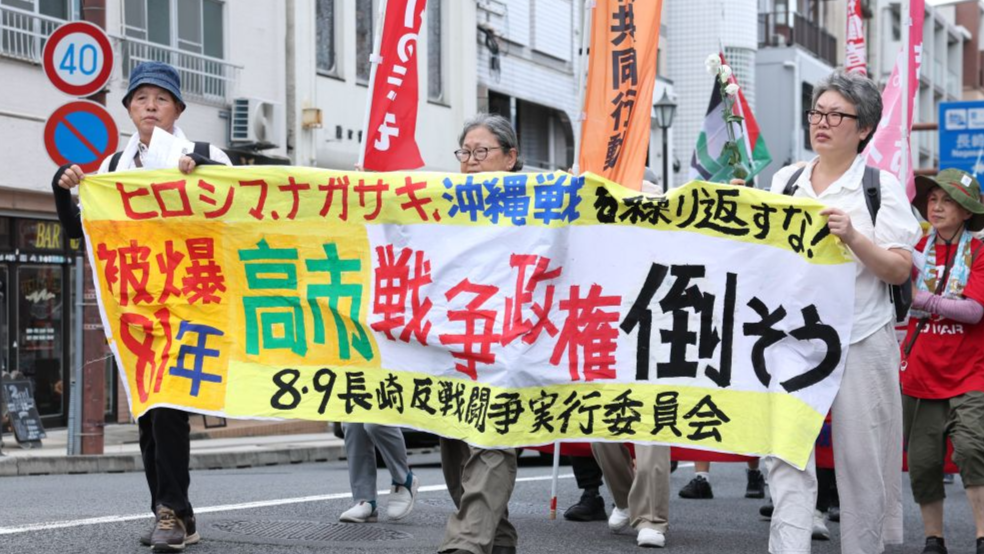
Japanese citizens take part in an anti-war rally near Nagasaki Peace Park in Nagasaki, Japan, on the 81st anniversary of the atomic bombing of Nagasaki, August 9, 2026. (Photo: Xinhua)
Senior Japanese officials paid homage to the notorious Yasukuni Shrine Saturday, the 81st anniversary of Japan's unconditional surrender in World War II, sparking widespread outrage across the international community, especially Asian countries and regions that endured brutal Japanese aggression.
Governments, historians and observers across Asia have sounded the alarm over Japan's growing neo-militarist tendencies, calling on Tokyo to face its wartime crimes truthfully and never cross the bottom line of peace.
JAPAN'S DISTURBING MOVES
On Saturday, Japanese Prime Minister Sanae Takaichi performed a remote act of worship toward the notorious Yasukuni Shrine, which honors 14 convicted Japanese Class-A war criminals from World War II and stands as a symbol of the country's militarism and wartime aggression.
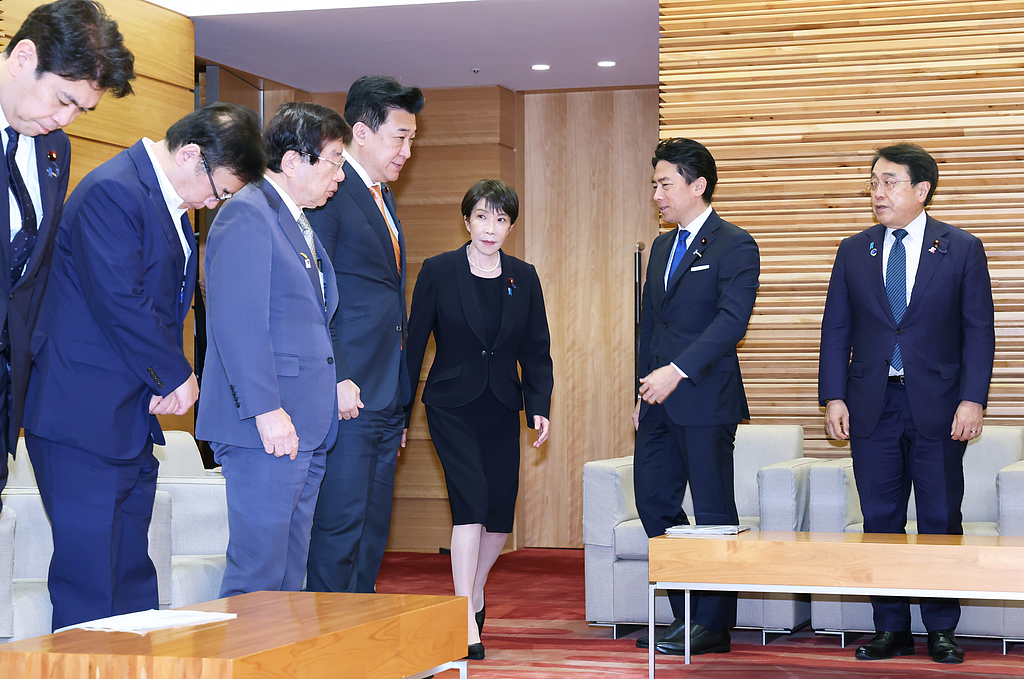
Japanese Prime Minister Sanae Takaichi, center, attends a cabinet meeting at her office in Tokyo, August 4, 2026. (Photo: VCG)
Earlier in the day, she made a monetary offering to the controversial shrine in her capacity as president of the ruling Liberal Democratic Party, while several cabinet ministers and senior politicians paid visits there, triggering strong criticism from peace advocates in Japan and beyond.
A spokesperson for the Chinese Embassy in Japan said Saturday that Japanese political leaders' latest moves involving the notorious Yasukuni Shrine constitute a serious challenge to the victorious outcomes of World War II and the post-war international order.
China urges the Japanese side to deeply reflect on its historical crimes, earnestly learn from history, honor its commitment to peaceful development, take real actions to break with militarism, halt dangerous moves toward remilitarization, and avoid placing itself in the defendant's seat of history once again, the spokesperson said.
South Korea on Saturday also expressed its deep regret over Japan's moves, saying that the government cannot but deplore the fact that responsible leaders of Japan once again forgot history and repeated anachronistic acts by sending offerings to or paying tributes at the Yasukuni Shrine, which glorifies Japan's past wars of aggression and enshrines war criminals.
ALARMING HISTORICAL DENIALISM
Observers noted that Japanese politicians have launched systematic historical distortion to downplay or even whitewash Japan's wartime crimes in an alarming remilitarization push.
An NHK March survey exposed eroding historical awareness: 48 percent of Japanese respondents said they had no knowledge that Japan launched aggressive wars against its Asian neighbors. Former NHK anchor Tomoyoshi Kimura warned this ignorance poses severe risks.
"For Japanese people, being born after the war cannot become a reason to claim there is 'no need for reflection,'" Kimura said. He expressed concern that Japanese society is drifting toward a dangerous historical amnesia, where many people neither understand nor wish to learn about the country's wartime past, warning that the lack of basic historical awareness has now reached a shocking level.
Decades of cross-border research have uncovered irrefutable wartime atrocities. Singaporean historian Lim Shao Bin's research in the past decade has focused on Unit 9420, a lesser-known biological warfare unit of the Japanese Imperial Army that "created an entire production line for germ bombs in Singapore and what is now Malaysia."
"More than 80 years have passed, and only now are we beginning to realize how much Japan still hasn't told us," Lim said.
Thailand carries heavy scars from the infamous "Death Railway." Forced by Japanese troops, over 60,000 Allied POWs and hundreds of thousands of Asian laborers built the 415-km line in just over a year. More than 100,000 died from overwork, starvation and disease.
"Most of the Japanese I met said they knew nothing about it; if they hadn't come to Kanchanaburi, they would have had no idea that their country had committed such brutal crimes in Thailand," said local resident Somporn Ajirasak.
Kim Joo-Yong, director of the Institute of Korea-China History and Culture at Wonkwang University, cited three irreparable traumas: the suppression of the March 1 Independence Movement on the Korean Peninsula in 1919, the Nanjing Massacre in 1937 and systemic military sexual slavery known as "comfort women."
"Those are historical facts," Kim said. "But historical denialists are still passing distorted accounts of the past on to younger generations."
DON'T LET HISTORY REPEAT ITSELF
For Lim, documenting the history of Unit 731 and its affiliated units is not simply an exercise in reconstructing the past. It is also about understanding the warning signs that precede future conflicts.
Japan's history of military expansion, he argued, demonstrates that preparations for war often begin years before open hostilities. "The international community must remain vigilant," he said, adding that there should be more effective supervisory mechanisms for former aggressor states to prevent similar tragedies from happening again.
"A country cannot portray itself merely as a victim while evading the harm it inflicted on others. A nation with genuine moral integrity ought to set an example for peace by courageously shouldering its historical responsibilities," said Tan Kok Wai, a Malaysian member of parliament.
Tan noted that Japan's expansion of its defense industry, stepped-up arms manufacturing and enhanced sustained combat capabilities in 2026 are deeply disturbing and worthy of close vigilance.
"Even in 2026, Japan has yet to truly break away from the imperialist era, which is deeply unsettling," Kim said.
Noting that this year marks the 80th anniversary of the opening of the Tokyo Trial, Jiang Bin, spokesperson for China's Ministry of National Defense, on Saturday urged Japan to genuinely learn the lessons of history and stop acting against the tide of history.
"If Japan persists in pursuing neo-militarism and becomes a source of instability threatening regional peace, it will once again face the judgment of justice and history," Jiang said.