


QALAAT AL-MADIQ, Syria, Aug. 18 (Xinhua) -- The first thing that came to mind as we climbed the steep dirt road toward Qalaat al-Madiq was a medieval adventure video game.
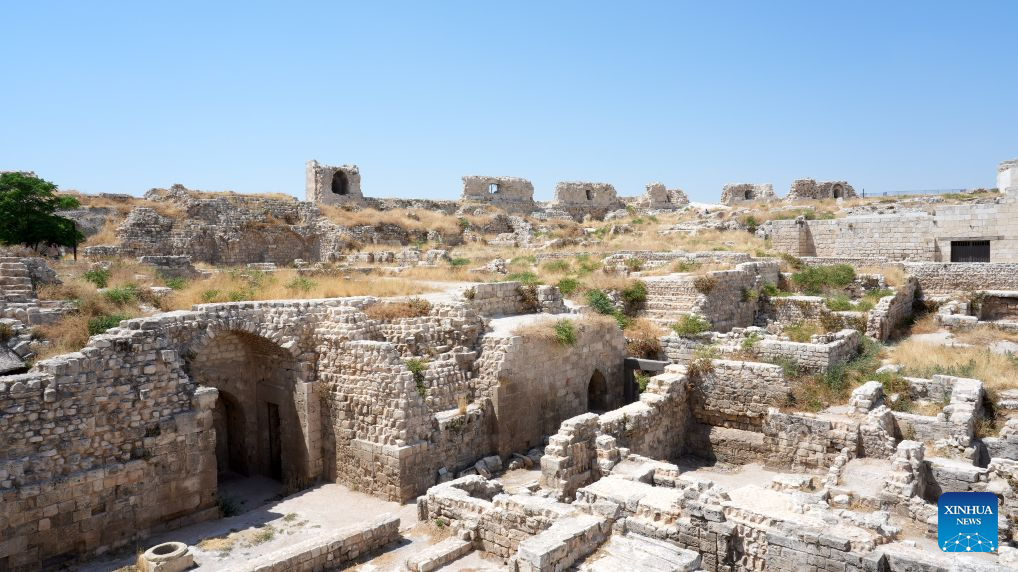
This photo taken on July 20, 2026 shows a view inside Aleppo Citadel in Aleppo, Syria. (Photo: Xinhua)
The narrow path twisted upward between ancient stone walls scarred by years of war. Dust rose behind our vehicle, and then the fortress gate suddenly emerged above us, towering over the surrounding plains.
Then came the children.
They ran toward us laughing, disappearing into narrow alleys, scrambling up broken staircases and darting through abandoned houses as if they had memorized every hidden corner of the medieval fortress.
Rising above the Orontes River valley in Syria's central province of Hama, Qalaat al-Madiq was, before the war, one of the country's rare "living castles" where families still lived within ancient walls.
Many of the children were born not inside the fortress but in refugee camps or during exile in Türkiye. They have only recently returned to the place their parents fled after fighting reached the area in 2012 and the citadel became part of a military zone.
To them, collapsed staircases are places to climb. Roofless houses are secret hideouts. Crumbling stone passages are winding paths waiting to be explored.
For the adults, however, every damaged wall carries a memory.
Before the war, buses carrying tourists from Europe, Asia and other parts of the Middle East climbed the same road to visit Qalaat al-Madiq and the nearby ruins of the ancient city of Apamea.
Now, as returning residents clear rubble from abandoned homes, long-forgotten objects are reappearing beneath layers of dust. An old cassette tape, long obsolete, emerged from one ruined room, as though frozen in time -- a relic of the moment when life inside the castle came to an abrupt halt more than a decade ago.
"The castle had around 1,500 residents before the war. Today only about 45 families have returned," said Nader Lad'a, head of the Apamea Antiquities Division.
Basic services are extremely limited: little water, no grid electricity, no sanitation. Much of the rubble remains. Many families struggle to find even a small corner of their damaged homes safe enough to shelter in.
Rebuilding poses an unusual dilemma. Many residents cannot afford traditional restoration techniques, even as antiquities officials caution that lower-cost modern materials could erode the castle's historic character.
Mohammed, 40, paused from shoveling rubble outside what had once been his family home. After nearly 14 years as a refugee in Türkiye, he had returned with his wife and son only days before our visit.
"I was shocked when I saw the house," Mohammed said. "We have little water, and electricity comes only from batteries and solar panels."
"There is no work. People are exhausted and poverty is severe," he said, resting on his shovel.
Yet for Mohammed, exile was harder. "In the end, this is your country. We were displaced for 13 years. I simply missed home," he said.
Eighty-year-old Sultana al-Sheikh Ibrahim sat outside her heavily damaged house with her orphaned granddaughter. She fled in the early years of the conflict with little more than the clothes she was wearing.
"When we came back, nothing remained," she said, gesturing toward the fire-blackened walls. "I only want to repair my house so that I can spend the rest of my life here."
Some residents proudly invited us onto their porches to admire the view, speaking with quiet optimism about rebuilding their lives.
The ancient stones seemed to echo that determination. Centuries after the fortress was built to protect those within its walls, it is once again sheltering people returning home after war.
As we prepared to leave, the children followed us back toward the castle gate.
They waved goodbye before disappearing once again into the maze of broken staircases, abandoned homes, and centuries-old stone walls.
The next morning, they would wake up and continue exploring what, to them, feels like the world's biggest playground.
Their parents would wake up to another day of clearing rubble, repairing walls, and wondering how to rebuild a future -- stone by stone, memory by memory.
All of that seemed to merge into one image that has stayed with me ever since. Of all the things Sultana had expected to lose, one companion survived: a lone bay laurel tree beside her ruined house, still standing after years of war, displacement, and fire.
As a cool summer wind swept across the hilltop, its leaves stirred -- a vibrant flash of green against the grey dust, quietly enduring.