


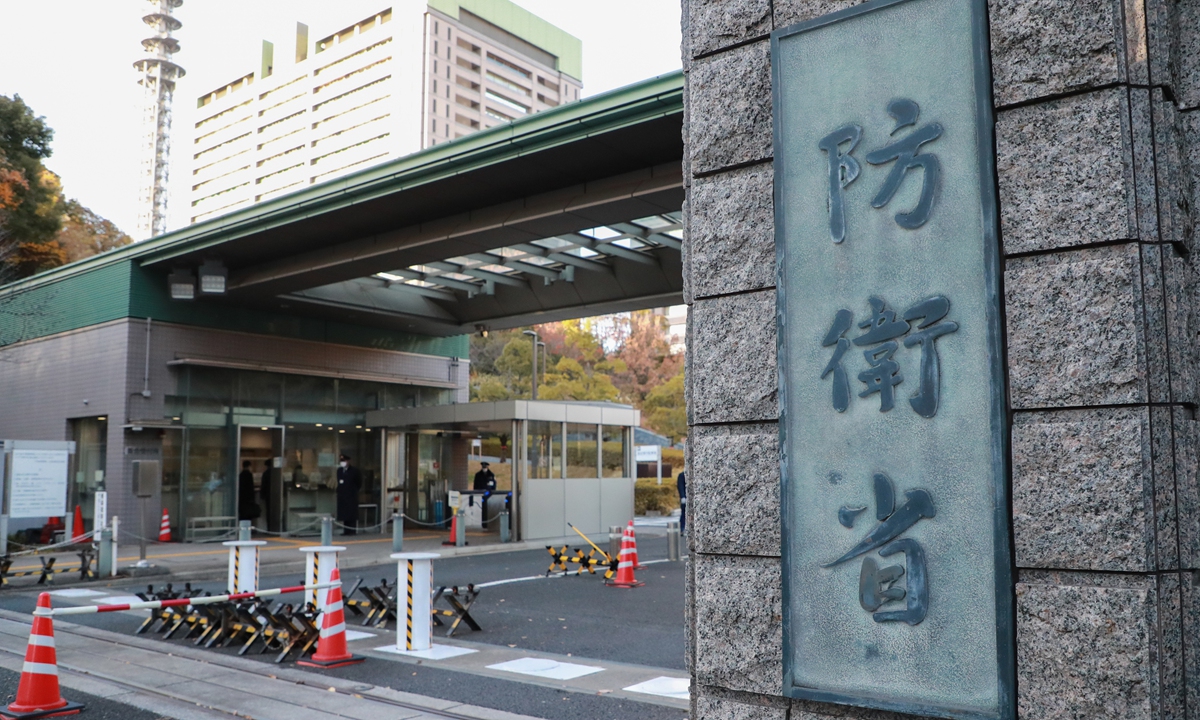
Japan's Ministry of Defense Photo: IC
Japan's right-wing forces have recently made a fresh push to expand the country's military apparatus. The country's Defense Ministry is reportedly considering a major organizational expansion in fiscal 2027 that could add up to three new bureaus, tentatively named as a "defense infrastructure bureau," an "international policy bureau" and a "facilities policy bureau," all tentative names at this point, the Asahi Shimbun reported on Tuesday.
The three new bureaus under consideration show that Japan's military buildup is moving beyond increases in weapons and defense spending to the development of a broader administrative and institutional system capable of supporting its growing military capabilities over the long term, Song Zhongping, a Chinese military affairs expert, told the Global Times on Tuesday.
Under the proposal being considered, the "international policy bureau" would oversee international affairs, including defense cooperation with other countries. The "defense infrastructure bureau" would be responsible for logistical support for the Self-Defense Forces (SDF), including transportation, supplies and medical services, with a focus on strengthening the capability to sustain combat capabilities during contingencies, according to the Asahi Shimbun.
The "facilities policy bureau" would oversee the development, maintenance and management of facilities at SDF bases and US military bases in Japan, the report said.
Japanese government ministries have undergone repeated reorganizations over the years, but the creation of a new bureau has typically been accompanied by the abolition of an existing one in order to free up funding and organizational slots. This time, however, the Defense Ministry is considering a net increase, without plans to abolish existing bureaus, according to the report.
According to Kyodo News, amid what it claimed as increasingly active Chinese and Russian military activities around Japan and a more complex security environment, Tokyo has been strengthening coordination with "like-minded countries" in Europe and Southeast Asia. Japan is also seeking to address emerging challenges such as the use of drones and AI in new forms of warfare, with the planned organizational changes aimed at dividing responsibilities more clearly and enabling faster policy-making.
Song pointed out that Japan's Defense Ministry used to operate under the principle of "exclusively defense-oriented policy," with a relatively limited range of military missions. But as Tokyo has expanded the scope of its security policy in recent years, including exercising the right to "collective self-defense," developing so-called "counterstrike capabilities" and deepening defense cooperation with other countries, the ministry has taken on a growing range of responsibilities.
The three bureaus under consideration reflect different aspects of Japan's changing military posture. The "defense infrastructure bureau" points to a greater focus on sustaining military operations rather than simply expanding weapons and equipment, the "international policy bureau" to the expansion and institutionalization of military cooperation, and the "facilities policy bureau" to growing infrastructure and administrative needs as Japan expands its military activities, the expert said.
Song underscored that the greatest risk posed by Japan's expanding defense cooperation with other countries is that it could provide a path to legitimize the country's transformation into a so-called "military power."
Together, these changes indicate that Japan is building a more comprehensive system to support a broader and more sustained range of defense activities, moving well beyond the traditional limits of its "exclusively defense-oriented policy," Song noted, adding that the three possible new bureaus should not be simply seen as an administrative reshuffle, but as a reflection of broader changes in Japan's security and military policy.
The ministry plans to include related expenditures in its fiscal 2027 budget request, which is scheduled to be submitted at the end of August. The expansion is being pushed by Japanese Defense Minister Shinjiro Koizumi and was described by the Asahi Shimbun as an unusual proposal to rapidly expand the ministry's organizational structure.
According to earlier reports from Japanese media, as Japan begins preparing its fiscal 2027 budget, the Defense Ministry is set to request about 8.9 trillion yen ($56 billion) from the Finance Ministry, which would mark a record high, and could even potentially reach 10 trillion eventually.
The sharp rise in defense spending and the ongoing changes within the Defense Ministry show Japan is moving toward expanded military capabilities and greater war preparedness, and also appear intended to lay the groundwork for revisions to Japan's three key security documents, further hollowing out the substance and limits of its "exclusively defense-oriented policy."
If Japan continues down this path, it will add to uncertainty and security pressures in Northeast Asia. Against the backdrop of Japan's inadequate reflection on its history of aggression and repeated visits by some politicians to the notorious Yasukuni Shrine, such a military shift will inevitably heighten concerns among neighboring countries over Japan's future strategic intentions, Song noted.