


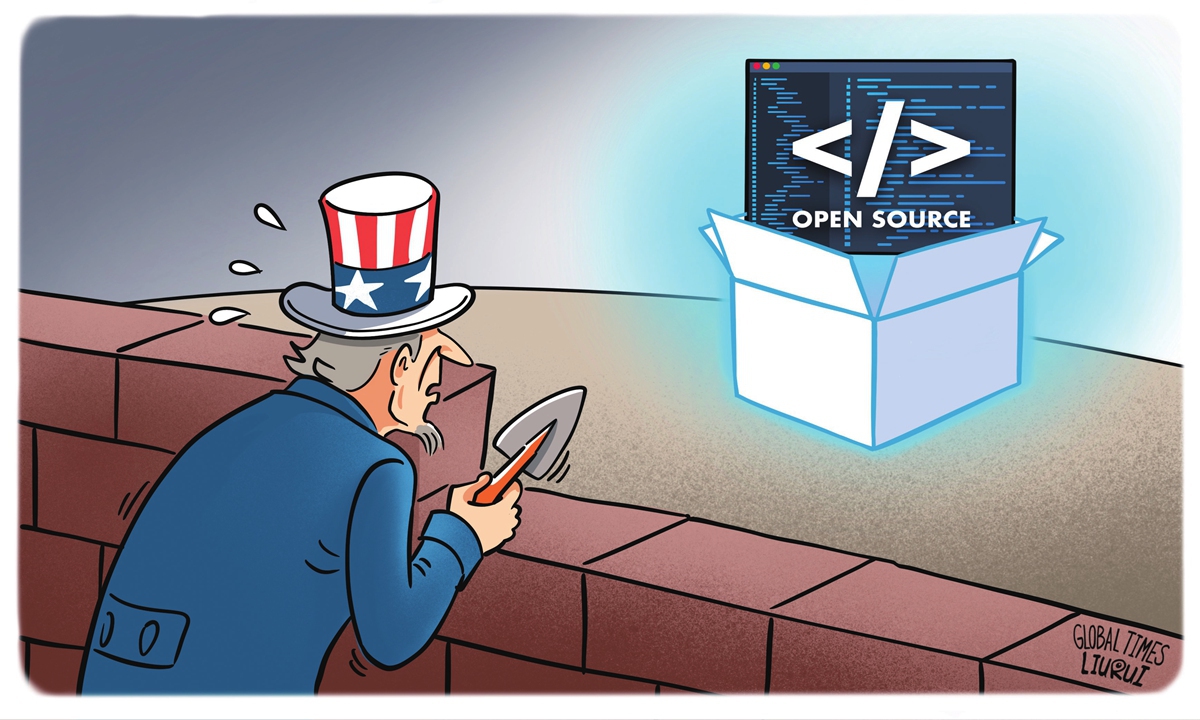
Illustration: Liu Rui/GT
As China's AI capabilities continue to advance, some US media outlets claimed that a "China AI blitz" is creating a "death zone" for US model makers, arguing that US companies without frontier-pushing technology or market-breaking pricing could lose their foothold amid mounting competition from Chinese models. It captures a real shift underway in the global AI industry, but cloaks it in a highly misleading label. The "death zone" is simply the middle ground of the AI business landscape, not a technological trap deliberately created by China to target US companies.
The "death zone" narrative rests on three fundamental fallacies. The first is to portray the market's natural process of weeding out weaker players as an act of attack between nations. Any technology industry undergoing rapid development will see prices fall, performance improve and companies increasingly differentiate. The same process in AI is a sign of an industry maturing. Blaming US companies' competitive difficulties on a "death zone" created by China simply avoids confronting problems among some US AI companies.
The second is equating the profit margins of a handful of model companies with the interests of the broader US or global AI industry. Cheaper and open-source models may squeeze the margins of a few companies, but they also lower the barriers to AI adoption for countless small and medium-sized businesses, research institutions and individual developers. For the vast majority of users, falling model prices mean lower innovation costs, greater choice and faster adoption of AI. Calling this process a "death zone" reflects the interests of a handful of high-margin model providers - not the millions of users who benefit from cheaper and more accessible AI.
The third is reducing China's AI development to price competition while overlooking the innovation ecosystem behind it. The global attention that Chinese models have drawn cannot be explained by lower prices alone. More importantly, Chinese companies are developing models that emphasize algorithmic efficiency, engineering optimization, open weights, industrial applications and ecosystem collaboration. Chinese AI companies are also competing fiercely among themselves. This diversity is driving continuous improvements in performance while pushing companies to lower prices and improve services. Reducing this dynamic innovation ecosystem to a "blitz" against the US obscures the real drivers of China's AI progress.
A proper understanding of China's AI development requires viewing it in the broader context of global technological progress and the international division of labor. One defining feature of China's approach is its drive to reduce the cost of developing and using AI. As AI increasingly becomes a general-purpose technology, lower inference costs mean more businesses, schools, hospitals and public institutions can adopt it. The second feature is its emphasis on open ecosystems. Open-weight models allow developers worldwide to deploy, adapt and test models locally, enhancing transparency and supporting data security in specific applications. The third is the focus on integrating AI with the real economy. With a comprehensive manufacturing base, abundant industrial use cases and a vast application market, China has strong conditions for putting AI to work.
China and the US have significant complementary strengths in AI. The US retains major advantages in advanced chips, software tools and top-tier talent, while China is strong in engineering, cost optimization, application development. Healthy competition and practical cooperation could expand the innovation frontier for the entire industry.
If the US treats every advance by Chinese models as a security threat, further restrictions, bans and ecosystem fragmentation could push the AI industries of China and the US toward institutional separation and mutual suspicion. Healthy competition should drive better performance, lower costs, stronger safety and wider adoption. More competitive Chinese models can push US companies to innovate more efficiently, while breakthroughs by US companies can likewise spur Chinese companies to advance. The real "death zone" AI should avoid is not market competition, but the innovation wasteland created by technological blockades, decoupling and zero-sum thinking.
The author is a director of the International Research Institute of Global Cyberspace Governance at Fudan University. opinion@globaltimes.com.cn