


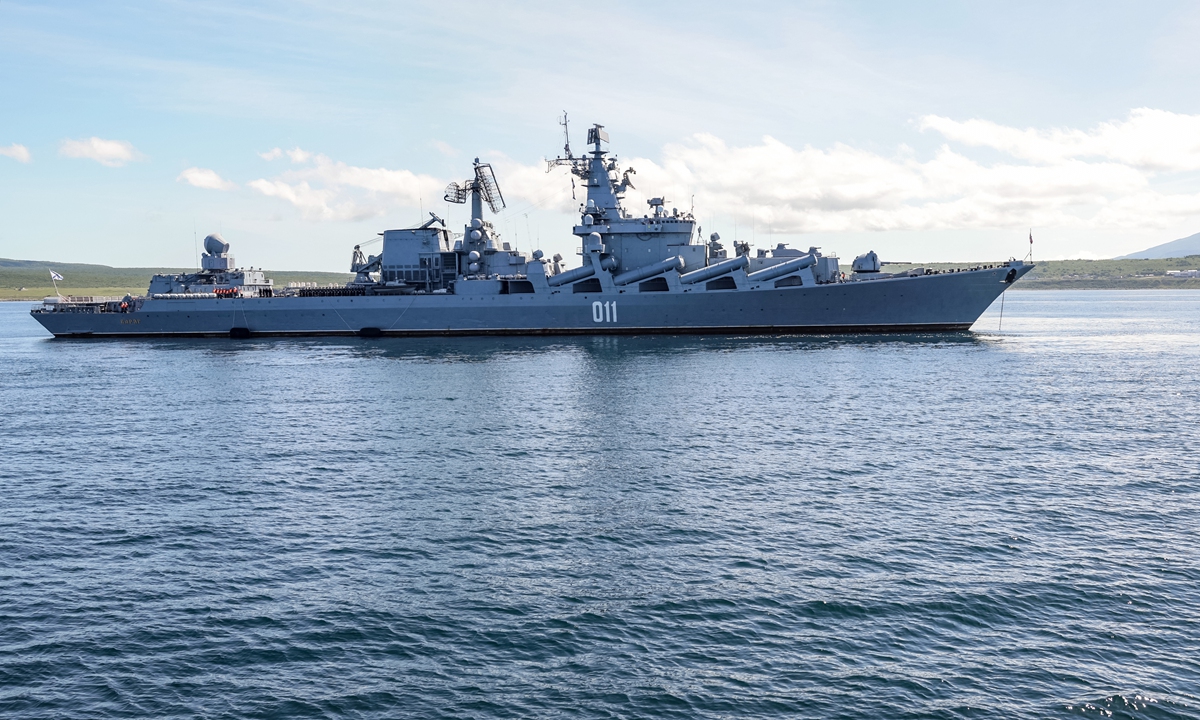
The Russian Varyag missile cruiser of the Pacific Fleet is seen after a military exercise near Yuzhno-Sakhalinsk, on Sakhalin Island, Russia, on August 13, 2026. (Photo: VCG)
Amid escalating tensions with Japan over the Southern Kuril Islands, Russia's Pacific Fleet carried out a missile strike against simulated enemy ships near the coast of the islands on Thursday. The deteriorating bilateral relationship also highlights Japan's increasingly isolated position in Northeast Asia due to the hardline approach pursued by Prime Minister Sanae Takaichi administration, said a Chinese expert.
Russia's Interfax news agency reported on Thursday that the Pacific Fleet's missile cruiser Varyag, the nuclear-powered submarine Omsk and a Bastion coastal missile system carried out a missile strike against simulated enemy ships near the coast of the Southern Kuril Islands during exercises.
"The crew of the Guards missile cruiser Varyag conducted live launches of two Vulkan anti-ship missiles, while the nuclear-powered submarine Omsk fired a salvo of Granit cruise missiles," the Pacific Fleet's press service said in a statement. "A Bastion coastal missile system deployed on the coast of one of the Kuril Islands fired an Oniks anti-ship missile," the fleet said.
The military exercise came amid growing tensions over the islands after Russian President Vladimir Putin visited Iturup, one of the four disputed islands in the Kuril chain, on August 13, prompting protests from Tokyo. Russian Foreign Minister Sergey Lavrov later summoned the Japanese envoy, saying Japan had made completely unacceptable statements by suggesting that the Russian president could not visit Russian territory, according to media reports.
Putin's first visit to the disputed islands as sitting Russian president sent a strong political signal that Moscow no longer views these islands as disputed territory. Russia considers sovereignty over the Southern Kurils settled by the outcome of World War II and frames its position as defending the postwar order.
The move delivered a heavy blow to Japan, Lü Chao, an expert on East Asian studies at the Liaoning Academy of Social Sciences, told the Global Times.
The move can also be seen as a message to Japan, which has aligned itself with the US in imposing sanctions on Russia. Since the outbreak of the Russia-Ukraine conflict, Tokyo has also provided sustained support to Ukraine, further straining ties with Moscow. Against this backdrop, tensions between Russia and Japan have deepened markedly, said the expert.
According to Japan's NHK, following Putin's visit to the island, the Japanese government plans to consider countermeasures, with one option being to strengthen the existing sanctions Tokyo has already imposed on Moscow over the Ukraine conflict.
Beyond the territorial dispute, Japan's tougher stance toward Russia reflects its expanding role in the US' so-called Indo-Pacific strategy. Lü noted that under Takaichi, Tokyo has adopted a more hardline regional policy, increasingly casting countries such as China, Russia as security threats while deepening coordination with Australia and the Philippines in Asia-Pacific region.
The expert also warned this approach risks intensifying bloc confrontation and further straining Japan's relations across Northeast Asia.
The Takaichi government's recent militaristic moves have drawn criticism from neighboring countries. On August 15, the 81st anniversary of Japan's surrender in World War II, Takaichi sent a ritual offering to the notorious Yasukuni Shrine, while her defense minister visited the shrine in person, prompting opposition from China and South Korea.
Also, in early August, South Korea protested Japan's continued territorial claims to the islets lying halfway between the two countries, called Dokdo by South Korea and Takeshima by Japan. The South Korean foreign ministry urged Japan to immediately retract its territorial claims, which were made through Japan's 2026 defense white paper released earlier that day, according to the Xinhua News Agency.
Japan's hardline diplomacy is unlikely to yield the desired results and will further isolate it in the region, Lü said, noting that its continued military buildup is also fueling concerns about a revival of militarism, putting countries across the region on heightened alert.