


Ecuadorian President Daniel Roy-Gilchrist Noboa Azín's state visit to China comes at a significant moment, as 2026 marks the 10th anniversary of the establishment of the China-Ecuador comprehensive strategic partnership.
A decade on, the relationship has developed from political trust into a broad partnership with growing economic ties. The latest visit offers an opportunity not only to review that progress, but also to consider how the relationship can gain new momentum and contribute to broader China-Latin America and Caribbean cooperation.
On Tuesday, Chinese President Xi Jinping held talks with Noboa in Beijing. Regardless of how the international landscape changes, Xi said, China has always viewed its relations with Ecuador from a strategic and long-term perspective. He also expressed readiness to continuously elevate bilateral relations and better benefit the two peoples.
Noboa described China as an important partner and friend of Ecuador, saying bilateral relations had entered a new stage. The two sides also witnessed the signing of multiple cooperation documents covering green industry, economic and trade cooperation, the digital economy and people's well-being.
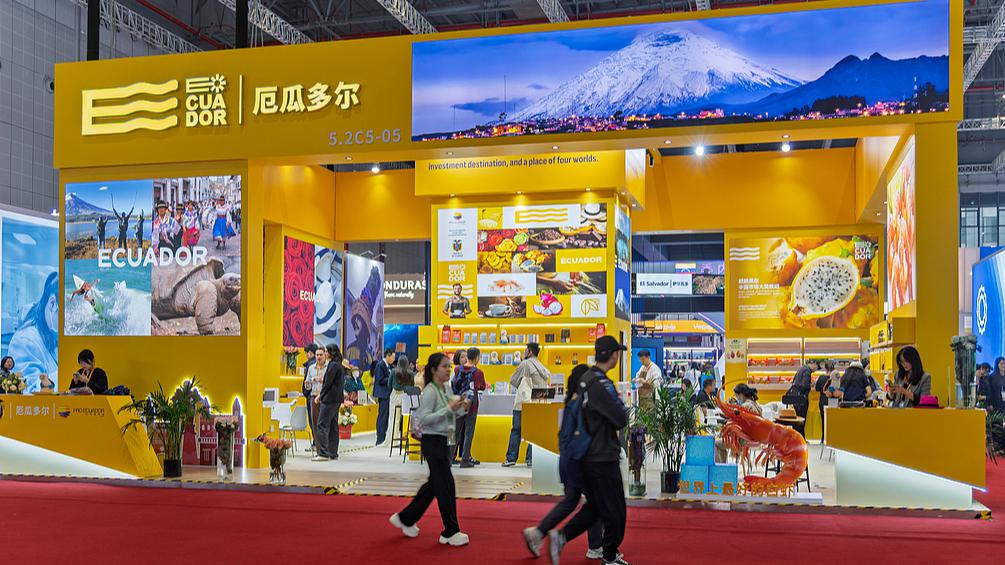
A view of the Ecuador pavilion during the eighth China International Import Expo in Shanghai, east China, November 8, 2025. (Photo: VCG)
A decade of growing economic ties
China and Ecuador established diplomatic relations in 1980 and elevated their relationship to a comprehensive strategic partnership in 2016.
The growth of economic ties provides one clear measure of what has changed over the past decade. Official data shows that bilateral trade increased more than four times from about $4.1 billion in 2015 to $17.33 billion in 2025. And in the first half of this year, the two-way trade reached $9.83 billion, up more than 20% year on year, said He Yadong, a spokesperson for China's Ministry of Commerce.
The China-Ecuador Free Trade Agreement, which entered into force in May 2024, has further strengthened economic cooperation. Under the agreement, the two sides will gradually eliminate tariffs on about 90% of tariff lines, with about 60% receiving zero-tariff treatment immediately.
For Ecuador, the Chinese market has become increasingly important. Ecuador's Ministry of Production, Foreign Trade, Investment and Fisheries reported exports to China of about $5.09 billion in 2024. In the first quarter of 2025, China accounted for 39% of Ecuador's shrimp exports.
Noboa has expressed Ecuador's intention to expand exports to China and welcome more Chinese enterprises to invest in the country.
The next step is to translate this growing economic connection into broader and more sustainable opportunities.
Sun Yanfeng, director of the Institute of Latin American Studies at the China Institutes of Contemporary International Relations, said that since the establishment of the comprehensive strategic partnership 10 years ago, bilateral relations have developed by leaps and bounds, making China-Ecuador relations "a model of all-round cooperation between China and Latin American countries."
Where future momentum may come from
President Xi called for the two sides to strengthen the alignment of their development strategies and implement the cooperation plan for jointly building the Belt and Road, while exploring cooperation in areas including the digital economy, green development, new energy and artificial intelligence. These areas are increasingly shaping the competitiveness of economies and the sources of future growth.
For Ecuador, cooperation in emerging sectors could complement efforts to diversify its economy and strengthen its productive capacity.
Milton Reyes, director of the China Studies Centre at Ecuador's Institute of Advanced National Studies, noted that cooperation in green energy and the digital economy aligns with Ecuador's own development goals and opens up complementary opportunities for both sides.
This could give the next decade of the comprehensive strategic partnership a different character: moving from expanding the scope of cooperation toward improving its quality and long-term impact.