


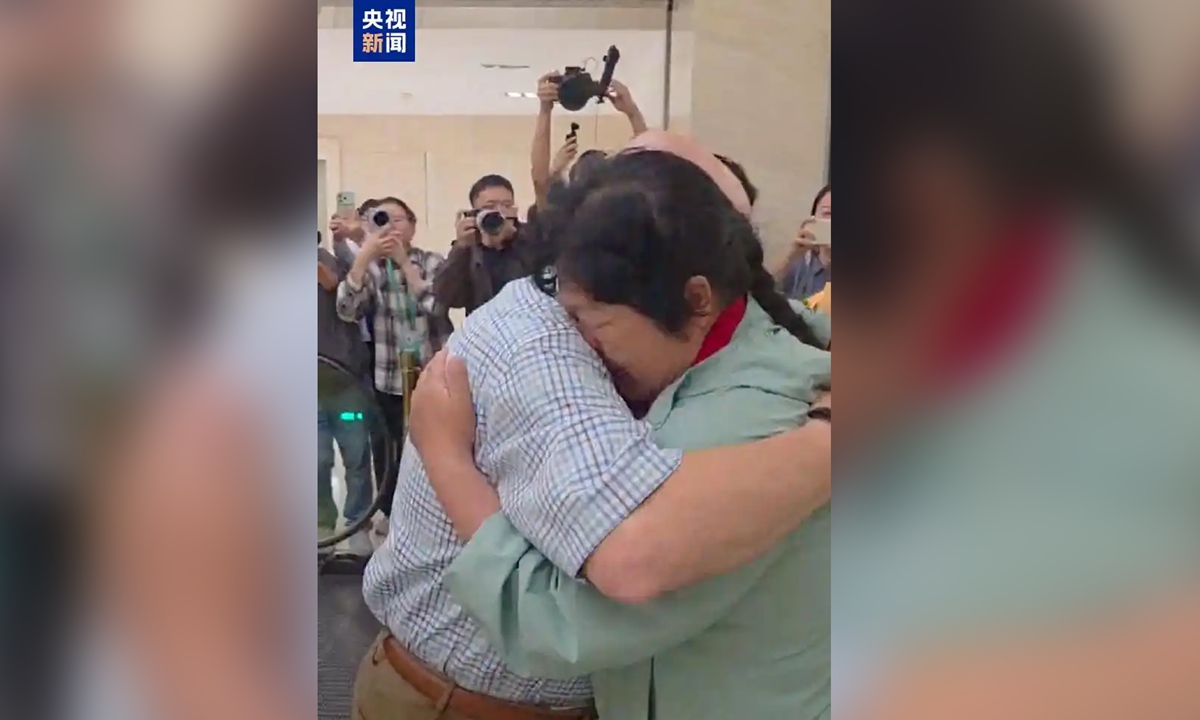
Ronald Sakolsky reunites with and hugs Yin Yuzhen at Ordos Ejin Horo International Airport in north China's Inner Mongolia Autonomous Region on August 23, 2026. (Photo: screenshot from CCTV News)
"Wo hui lai le!" ("I'm back!") Early Sunday morning at Beijing Capital International Airport, a white-haired elderly American man uttered these words in imperfect Putonghua. With that, a China-US people-to-people friendship that spans mountains and oceans entered a new chapter.
The man is Ronald Sakolsky. In 1999, while teaching in Luoyang, Central China's Henan Province, he was deeply moved by efforts of Yin Yuzhen, a desert afforestation guardian in China, to plant trees and combat desertification in the Mu Us Desert. He raised $5,000 to support her work. More than 20 years later, that donation has grown into over 50,000 mature trees, turning once-barren yellow sands into a sea of green. The friendship between Sakolsky and Yin has become a cherished story of China-US people-to-people exchanges.
One is an American educator from across the ocean; the other is a Chinese desert-control pioneer rooted in the wilderness. Though they spoke different languages, came from different cultures, and lived in entirely different social environments, they were remarkably connected by the simple act of planting trees and accomplished a deeply moving good deed. $5,000 is not a huge sum, yet it clearly reflects how the people of China and the US share the same deep aspirations for a better life, a cleaner environment, and peaceful development.
When Sakolsky set foot in China once again, he was greeted by large numbers of Chinese media outlets and a warm welcome across the internet. This is the hospitality of an ancient civilization, and it is also rooted in the Chinese view of friendship: harmony in diversity and sincerity in dealing with others. Sakolsky joked that he is a "laonei" (an insider), not a "laowai" (a foreigner). Such a sense of belonging is not new in the history of China-US exchanges. From the high-level recognition and warm reception given to Flying Tigers veterans, to the continuation of the "Guling Affinity," and now to the renewed telling of Sakolsky's friendship, these stories repeatedly affirm that friendly exchanges between peoples are the foundation and lifeblood of state-to-state relations.
Some netizens have described the friendship between Sakolsky and Yin this way: When goodwill crosses the yellow sands, it will eventually reunite in the form of a forest. In fact, the green story of the Mu Us Desert is also a vivid example of global desertification control. The miracle of 50,000 trees began with a modest donation. Major-country cooperation between China and the US is precisely a grand mosaic pieced together from one concrete deed after another. Looking at the world today, humanity faces a series of global challenges including climate change, desertification, public health, AI governance, and transnational crime. China and the US can fully work together in more areas to turn "deserts" into "oases," benefiting both countries and all of humanity.
The story of Sakolsky and Yin is also a mirror. If two ordinary people who were complete strangers could cooperate to plant 50,000 trees, then the value that more people and broader cooperation can create is immeasurable. In an interview, Sakolsky said that after this trip ends, he hopes to send a signal to the world: Chinese and Americans can work together and make a peaceful world. We wish Sakolsky an unforgettable and pleasant journey in China, and hope that when he returns to the US, he will take this sincere friendship with him and share it with more ordinary Americans.