


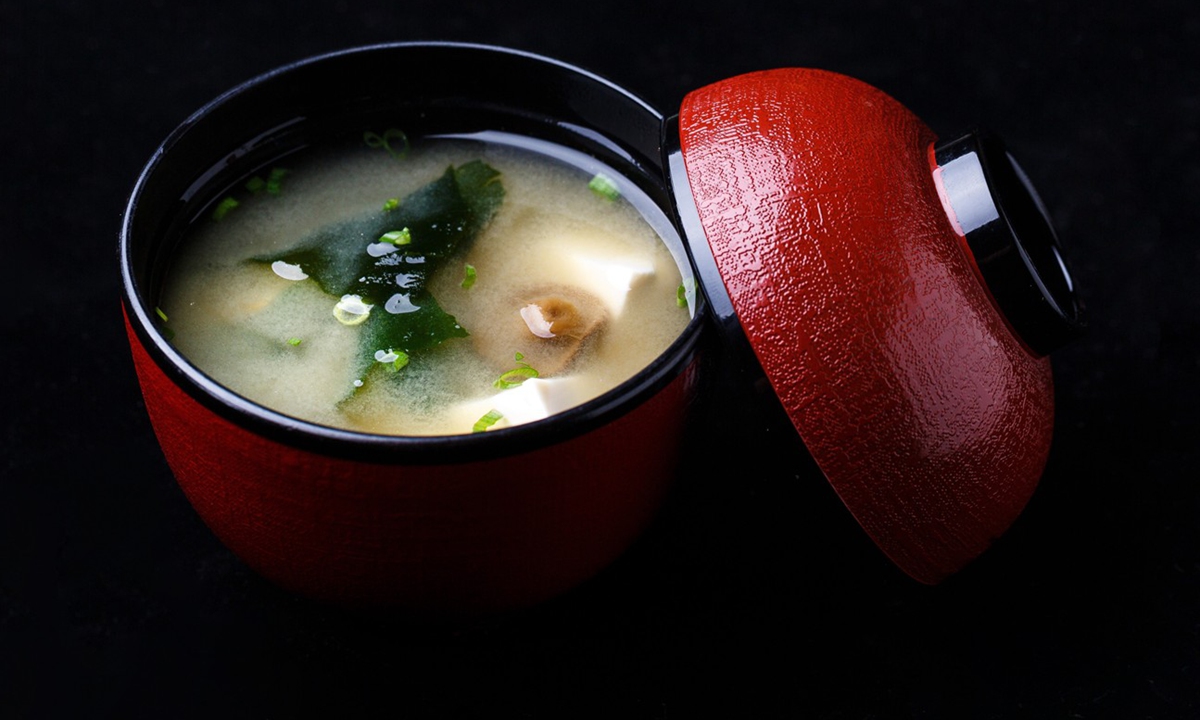
Japan's miso soup. (Photo: VCG)
Nagatanien, a well-known Japanese food brand, was recently found to have its miso soup products actually produced in China. The news caused an uproar in Japan. Some Japanese netizens expressed disappointment, claiming that products made in China "lack credibility," and even called for a "boycott of Nagatanien," vowing to "never buy again." It was not until an industry insider came forward to expose the fallacies behind the notion that "Japanese-made products are inherently safe and reliable" that the boycott calls began to lose momentum. The insider's detailed analysis was widely circulated online.
Japan's deeply rooted faith in domestic products is, in essence, a carefully constructed consumer myth. In the eyes of many Japanese consumers, "Japanese-made" food is naturally superior, while "Made in China" is considered "unsafe." This bias has a long history, and when combined with the growing populist and xenophobic sentiments in Japanese society in recent years, it frequently stirs up waves of controversy in Japan's public discourse.
In reality, as the industry insider pointed out, over 90 percent of Japan's domestic food companies are small businesses, and their exports are often hampered by issues such as product specifications and standards. Over the years, China has established a relatively rigorous full-process food safety and traceability system, covering soil testing, pesticide residue testing, finished product inspection, customs inspection, and many other links. What is even more ironic is that the insider also revealed that over 95 percent of the soybeans used in Japan to make soy sauce and natto comes from Northeast China. Those who fly into a rage over the "Made in China" label on miso soup packaging never realized that the seasonings they rely on at every meal have long been deeply embedded
The dispute over the origin of a bowl of miso soup reflects Japan's self-deceiving mentality in the tide of globalization. In recent years, from Kobe Steel to Nissan Motor, from Kobayashi Pharmaceutical to the recent false labeling of beef as "Kagoshima-produced," Japan's manufacturing "myths" have been crumbling one after another. Yet Japanese society still clings to the obsession that it is a "special case" in East Asia and somehow stands above the rest. Clinging to the illusion of superiority in domestic products will only leave Japan's food industry increasingly isolated and cause it to miss opportunities to integrate with the global market.
The stereotype that "products made in China are unsafe" is itself a deliberate fabrication by certain people in Japan. The fact that a bowl of miso soup can throw Japan's public opinion into such disarray demonstrates that this narrative is fragile, and its eventual collapse in the face of facts is imminent.