


Amid widespread anticipation of a potential summit between the Chinese and US heads of state this September, the US military has once again sought to assert its presence in the Taiwan Strait. According to Reuters, a US Navy P-8A Poseidon aircraft flew through the Taiwan Strait on Friday. The US Seventh Fleet publicly claimed that the flight was conducted "in accordance with international law" to demonstrate the US commitment to a "free and open Indo-Pacific." According to Chinese military sources, the People's Liberation Army (PLA) tracked and monitored the plane's transit, and the situation was under control.
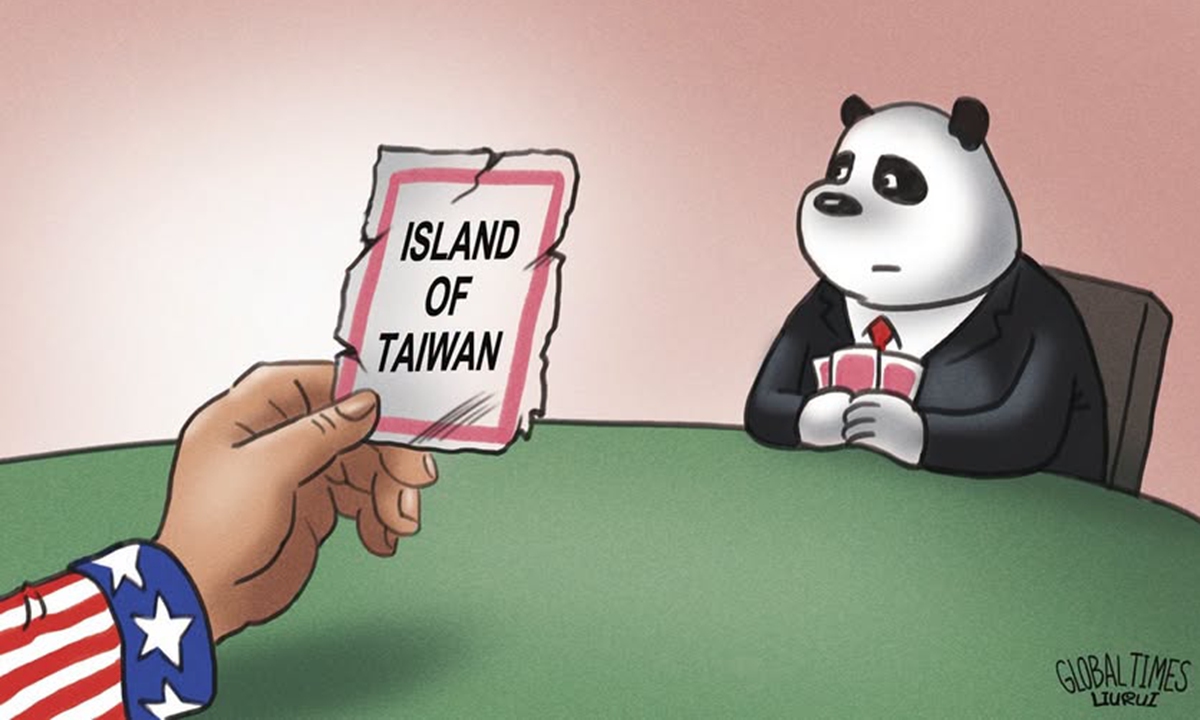
Illustration: Liu Rui/GT
On the surface, this might seem like a routine operation for the US military. Viewed in the context of current China-US relations and the situation across the Taiwan Strait, however, it is far from routine.
First, the timing is acutely sensitive. As speculation mounts over a head-of-state meeting next month, the US side is releasing signals of wanting to "manage differences and facilitate dialogue" while simultaneously flexing its military muscle in the Taiwan Strait. This dual-track approach - talking stability on the one hand while engaging in tactical probing on the other - reveals that the US has not truly abandoned its old playbook of "using the island of Taiwan to contain China." It still views the Strait as a key lever for containment, leverage and diplomatic pressure.
Second, the aircraft deployed is hardly ordinary. The P-8A is a specialized military platform integrating maritime patrol, anti-submarine warfare and signals intelligence. Flying such an asset through the Taiwan Strait is far from a symbolic gesture. Stripped to its core, this remains a close-in reconnaissance mission carrying clear military pressure - a deliberate attempt to stir up regional tensions and send the wrong signals to "Taiwan independence" forces.
For years, the US has repeatedly invoked "freedom of navigation" and "international airspace" to justify its maneuvers in the Taiwan Strait, aiming to achieve two goals: maintaining its strategic presence in the Western Pacific and reassuring its "allies" and local forces on the island of Taiwan. Yet the reality today is that the Taiwan Strait is no longer a stage where the US military can come and go at will just to put on a show.
Meanwhile, on Thursday local time, a US military charter plane carrying eight people crashed in a remote area of Alaska, killing everyone on board. The cause is still under investigation. While one event was a tragic accident and the other a so-called routine transit, placing them on the same strategic map points to a single takeaway: US military tentacles are stretched far and wide, but its operational risks, capability gaps and tactical costs are becoming increasingly evident.
The transit of the P-8A through the Taiwan Strait is no novelty. It is the same old playbook: leveraging "freedom of navigation" to embolden "Taiwan independence" forces, disrupt regional stability, and stage political theater for domestic audiences and overseas allies.
What truly merits attention, however, is China's response: tracking and monitoring the flight throughout, with the situation under control. These words demonstrate that China has developed a mature, steady and systematic capability to handle US military moves around the Strait. You come, we know; you move, we track; you probe, we keep the entire situation under control. This reflects a seamless combination of situational awareness, operational response and strategic composure.
Every time the US seeks to assert its presence in the Taiwan Strait, it merely exposes its underlying strategic contradictions and anxiety. It wants to stabilize ties with China, yet refuses to give up the Taiwan card; it fears the situation going out of control, yet continuously creates risk; it seeks to project global hegemony, yet finds it increasingly difficult to hold the upper hand on the ground. Consequently, such moves may look aggressive, but they are increasingly becoming political performances with diminishing marginal returns.
The Taiwan question has never been a card for the US to play at will - it lies at the very core of China's core interests. Any attempt to apply military pressure, political provocation or strategic probing through the Taiwan question will ultimately fail to alter one fundamental truth: Initiative over the Taiwan question rests not with long-distance military aircraft or warships, but with China's unwavering resolve and solid capabilities to safeguard its national sovereignty, unity and security interests.
Looking at this latest P-8A transit, the key question is not that the US side did it again, but what - if anything - it actually changed. The answer is clear: It did not alter the strategic balance in the Taiwan Strait, it did not shake China's strategic composure, and it did not disrupt the PLA's control over the situation. Instead, it offered the international community a clear view of who is fanning tensions and who is exercising restraint; who is provoking and who is steadily in control of the situation.
The era when a single US military maneuver could rattle the entire region is slipping away. If the US remains obsessed with "using the Taiwan island to contain China," it will only encounter one inevitable result: Provocations may create noise, but they cannot bend the arc of history. It is time to retire this outdated US playbook on the Taiwan Strait.