


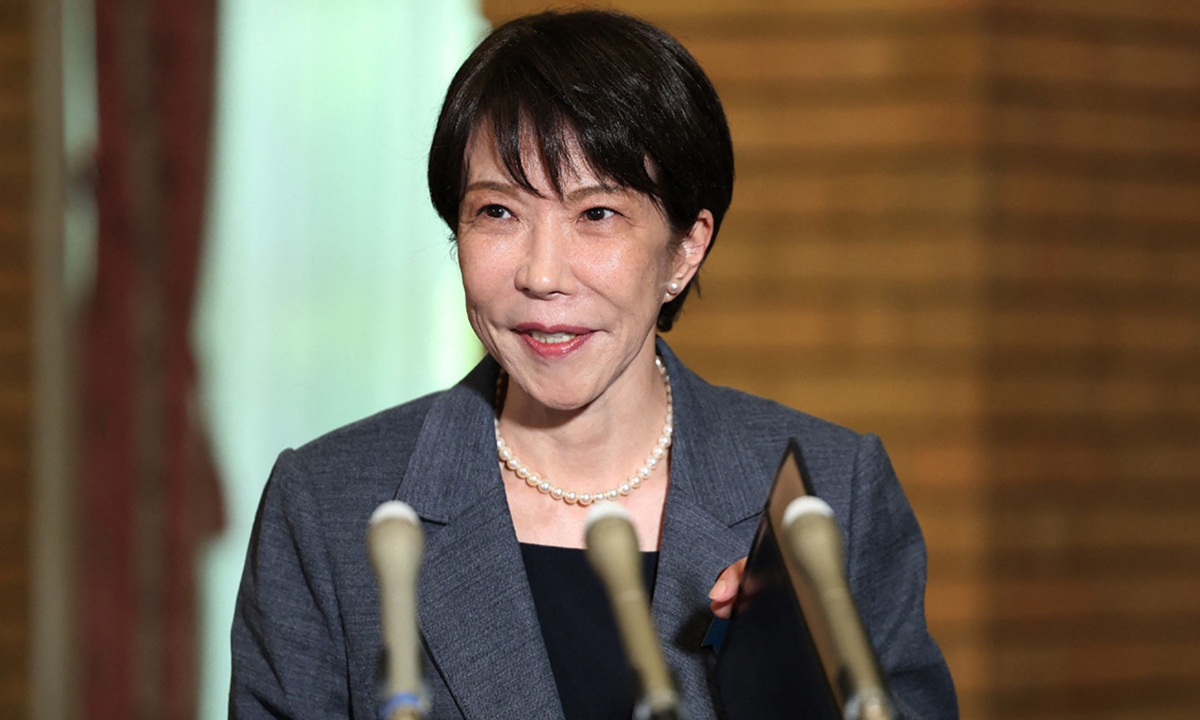
Japanese Prime Minister Sanae Takaichi speaks to reporters ahead of her departure for a tour of Europe at the Prime Minister's Official Residence in Tokyo on June 13, 2026. (Photo: VCG)
According to a Japanese media report on August 21, Japanese Prime Minister Sanae Takaichi recently posted a series of lengthy messages on social media to defend herself against mounting criticism, even quoting the phrase "a state cannot stand once it has lost the confidence of the people" from The Analects of Confucius in a desperate bid to rally public support. Japanese political commentators noted that these moves reflect her sense of urgency. Nevertheless, Japanese public opinion is not buying her rhetoric, given her practice of saying one thing but doing another.
In her posts, Takaichi claimed that she was mentally prepared for "a certain degree" of criticism, adding, "But 'a state cannot stand once it has lost the confidence of the people' - without the trust of the public, a government cannot stand." She also noted that if she cannot gain the public's trust as prime minister, it may hinder the implementation of future policies.
Takaichi invoked The Analects of Confucius in an attempt to "limit the damage," but the problem is that she treats this quote merely as a public relations ploy without truly understanding its deeper meaning. "A state cannot stand once it has lost the confidence of the people" is not a shield to be wielded while simultaneously betraying that trust and demanding the public's tolerance. Confucius' maxim was never intended to teach people how to "justify" a breach of trust, but rather how to "prevent" it; it does not address how those in power should defend themselves in the public sphere, but rather what they must do to earn the people's trust.
The dictum "a state cannot stand once it has lost the confidence of the people" comes from The Analects of Confucius: Yan Yuan. When Zi Gong asked about the way to govern a country, Confucius replied: "Sufficient food, sufficient military preparedness and the trust of the people." Abundant grain supplies, capable national defense and public confidence were the three cornerstones of sound governance.
Zi Gong pressed further, asking what should be abandoned first if, out of necessity, one had to give up one of these in turn. Confucius answered "drop military might," and then "drop food supplies." This left the timeless maxim: "Death has always been with us, but a state cannot stand once it has lost the confidence of the people."
Confucius could not have made the order of priority among food, military strength and trust in the governance of state any clearer; of these three, public trust is the most important. Without military preparedness, a nation faces instability; without food, the people suffer hardship; but once the trust of the people is lost, the government cannot even stand.
This is because food ensures survival, military preparedness guarantees security, but only trust sustains the most fundamental political relationship between the state and its people. Therefore, Takaichi's problem today is not merely "why her approval ratings are falling," but rather "why the people no longer trust her."
The reasons are not hard to fathom. First, a failure to address people's livelihoods. Surging prices and rising living costs represent the most tangible and immediate source of anxiety in Japanese society. Ordinary people care about their wallets, their incomes and grocery bills - not the countless lengthy posts and explanations churned out on social‑media platforms. With real‑life hardships all too evident, hollow excuses can hardly win over public trust.
Second, a failure of self‑reflection. Faced with a continuous decline in approval ratings, if a leader is unwilling to even acknowledge where the problem lies - or worse, adopts an attitude of "I don't know the reason" or "I have nothing to reflect on" - that is not merely a lack of understanding of public sentiment, but a lack of respect for it. The greatest fear in politics is not making mistakes, but making mistakes without realizing it, and clinging to appearances even after losing the people's trust.
Third, moral failings in dealing with history. A political figure who truly understands that "a state cannot stand once it has lost the confidence of the people" would never repeatedly test the limits on historical issues, much less continuously send the wrong signals on major topics such as the history of aggression, the shadow of militarism, and regional peace and security.
As soon as Takaichi took office, she made erroneous remarks regarding Taiwan and has been racing down the dangerous and misguided path of reviving militarism. Being dishonest about history, wavering in her commitment to peace and lacking basic respect for neighboring countries - this "breach of trust" is by no means merely a diplomatic misstep; ultimately, it will also erode her domestic political credibility.
Ultimately, Takaichi's problem is that she pays lip service to "trust" while her actions undermine it; she quotes The Analects of Confucius but her conduct runs counter to The Analects of Confucius' principles of governance. She sees only the result - a decline in her approval ratings - but refuses to acknowledge that the cause lies in her own gradual erosion of trust.
Ancient Chinese political wisdom has long offered a more profound explanation of this. The Book of History states: "The people are the foundation of a state, and the state will have peace when the foundation is solid." The Words of Mencius goes a step further, asserting: "The people are the most important; the nation is the next; the sovereign is least." In other words, power is not meant to demand understanding from the people. It exists to respond to them, serve them and hold them in reverence.
This is the true essence of the saying "a state cannot stand once it has lost the confidence of the people." Trust is not a written statement, a citation of classical texts, a string of lengthy posts on social media, or a cultural prop resorted to at the last minute when a crisis strikes.
Trust stems from the ruler's integrity, sincerity, sense of responsibility and willingness to correct mistakes and reflect. It comes from keeping the people's hardships close to one's heart and arises from upholding moral boundaries on matters of principle.
If Takaichi truly wishes to understand The Analects of Confucius, she should not merely use the phrase "a state cannot stand once it has lost the confidence of the people" to gloss over her own shortcomings. She should first ask herself: Why has she betrayed the trust of her own citizens? Why has she betrayed the trust of neighboring countries? Why has she betrayed the trust of historical justice?
This quote from Confucius is by no means an excuse to exonerate her. On the contrary, it serves as a clear mirror that lays bare the true intentions of those in power.