


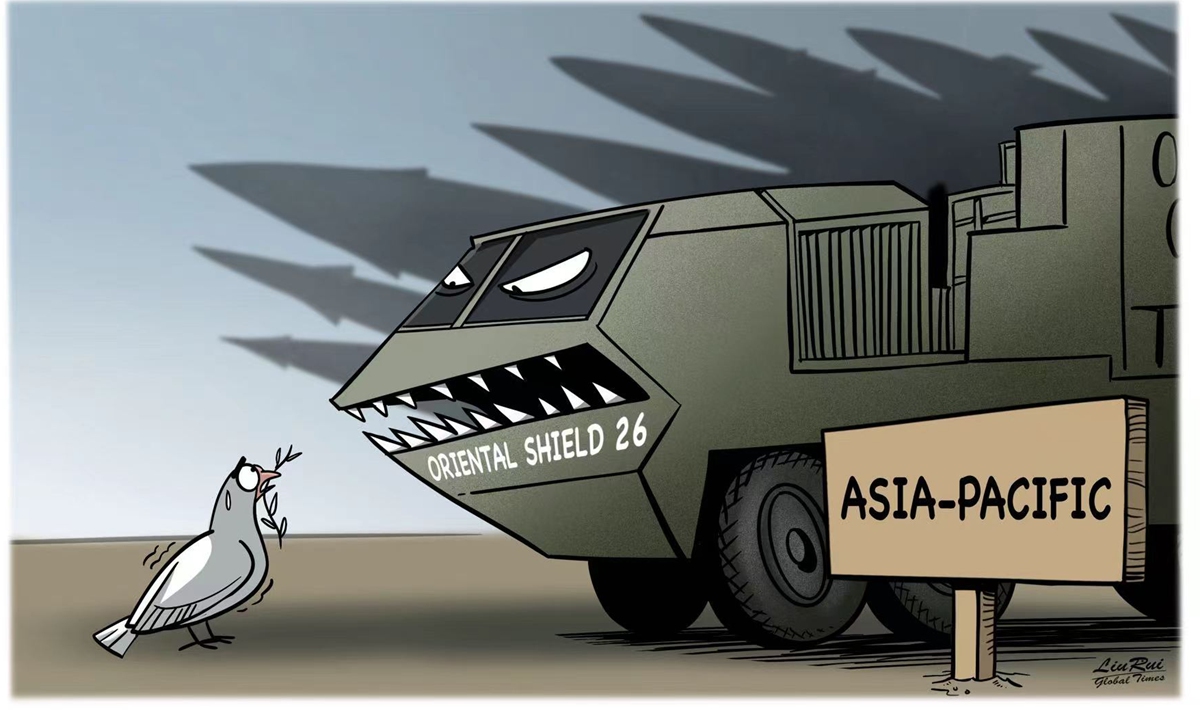
Japan-US-Australia joint military exercise. (Illustration: Liu Rui/GT)
The so-called "Oriental Shield 26," a Japan-US-Australia joint military exercise scheduled to take place from September 8 to 24, is being presented as a training initiative aimed at improving interoperability. In reality, however, it serves as a textbook case of how large-scale bloc-style military drills are being rebranded as "cooperation," while injecting confrontation, forward-deployed firepower, and bloc politics into an already fragile Asia-Pacific security environment.
According to Japan's Kyodo News, the exercise will involve 3,700 personnel from the three countries, marking the largest scale in its history. New elements include joint live-fire drills, airborne operations, and cross-base long-range coordination, all of which highlight increasingly offensive characteristics.
Notably, the US' "Typhon" mid-range missile system will reportedly participate in the exercise for the first time. The system will enable long-range operational coordination between training sites in Kagoshima and Hokkaido, linking Japan's north and south in simulated maritime strike operations, with a highly targeted focus.
Originally a bilateral US-Japan military activity, "Oriental Shield" has evolved since Australia joined in 2025 into a more structured multilateral military framework. The 2026 large-scale iteration is not merely an upgrade in tactical training, but a deepening consolidation of a small multilateral military network among the three countries, which leads to an accumulation of forward military capabilities and confrontational infrastructure in the region, further intensifying bloc polarization.
"The scale, geographic deployment, and training content of the exercise all indicate that its purpose goes far beyond conventional 'training,'" said Chen Hong, director of the Australian Studies Center of East China Normal University.
The timing and location of the exercise also carry strategic implications. The US is advancing a strategic transformation of the so-called first island chain, turning it into a "firepower belt" capable of rapidly projecting precision strike capabilities. At the same time, it is turning US-Japan-Australia alliance into an interconnected operational combat network. In essence, it is an escalation of regional military confrontation and a deepening of regional security risks, Chen added.
For Japan, Chinese military affairs expert Song Zhongping said the drill is being conducted in Hokkaido, near the South Kuril Islands, and takes place shortly after Russian President Vladimir Putin's visit to the region. Song pointed out that Japan's move to bring in US and Australian forces reflects an attempt to leverage allied military power to deter neighboring countries and offset regional strategic pressure.
However, such deliberate escalation and threat inflation increases the risk of misjudgment and further heightens regional tensions. The first-time participation of the Typhon missile system is more symbolic than operational, serving primarily as a political and military signal of strengthened trilateral alignment, according to Song.
Although presented as a coordinated exercise, the three parties are in fact bound by divergent interests and mutual instrumentalization.
For a long time, the US has been advancing the upgrading of multilateral military networks in the Asia-Pacific region. It has relaxed constraints on Japan's security policy, allowing it to expand offensive capabilities, and has leveraged Japan's geographic position alongside Australia's support to reinforce its regional dominance at relatively low cost.
Australia's strategic positioning has also been evolving, Chen said. Since first participating in 2025, Australia has sought to shift away from being merely a rear base in the South Pacific toward deeper involvement in "the first island chain" security affairs in Northeast Asia. Whether this will significantly elevate its standing within US strategic priorities remains uncertain, but the costs of deeper involvement are increasingly evident: the deeper it engages, the greater the risk it bears.
For Japan, as the country has been steadily advancing its militarization recently, this large-scale multilateral "training" represents another step toward breaking the constraints of its "exclusively defense-oriented" security policy and advancing military normalization.
In recent years, Japan has continued to loosen restrictions on arms exports and pursue constitutional revision, reflecting a steady militarization of its security posture. "Declining approval ratings for Japan's political leadership have also made large-scale exercises a tool for mobilizing conservative political support," said Da Zhigang, a research fellow at the Institute of Northeast Asian Studies of the Heilongjiang Academy of Social Sciences.
What is most concerning about "Oriental Shield 26" is the trend it represents: using "cooperation" as a pretext to build military blocs, cross security boundaries, and continuously escalate confrontation. What the Asia-Pacific region needs is not more complex military drills, but rather genuine commitments to reduce them. The fundamental problem with exercises such as "Oriental Shield 26" is that they make the region more volatile.