


At the 2026 World Humanoid Robot Games in Beijing, the robots were supposed to be the stars, sprinting down tracks and breaking records, stumbling through obstacle courses, scoring goals, breaking into cheerleading dances and occasionally wobbling their way through the competition.
But amid the packed stands and nonstop demonstrations, another spectacle kept catching my eye – the sheer number of children in the audience excitedly crowding the barriers, eager for a closer look and squealing with pure, unbridled joy and wonder.
I found myself wondering whether the message to the next generation was less "look what robots can do" than "look what you could one day make." And after several conversations with parents, it became clear that for many Chinese families, the Robot Games could be something of a career fair for the next generation – a glimpse of the world their children might one day help build.
This year's edition, the second since the competition launched in 2025, opened Saturday evening at Beijing's National Speed Skating Oval and ran for five consecutive days. Organized around the theme "Intelligence Competing Toward the Future," the Robot Games brought together 666 teams from 16 countries across six continents competing in 51 events with a combined total of more than 2,000 robots.
Ahead of the Games, organizers noted that two- and three-person ticket bundles were among the most popular options, with sales patterns pointing to families, friends and colleagues attending in groups. Officials pitched the multi-person tickets explicitly as a way to make watching the competition a family activity, describing the event as offering both a science lesson and a shared outing.
That framing seemed to hold up once the Games opened. Interestingly, the crowd was indeed increasingly made up of elementary-school-aged children, drawn not only to the competitions themselves but to the interactive exhibits on site – robots breakdancing, cooking, making coffee and drinks – and fueling a steady stream of purchases of robot-themed toys and merchandise.
I saw the same pattern up close. For one parent, the trip was about giving her 7-year-old son a tangible sense of where technology is heading:
"I wanted him to see what technology is actually becoming, rather than only learning about it from his books or the internet. He's been very curious from such a young age, so we think maybe one day he'll be the person building these robots."
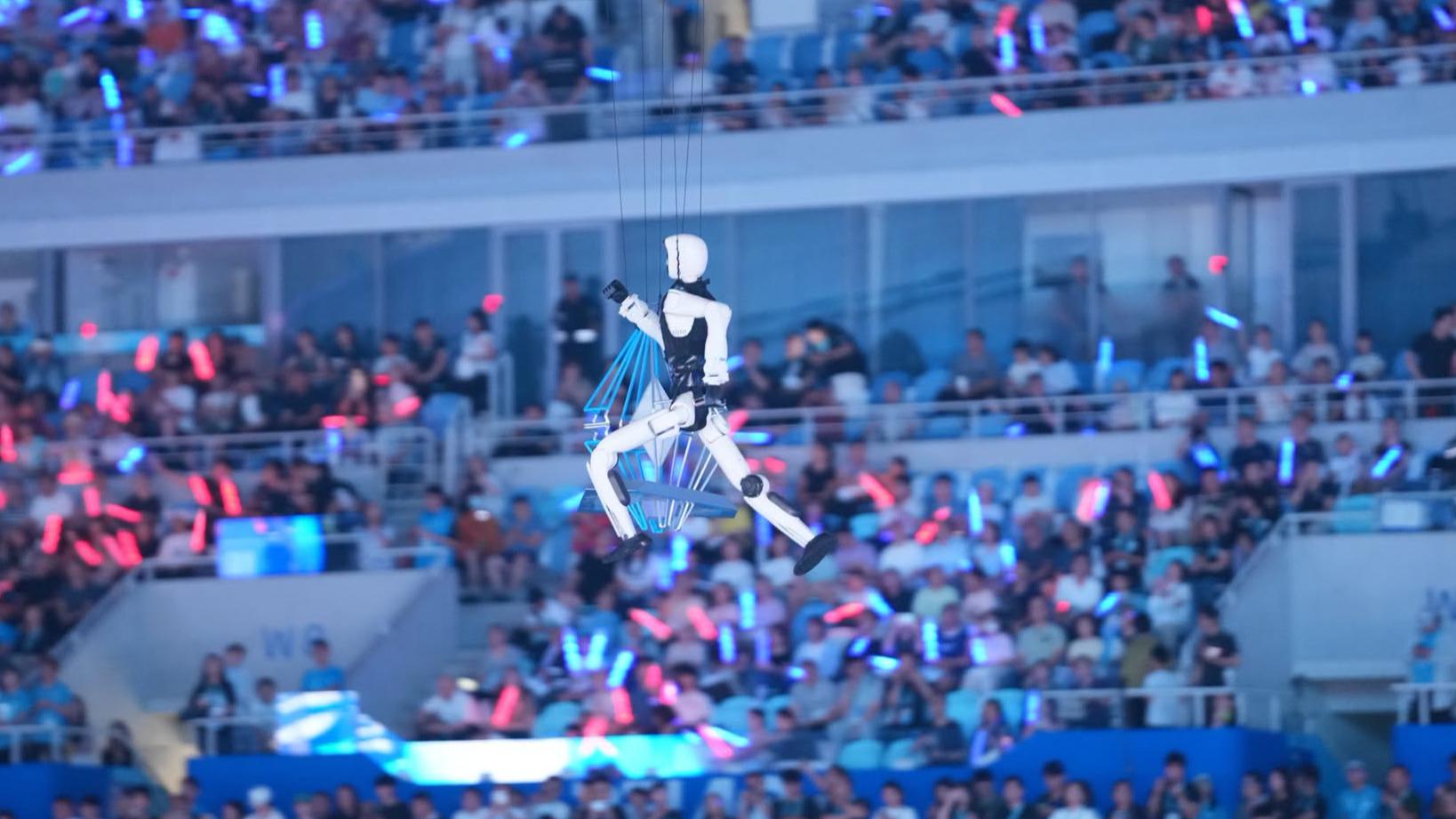
A humanoid robot is lifted above the arena during the 2026 World Humanoid Robot Games, with spectators watching in the background, August 25, 2026. (Photo: Qu Bo/CGTN)
That sentiment echoed across. Robotics, AI and STEM aren't abstract national priorities to these parents. They're dinner-table conversation, extracurricular budgeting, and now, weekend outings. Another parent framed it in more competitive terms, worried about her kids falling behind peers already immersed in the field:
"There are so many children learning programming and robotics now. If she is interested, I want to give her the chance to see what other kids are doing and become a part of it from a young age."
The kids, for their part, aren't always thinking in terms of five-year plans. One boy, immersed in how the robot was trying to climb a particularly large box during the obstacle course, shared:
"I liked when they score goals and walk into the net. So funny!"
Not every parent frames the visit as strategic. For some, it's a fun, novel outing that happens to double as inspiration. As we amusedly watched kids swarm a cute little bot in shiny costume, another parent shared:
"My daughter thinks robots are cute, so when we saw the games were happening here, we thought, why not? It's something different from our usual weekend activities, and look how happy she is to see them up close," he said.
Whether the motivation is calculated or casual, the pattern holds: across all days, families were a visible, deliberate part of the audience at the Robot Games. In a country investing heavily in robotics and AI as strategic industries, it's hard not to read the presence of so many young spectators as part of a much longer pipeline – a generation being introduced, one wide-eyed weekend at a time, not just to the machines they may someday help build, but to the idea that these machines will belong in their world.