


2026 China-South Africa Seminar highlights right to development, rejects narrow Western human rights narratives
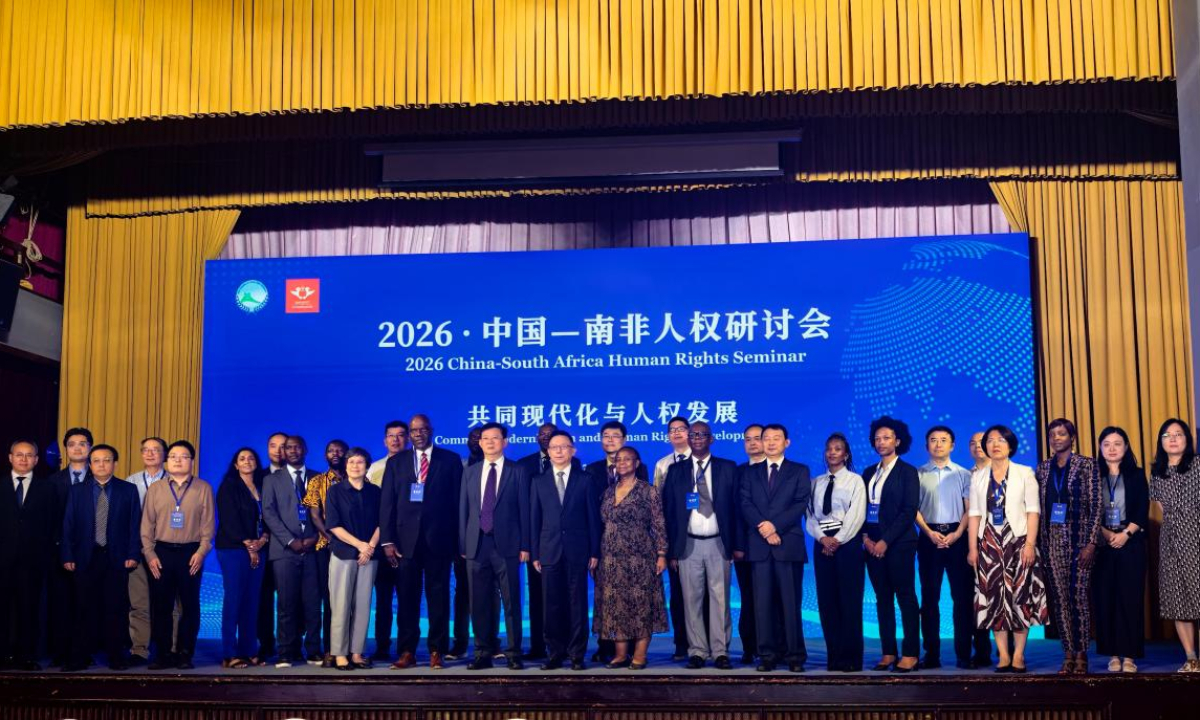
Chinese and South African officials and scholars participate in the 2026 China-South Africa Human Rights Seminar in Hangzhou, East China’s Zhejiang Province, on August 27, 2026. (Photo: Zhang Ao)
Genuine progress in human rights must be rooted in inclusive development and people-centered wellbeing. This is a conviction shared by Chinese and South African officials and scholars at the 2026 China-South Africa Seminar on Human Rights. Convened Thursday in Hangzhou, East China's Zhejiang Province, the event saw participants underscore the need to work hand-in-hand to advance modernization, while pushing back against the one-sided human rights narratives advocated by some Western countries.
Held to mark the 40th anniversary of the adoption of the UN Declaration on the Right to Development, the seminar brought together some 60 representatives from China and South Africa.
Zhou Shuchun, executive vice-chairman of the China Foundation for Human Rights Development, said at the seminar that China and South Africa are good partners pursuing shared development and fellow travelers on the path toward modernization.
"We must firmly uphold the inalienable right to development for peoples across the Global South, and achieve common progress in human-rights cause," Zhou said.
He added that unlike certain countries' "decoupling" and arbitrary tariff practices, China consistently gives priority to Africa. China's vast market will unlock broader opportunities for Africa's development, deliver greater wellbeing to peoples in China and Africa, and inject robust momentum into global economic growth.
David Monyae, director of the Center for Africa-China Studies at the University of Johannesburg, emphasized the importance of cooperation quality. "The far more critical question concerns the developmental quality of trade. Our task is not just to calculate how much Africa trades with China. Our task is to define what kind of Africa this cooperation helps to build. Modernization for all calls for development that leaves no one behind," he said.
Monyae criticized distorted Western human rights practices. "Some Global North countries approach human rights in a narrow, one-dimensional way. They prioritize individual political rights at the cost of collective rights and the right to development. Development should not be a privilege reserved for a small number of countries and elites," he told the Global Times.
Sayuri Govender, acting director of the Economic, Social and Cultural Rights Division at South Africa's Department of International Relations and Cooperation, said China's development experience is highly valuable for Africa. "Partnerships such as that between South Africa and China should be deepened and strengthened. We ought to draw useful lessons and share good practices to tackle challenges including inequality," she said.
Yang Baorong, senior research fellow at the Chinese Academy of Social Sciences, pointed out at the seminar that China's initiatives in Africa aim to advance Africa's right to development by drawing on China's experience as a developing country, thereby boosting Africa's development capacity and empowerment in a well-structured manner. He also noted that during commodity market upswings, each unit of growth in bilateral trade with China leads to a 4.2-6 percent increase in trade creation for Africa.