


Two recent reports published in The New York Times demand attention. One investigates why the US can't quit its wars, dissecting the quagmire of US withdrawal from Afghanistan alongside its military predicaments regarding Iran. The other points out that "in the age of global warming, some fear 'the entire Himalayas are melting'," illustrating the cascading disasters triggered by glacier melt across high-altitude regions through two separate mountain catastrophes.
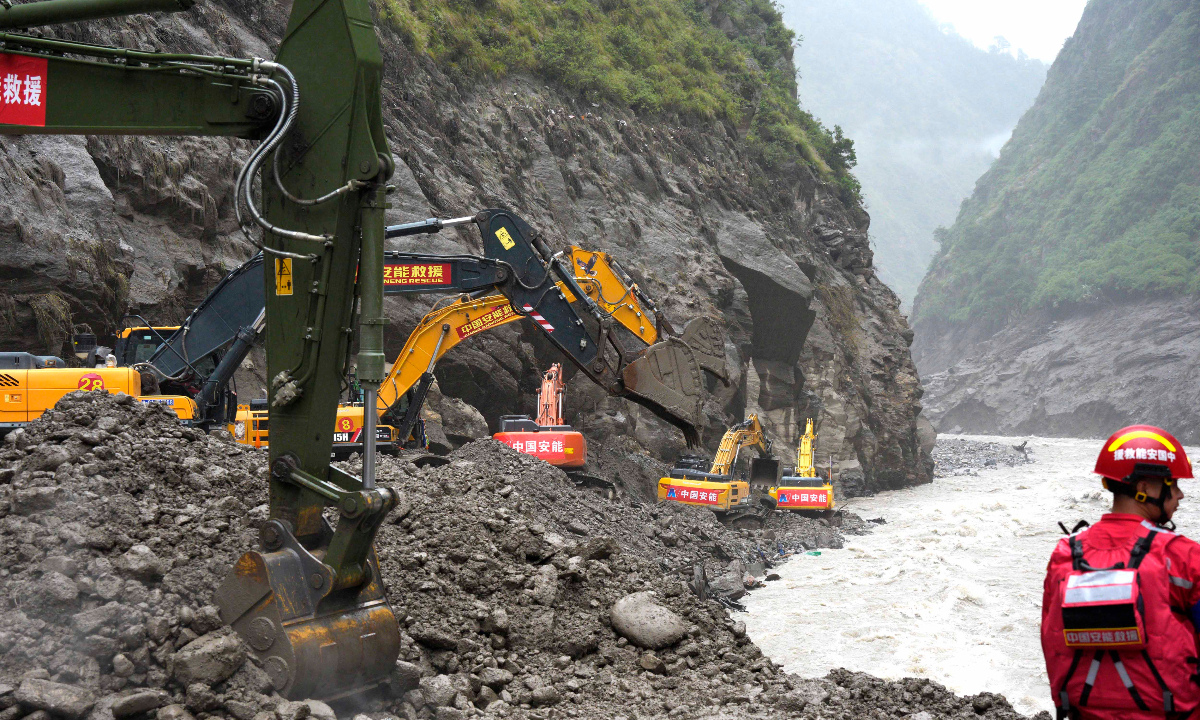
A member of the Xizang Fire and Rescue Corps conducts emergency rescue operations at Gyirong Port on the China-Nepal border in Southwest China's Xizang Autonomous Region on August 29, 2026. (Photo: IC)
The first article notes that for much of the Afghanistan war, the only thing harder for the US than winning was quitting. "Today, the US military is mired in a new war in Iran. Once again, the prospects for a military victory look bleak. Even President Trump has hinted that he would like to quit the war, only to reverse course and make a case for staying," it reads.
The US has faced questions about quitting in just about every war it has fought since its emergence as a global power after World War II, the article says. "The long war in Afghanistan raises hard questions for the generals and policymakers contemplating the way forward in Iran: Why was quitting in Afghanistan so hard? What does the long struggle to accept defeat there say about the Trump administration's predicament in Iran?"
The second article recounts how, on the morning of August 26, part of a glacier and the mountainside beneath it collapsed on the north side of the Langtang Lirung peak, setting off a 100-kilometer flood of water, mud and debris. By August 28, Nepal's National Disaster Risk Reduction and Management Authority said that 579 people had been killed. Many, many more are still missing. This leaves a staggering toll of casualties and devastation.
Around 6,500 kilometers west, mourners gathered in Dorset, England, to grieve the victims of another disaster. On July 30, Nirmal Purja, a celebrated Nepali mountaineer, was killed by an avalanche on Broad Peak in Pakistan's Karakoram range together with nine other climbers.
"The two disasters occurred within a month of each other on the mountainous region that extends from Pakistan through Nepal, where scientists, climbers and trekkers have witnessed accelerating losses of snow and ice," this piece says.
Spanning politics and nature, war and ecology, these two reports show that when the world is governed by the logic of power and limitless extraction, the price is ultimately paid by ordinary people, vulnerable regions, and our shared human future. Together, the two articles bear witness to a brutal reality - Hegemony triggers political "avalanches," just as a loss of reverence amplifies natural ones. What humanity truly needs is not the exertion of strength to crush rivals, but the wisdom to halt wars, foster cooperation, and pursue shared governance.
The lesson of Afghanistan: Once war becomes a tool, quitting becomes a trap
Following the killing of Osama bin Laden in 2011, the core justifications for US war had effectively dissipated; yet withdrawal did not follow. Calculations, accumulated layer upon layer, drag out a war that should have ended a decade sooner.
This is the most typical dilemma of the US interference: When launching a war, the goals are always portrayed as extraordinarily grand, but once bogged down in the quagmire, the objectives can only be lowered passively and repeatedly - from "winning the war," to "maintaining the situation," and eventually to "passing the failure on to the next administration." The less victory comes into sight, the harder it becomes to admit defeat; the more unwilling one is to withdraw, the greater the sunk costs become.
That is why the international community's concerns over the situation involving Iran today are anything but accidental. Military force may destroy facilities, but it can hardly rebuild trust; it may open new fronts, but it cannot put an end to old hatreds. Airstrikes, economic blockades and maximum pressure may create temporary deterrence, but they cannot ease the other side's regional security concerns, much less create a stable political order.
The Himalayas' warning: Nature never indulges in wishful thinking
Glaciers are retreating, ice and rock are collapsing, and rockfalls are becoming more frequent. Environments once regarded as relatively stable are becoming increasingly unfamiliar and dangerous. Mountain disasters naturally have complex geological, precipitation and other specific causes, but the risks brought about by accelerated melting of ice and snow are no longer something that any single country can avoid on its own.
Following the mudslide that struck Nepal, China's Ministry of Foreign Affairs stated explicitly that based on assessments by experts and official institutions from China and Nepal, "the mudslide was triggered by a collapse of a high-altitude glacier in Nepal." In the face of such disasters, what we should do above all is respect science, revere nature, protect lives and make every effort to conduct rescue operations - not use disasters as material for fabricating narratives or shifting blame.
In his later years, the renowned modern Chinese historian Qian Mu summed up the highest characteristic of traditional Chinese culture in the concept of "the unity of Heaven and humanity." Qian's notion of "Heaven" does not entirely correspond to the "Gods" or "spirits" of religion. In his interpretation, it encompasses both the natural world and the workings of heaven, the cosmic order and moral principles. It does not call on people to retreat passively from the world. Rather, it reminds humanity that only by respecting the laws of nature and holding the boundaries of the unknown in awe can one find a secure place for oneself in the world. Viewed against the backdrop of today's climate change, this perspective remains profoundly enlightening.
The certainty the world needs is joint progress and win-win cooperation
The world today presents two starkly different realities.
On one side, conflicts in the Middle East are spilling over and escalating: Every attack risks triggering an even more forceful retaliation, while regional security, energy markets and people's lives are all being drawn into uncertainty. On the other side, China continues to expand cooperation with Shanghai Cooperation Organization (SCO) member states in areas such as the digital economy, green development, artificial intelligence governance, poverty alleviation, and improvements in people's livelihoods - with the focus not on who dominates whom, but on how to grow the pie of shared development.
A year ago, the Global Governance Initiative was proposed at the SCO Summit in Tianjin, clearly articulating five core principles: adhering to sovereign equality, abiding by international rule of law, practicing multilateralism, advocating the people-centered approach and focusing on taking real actions. This initiative provides a profound answer to a pressing question: Faced with a series of challenges - including war and conflict, climate change, and the development gap - no country can remain unscathed; the international community can only find a way forward through equal consultation, joint rules-making, and the sharing of outcomes.
From the prolonged war in Afghanistan to collapsing glaciers in the Himalayas, facts have repeatedly demonstrated that lasting peace cannot be maintained through sheer power, nor can genuine prosperity be achieved by exhausting nature. Certainty must be created by respecting facts, revering nature, upholding rules and acting together.
The diversity of civilizations should transcend the impulses of hegemony; the destinies of nations should illuminate one another through harmonious coexistence. "A just cause wins support, while an unjust one loses it" - this ancient Chinese maxim, engraved in the annals of history for millennia, remains an enduring truth.