


The center of gravity shifts eastward: The SCO Summit redraws the map of international balance
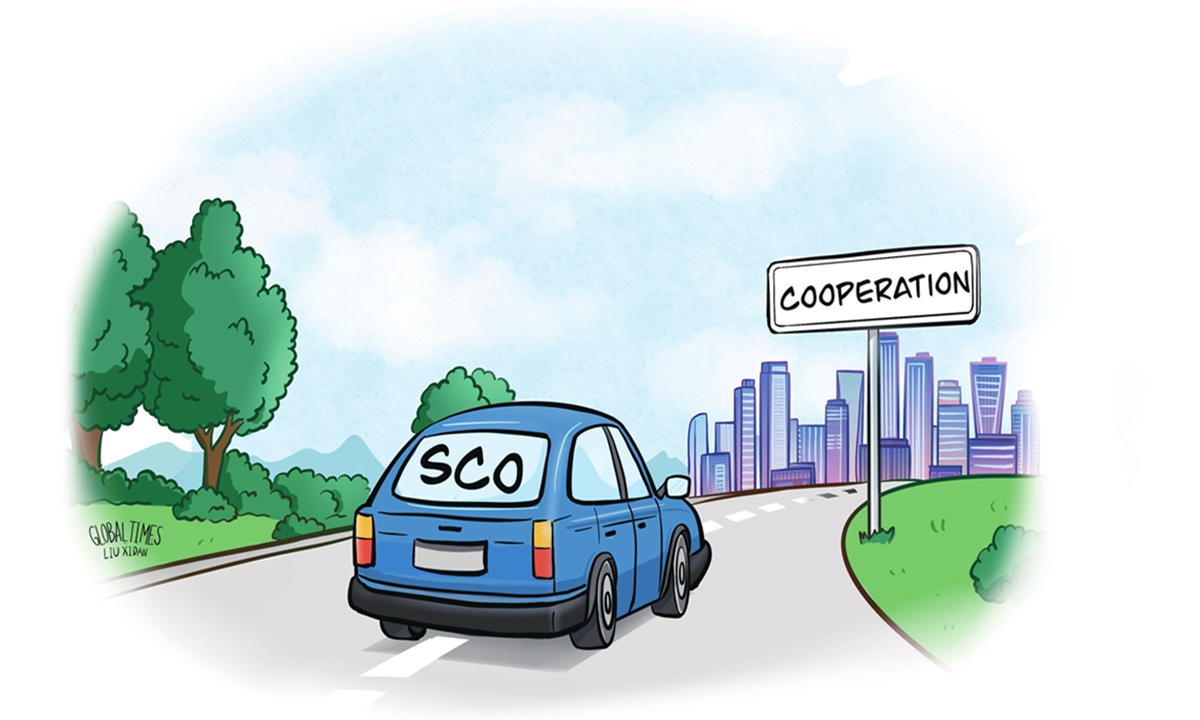
Shanghai Cooperation Organisation. (Illustration: GT)
The meetings held in the Kyrgyz capital, Bishkek this week were a powerful political demonstration of the scale of the transformation underway in the structure of the international system. Leaders from China, Russia, Central Asian states, India, Iran and Pakistan, along with a number of leaders from partner countries, convened under the banner "25 Years of the Shanghai Cooperation Organisation (SCO): Together Towards Sustainable Peace, Development, and Prosperity," at a time of escalating military conflicts, trade wars and economic sanctions.
Monday's meetings preceded the official meeting of the Council of Heads of State, scheduled for Tuesday, which is expected to adopt the "Bishkek Declaration" to mark the 25th anniversary of the organization's founding. However, the most significant developments emerged in the bilateral meetings, particularly between Chinese President Xi Jinping and Russian President Vladimir Putin, and in the presence of Indian Prime Minister Narendra Modi and Iranian President Masoud Pezeshkian. This transformed Bishkek into a platform for dialogue between powers of considerable political, economic and military weight that cannot be ignored.
The SCO, founded in 2001, is no longer a limited regional framework for confronting the "three threats," namely terrorism, separatism and extremism. Following the accession of India and Pakistan, and later Iran and Belarus, its full membership now comprises 10 countries, stretching from East Asia to Eastern Europe, covering an area exceeding 36 million square kilometers.
More than 3.4 billion people live within the SCO member states, representing about 42 percent of the world's population. This bloc represents not only a demographic force but also the largest human market and potential workforce, encompassing China, one of the world's two largest economies, and India, one of the fastest-growing major economies, in addition to Russia and Iran with their vast energy resources.
The true significance of the SCO summit lies not in compiling these figures, but in attempting to translate them into institutional power. Discussions are focused on expanding the use of national currencies in trade, developing independent financing mechanisms for joint projects, and continuing consultations on establishing a development bank and fund affiliated with the organization. This does not mean the dollar will lose its position quickly, but it does reveal a gradual path to reducing the exposure of member states' economies to Western sanctions and financial pressures.
In the transport sector, the organization seeks to link the China-proposed Belt and Road Initiative with the North-South Corridor, which connects Russia with Central Asia, Iran and the Indian Ocean. If these projects succeed in overcoming funding, sanctions and border challenges, they will reshape trade routes between Asia and Europe and provide landlocked Central Asian countries with new access to international markets and ports.
In terms of security, the organization includes four nuclear powers - China, Russia, India and Pakistan - along with Iran, which occupies a central position in energy, security and maritime equations. Therefore, the summit's discussions focused on the war in Ukraine, the escalating US-Iran tensions, the security of the Strait of Hormuz, Afghanistan and counterterrorism. During his meeting with Putin, Modi called for an end to the Ukrainian war, while Beijing and Moscow emphasized the need to move toward a multipolar world order and reform international governance institutions.
However, it would be an exaggeration to view the SCO as an "Eastern NATO" or a homogenous alliance against the West. China and India have border and economic rivalries, India and Pakistan have deep historical grievances, and members hold differing views on the war in Ukraine and relations with the US. The consensus-based decision-making mechanism sometimes limits the organization's ability to move from political statements to practical implementation. Nevertheless, the Bishkek summit sends a clear message: The center of international gravity is gradually shifting eastward, not only due to the decline of the West, but also as a result of the rise of states with the population, resources, markets and political will to expand their autonomy.
The SCO will not overturn the global order overnight, but it is steadily becoming one of the platforms where the rules of the new international balance of power will be forged.
The author is a professor of strategic studies at Al-Hussein Bin Talal University.