


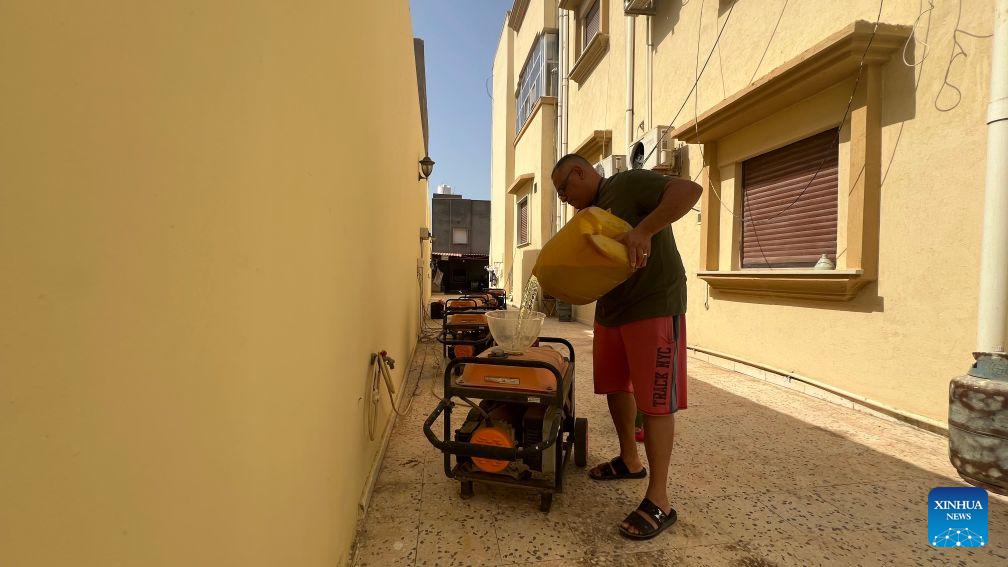
This photo taken with a mobile phone shows a man filling the fuel tank of an electric generator in Tripoli, Libya, on July 24, 2026. (Photo: Xinhua)
TRIPOLI, Sept. 1 (Xinhua) -- After owning his truck for seven years, 49-year-old Ahmed Al-Sharif is considering selling it.
Al-Sharif relies on the truck as his only source of income, using it to transport furniture to support his family of six. But these days, keeping it running has become increasingly difficult for him and other drivers in Libya as diesel becomes harder to obtain amid the country's intertwined power and fuel crises, which have lasted more than six weeks.
With the temperature nearing 40 degrees Celsius, he stood beside his truck in a long queue outside a fuel station in the Libyan capital city of Tripoli, waiting for his turn to get diesel.
He told Xinhua that the wait could last two or three days, while power cuts could add more hours as stations stop operating. "If there is a total blackout, we will remain waiting for an unknown period," he said.
The problem is compounded by the high cost of diesel on the black market, where a liter of diesel costs about 8 Libyan dinars (about 1.26 U.S. dollars), more than 50 times the official subsidized price.
"If I buy diesel on the black market, I will not be able to make ends meet with what I earn from daily work after paying for it," he said.
With the new school year approaching and prices rising, Al-Sharif is considering borrowing money to cover his family's needs. He is also looking for another job.
The crisis has not been limited to drivers, as power cuts have also affected businesses.
At a food market in eastern Tripoli, 32-year-old Khaled Ibrahim, a supermarket owner, said power cuts lasting more than 10 hours had caused refrigeration equipment to stop, leaving chilled water unavailable and causing some frozen goods to spoil.
"This is the worst season for me, and I have not been able to continue under these circumstances," said Ibrahim.
The crisis has also spread to the water system, with supplies cut off in large parts of the capital due to disruptions affecting the Great Man-Made River, a major network of pipelines and aqueducts that supplies fresh water to parts of Libya.
In central Tripoli, Rafaa Zaid, the owner of a cafe, was forced to close his business because of the water shortage.
Zaid said power cuts could be temporarily managed with a generator, but the lack of water makes it impossible to operate the cafe, even as he continues to pay rent.
"Every day that passes without opening the cafe means another loss, but what can I do? I cannot work without water," he said.
For Al-Sharif, Ibrahim and Zaid, the shortages are not separate problems. A power cut can shut down a fuel station, making it harder for drivers to get diesel. A shortage of diesel, in turn, raises the cost of running generators, while disruptions to the Great Man-Made River system can leave businesses without water even when they have electricity.
The impact of the power crisis has also been felt beyond homes and businesses.
According to the Libya Herald in late August, the extensive and frequent power cuts and blackouts have led to violent demonstrations in the country, with road blockades involving the setting of fires to rubbish and tires, and the barricading of state buildings with rubble.
Bashir Al-Marash, the chairman of the state-owned General Electricity Company of Libya, assured that Libya's current electricity crisis will end within the next two weeks, the report said.
Although Libya holds the largest proven crude oil reserves in Africa, it heavily imports refined petroleum products such as gasoline and diesel due to domestic processing limitations and infrastructure challenges.
Brega Petroleum Marketing Company is a state-owned Libyan enterprise headquartered in Tripoli that manages the domestic storage, marketing, and distribution of petroleum and refined oil products.
Ahmed Al-Masallati, director of media and communications and official spokesperson for the company, said on Sunday that the global crisis, and specifically the shipping disruptions in the Strait of Hormuz and the repercussions of global energy crises, have delayed the arrival of some fuel shipments to Libya.
On a local level, he said that reduced production at the Zawia refinery due to power outages and security conditions contributed to a temporary drop in the quantities available for distribution.
Tariq Al-Tarhouni, an energy expert and head of the Department of Renewable and Sustainable Energy Engineering at Libya's Omar Al-Mukhtar University, said the problem goes deeper than a shortage in electricity generation.
"Libya's electricity crisis is not merely a power generation crisis, but a crisis in the management of the entire energy system," he said.
He added that a sustainable solution requires rebuilding Libya's energy system around efficiency, reliability, diversity and decentralization, while rehabilitating conventional generation, strengthening the grid and improving demand management. ■
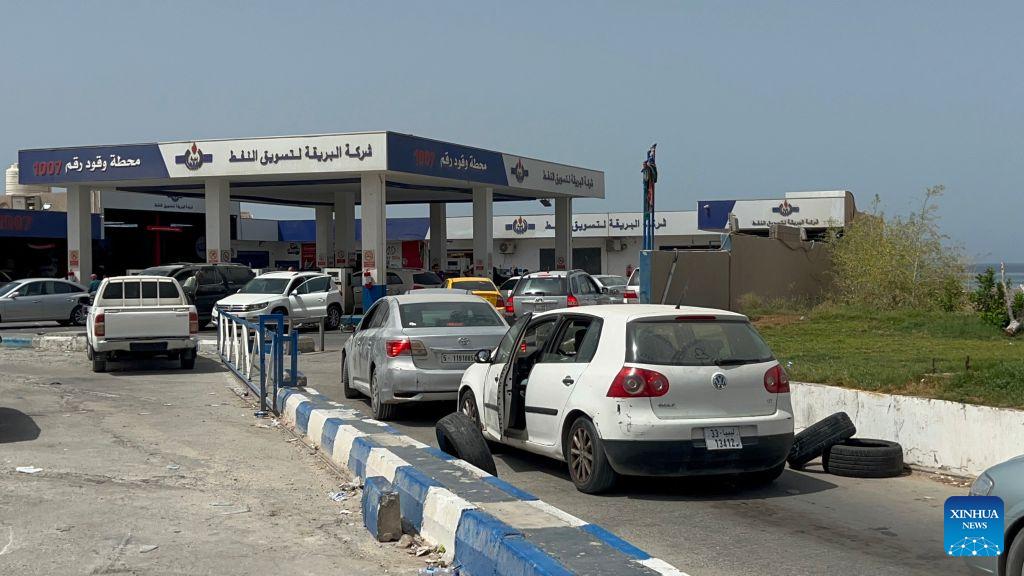
This photo taken with a mobile phone shows vehicles lining up at a filling station in Tripoli, Libya, on Aug. 24, 2026. (Photo by Hazem Turkia/Xinhua)