


Kazakh president pledges to further consolidate permanent comprehensive strategic partnership with China
BISHKEK, Sept. 2 (Xinhua) -- As Kazakhstan's relations with China have reached an unprecedentedly high level, his country stands ready to further consolidate the permanent comprehensive strategic partnership with China, enrich the relationship and open up new prospects for cooperation, President Kassym-Jomart Tokayev said.
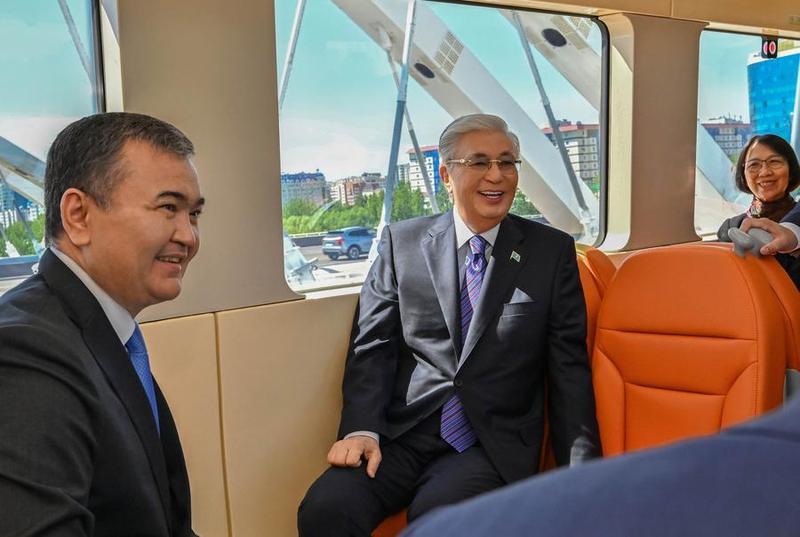
Kazakh President Kassym-Jomart Tokayev (2nd L) takes the light rail on the first day of its operation in Astana, Kazakhstan, May 16, 2026. (Kazakhstan's presidential press service/Handout via Xinhua)
In a written interview with Xinhua, Tokayev said the two countries have a long history of bilateral good-neighborly friendship and a lengthy common border.
"As a Kazakh proverb goes, 'Those who walk the same road share a common destiny.' The friendly relations between Kazakhstan and China serve the fundamental interests of the peoples of both countries and are also an important factor in maintaining peace and stability across Eurasia," he said.
"I sincerely thank President Xi Jinping for his friendship toward Kazakhstan. The political dialogue that we have consistently maintained has become a core pillar of Kazakhstan-China relations," Tokayev said.
"Our strategic partnership is comprehensive and covers all key areas -- from trade, investment, energy and transport to industrial cooperation, agriculture, digitalization, healthcare, science and technology, education and culture," he said.
Two-way trade continues to reach new records, with China being Kazakhstan's largest trading partner, he said, branding transport and logistics as strategic areas of cooperation between the two countries.
As a natural link connecting the East and West, Kazakhstan is working with its Chinese partners to build modern transport and logistics infrastructure of regional scale, he said.
Within the framework of Belt and Road cooperation, the two countries are reshaping the transport landscape between Asia and Europe by developing the Trans-Caspian International Transport Route, building new railway trunk lines, expanding dry ports and logistics hubs, and upgrading border infrastructure, he said.
On the Trans-Caspian International Transport Route, Tokayev said it holds a priority position in Kazakhstan-China cooperation and is an important transport corridor connecting China and Europe.
The common task of the two countries, he said, is to maximize the route's competitiveness, emphasizing the importance of building smart customs systems, enhancing coordination between information systems, and automating border procedures.
Tokayev said Kazakhstan-China cooperation is moving to a new level, with the scope of cooperation extending from traditional cooperation in the real economy to partnership in the digital economy.
Regarding scientific and technological cooperation as particularly important, he said that China is relatively advanced in such fields as artificial intelligence, digital technologies, robotics, new energy and high-tech manufacturing, while Kazakhstan is also accelerating the implementation of its digital transformation strategy.
"During my recent visit to Shanghai to attend the World Artificial Intelligence Conference, I held fruitful meetings with heads of leading Chinese technology companies. We intend to implement cooperation projects in such areas as the digital economy, smart manufacturing, e-commerce, scientific research and talent development. Scientific and technological cooperation has every possibility of becoming one of the most important directions for the new stage of Kazakhstan-China cooperation," he said.
Artificial intelligence should serve the development of all humanity, and all countries should have fair access to modern technologies, knowledge and computing resources, he said. "On this issue, our position is in line with that of China."
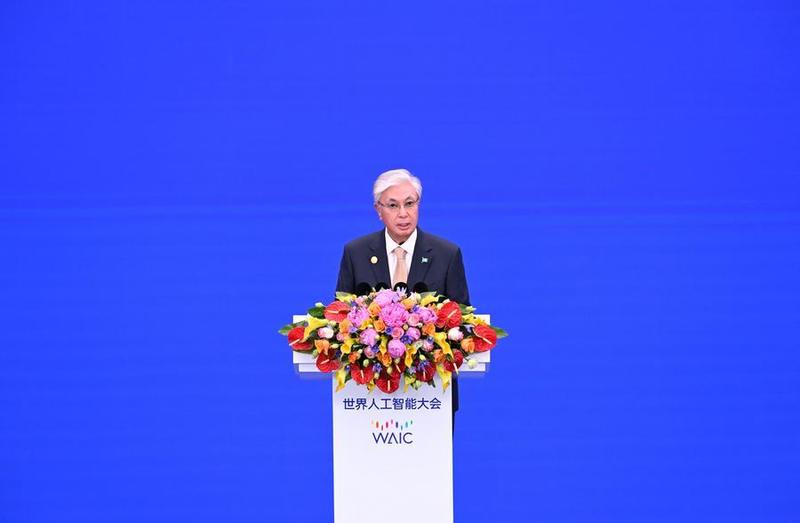
Kazakh President Kassym-Jomart Tokayev addresses the opening ceremony of the 2026 World AI Conference and High-Level Meeting on Global AI Governance in Shanghai, east China, July 17, 2026. (Xinhua/Shen Hong)
In the international arena, Tokayev stressed bilateral active cooperation and their similar positions on such issues as strengthening the core role of the United Nations, upholding the principles of international law, pursuing genuine multilateralism and peacefully resolving conflicts.
He reaffirmed Kazakhstan's commitment to the one-China principle and opposition to acts that undermine national territorial integrity.
Kazakhstan will continue to strengthen solidarity and cooperation with China within the frameworks of the United Nations, the Shanghai Cooperation Organization and the Conference on Interaction and Confidence Building Measures in Asia, and will fully support cooperation under the China-Central Asia mechanism, he said.
This year marks the 25th anniversary of the founding of the Shanghai Cooperation Organization, which, Tokayev said, has successfully upheld the "Shanghai Spirit" of mutual trust, mutual benefit, equality, consultation, respect for diverse civilizations and pursuit of common development. These principles can be regarded as a "standard" for international cooperation.
Noting that next year marks the 35th anniversary of diplomatic relations between Kazakhstan and China, he said that in addition to political and economic ties between the two sides, people-to-people exchanges have also developed actively -- a trend vividly demonstrated by the 2026 Kazakhstan-China Year of Cultural Exchange.
Highlighting deepening educational ties, Tokayev said that tens of thousands of Kazakh students are currently studying in China, while many Chinese students are choosing to study at universities in Kazakhstan. Branches of renowned Chinese universities and Luban Workshops have been operating in Kazakhstan, while academic exchanges and university cooperation programs continue to expand.
Tokayev pointed to the mutual visa exemption regime as a major driver of tourism between the two countries. He noted that Chinese tourist arrivals in Kazakhstan reached 962,000 last year, an increase of 47 percent from 2024.
He voiced hope to "show our Chinese friends a diverse Kazakhstan -- modern Astana, ancient Turkistan, the mountains of Almaty, the unique natural landscapes of Mangystau, the vast steppe and the heritage of the ancient Silk Road, as well as our music, cuisine and tradition of hospitality."
"At the same time, we are also eager to experience China -- a country with an ancient civilization and remarkable achievements in development," Tokayev said.