


Youth carry forward China-Myanmar paukphaw friendship via cultural, tech ties
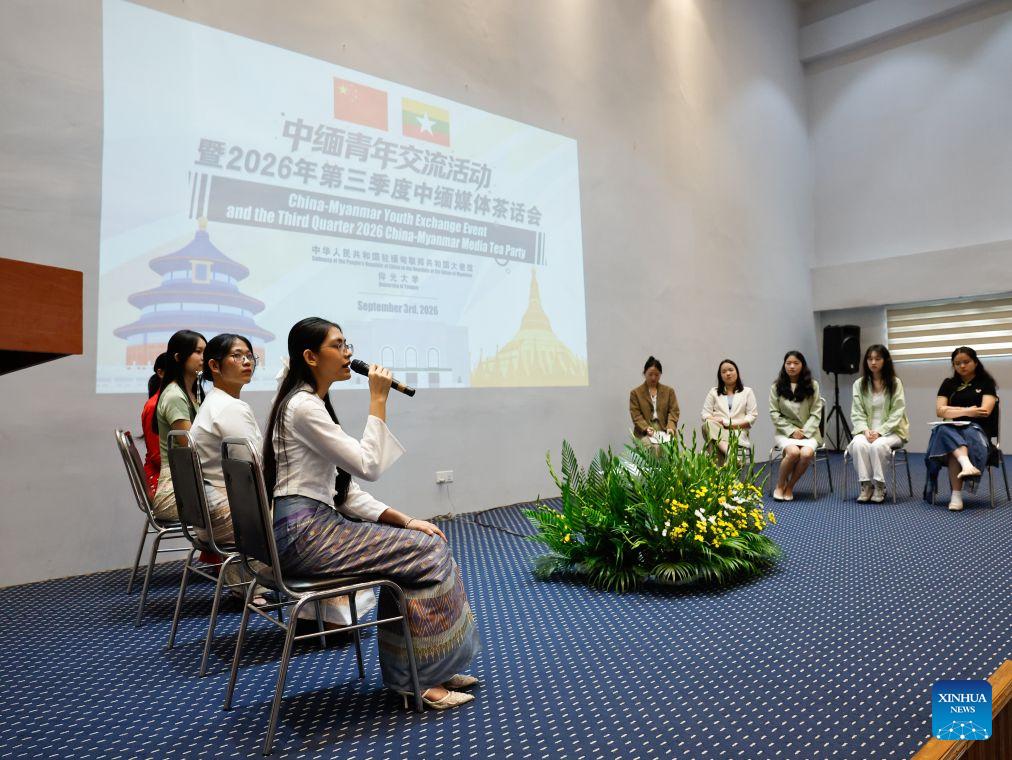
Participants attend the China-Myanmar Youth Exchange Event and China-Myanmar Media Tea Party for the third quarter of 2026 in Yangon, Myanmar, Sept. 3, 2026. Jointly hosted by the Chinese Embassy in Myanmar and Yangon University, the event gathered around 300 attendees, including diplomatic officials from the Chinese Embassy in Myanmar and representatives from nearly 40 Chinese and Myanmar media organizations, think tanks and academic institutions. (Photo: Xinhua/Myo Kyaw Soe)
YANGON, Sept. 4 (Xinhua) -- From Pu'er in southwest China's Yunnan Province to Yangon, Myanmar, the journey mirrors the historical legacy of the ancient Tea Horse Road, yet today this age-old connection lives on in small, everyday moments for Liu Changya.
"Through everyday encounters such as learning each other's language, chatting with classmates and simply spending time side-by-side, members of the post-2000 generation like us get to understand this shared history firsthand and carry forward the Paukphaw friendship," said Liu, an exchange student from Pu'er University, who is currently studying the Myanmar language at Yangon University of Foreign Languages.
The profound youth-driven inheritance of bilateral friendship was highlighted at the China-Myanmar Youth Exchange Event and China-Myanmar Media Tea Party for the third quarter of 2026, jointly hosted by the Chinese Embassy in Myanmar and Yangon University on Thursday.
Young participants stood to gain far more than improved language proficiency and enhanced career prospects. Experts at the event noted that China's advancing technological innovation and in-depth cultural exchange mechanisms have become pivotal platforms for Myanmar's younger generation to access practical development resources and innovative experiences.
Naing Swe Oo, senior advisory board member of the Myanmar Institute of Strategic and International Studies, pointed out that Chinese smart agriculture technologies and new energy solutions have become an indispensable strategic support for Myanmar's national modernization drive. He encouraged Myanmar youth to learn advanced technologies from China and promote their localized application.
Echoing the viewpoint, Thaung Htike, rector of Yangon University, said that national and international cooperation mechanisms, including Lancang-Mekong Cooperation programs, have continuously facilitated in-depth technological exchanges and practical cooperation between young people of the two countries.
Representing Myanmar's media community, Thet Mon Tun, senior editor at Swe Myo Pauk Phaw Magazine, shared her insights on China-initiated media exchange programs for Global South countries. By bringing together media workers from these countries, the event stands as one concrete symbol of China-sponsored solidarity among the Global South countries, she said.
"Paukphaw means relatives and we are relatives," Thaung Htike noted. "As kin, we understand and trust each other naturally. We are willing to share resources, deepen pragmatic cooperation, and empower younger generations to jointly drive the common development of both countries."
The event gathered around 300 attendees, including diplomatic officials from the Chinese Embassy in Myanmar and representatives from nearly 40 Chinese and Myanmar media organizations, think tanks and academic institutions.