


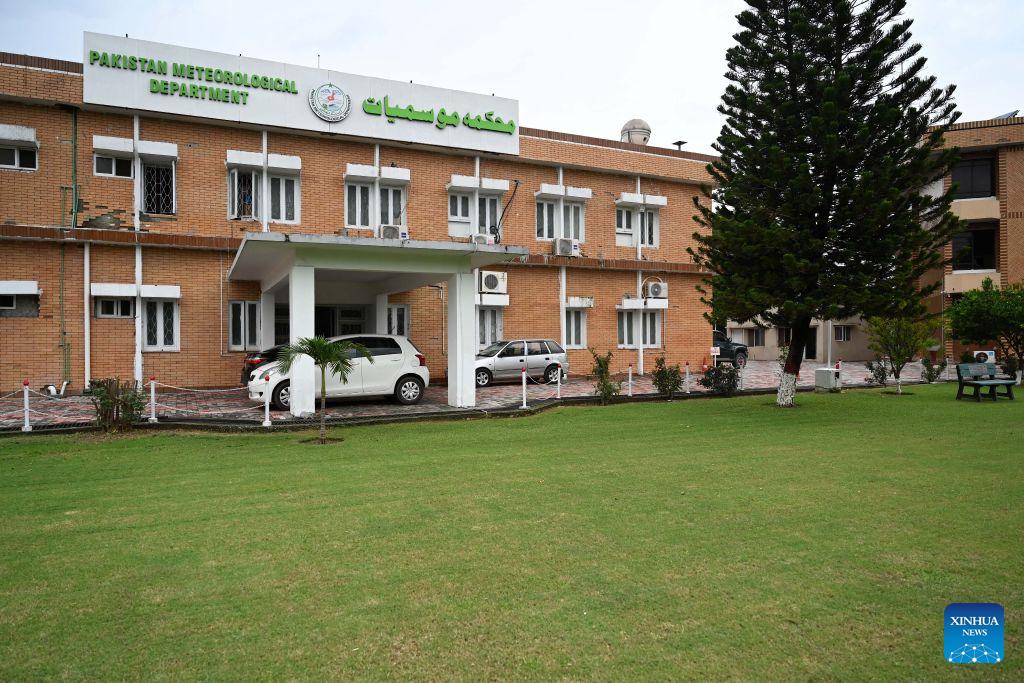
This photo taken on Aug. 17, 2026 shows the building of the Pakistan Meteorological Department (PMD) in Islamabad, Pakistan. (Photo: Xinhua/Ahmad Kamal)
ISLAMABAD, Sept. 4 (Xinhua) -- Riaz Hussain, a resident of a village in Talagang district in Pakistan's eastern Punjab province, had grown used to seeing rain damage his wheat crop year after year. But this harvest season, instead of relying on luck, he closely followed weather forecasts and advisories issued by the Pakistan Meteorological Department (PMD), adjusting his farming activities accordingly.
"I live in a rain-fed area, and after losing a lot of money during the last few years due to poor planning and getting caught by rain in the middle of reaping the crop, I saved a lot this year because I kept following the meteorological department's advisories right from the start," Hussain told Xinhua.
His good harvest has since made him a role model in the village. Other farmers are now following his example and seeking weather guidance from the meteorological department at different stages, from sowing to raising their soon-to-be-harvested peanut crop.
For Hussain, an accurate forecast meant more than just information, it helped protect his livelihood. A similar warning proved crucial for Rustom Baloch, who lives more than 1,000 miles away in Naseerabad district of southwestern Balochistan province.
Baloch received an early warning from the PMD that his home was in a flood-prone area. Acting on the alert, he evacuated his family and moved his valuable belongings to a safer place before the floodwaters arrived.
"A flash flood subsequently struck the area. Though I faced financial losses, the warning gave me valuable time to take precautionary measures and protect my family from the worsening situation," he told Xinhua.
The PMD's ability to provide timely weather alerts has been strengthened through cooperation with the China Meteorological Administration (CMA), including the use of MAZU, China's homegrown AI-powered meteorological early warning system.
"We were already doing a great job in forecasting weather, but the cooperation between the CMA and PMD has helped strengthen our forecasting and early-warning capabilities, with the MAZU system serving as an important component of this cooperation by providing an integrated platform for accessing and analyzing weather information," Furrukh Bashir, director of the Research and Development Division of the PMD, told Xinhua.
"With MAZU, observational data, numerical weather prediction models, satellite information and AI are brought together on a single platform, streamlining meteorologists' work and allowing them to produce faster, more informed forecasts and early warnings," he added.
MAZU is now helping communities in more than 40 countries, including Pakistan, one of its early recipients. Pakistani meteorologists received training at universities in China to operate the system, while Pakistani scientists also took part in its co-development. The system has been in use in Pakistan for about one and a half years.
"The MAZU system provides access to international forecasting models from different sources while also integrating information from the PMD. This gives Pakistani meteorologists a broader picture of developing weather conditions and helps them make more informed decisions regarding significant weather changes and early warnings," Bashir said.
The cooperation has also brought the two countries' meteorological communities closer through scientific exchanges, training and joint development of meteorological systems.
Talking to Xinhua about the system, Zaheer Ahmad Babar, acting director general of the PMD, said the CMA has been helping developing countries strengthen their meteorological knowledge and capabilities as part of a broader effort to improve early-warning systems.
"It is helping countries strengthen their meteorological capabilities and better understand weather patterns, enabling vulnerable communities to take preventive measures, protect lives and livelihoods, and build greater resilience against extreme weather events," Babar said.
The cooperation reflects China's efforts to share its meteorological expertise and technology with other countries and help ensure that early warnings reach communities in time, he added.
For Pakistan, where agriculture is highly dependent on weather and communities in flood-prone areas remain vulnerable to extreme events, such warnings are making a real difference. For local authorities, it can save precious time to prepare communities before conditions become dangerous. For a family living in a flood-prone area, it can mean having enough time to leave home and move to safety. For a farmer, a timely forecast can mean delaying harvest until dangerous weather passes.