


The Center for a New American Security (CNAS) has just released a highly inflammatory report that openly discusses "extreme measures," including military strikes on Chinese data centers, to stop China from being first to achieve artificial general intelligence (AGI). It even floats the idea of a "preemptive strike." Talk of using armed force against civilian infrastructure is indistinguishable from terrorism. That such rhetoric can circulate so openly in Washington is startling.
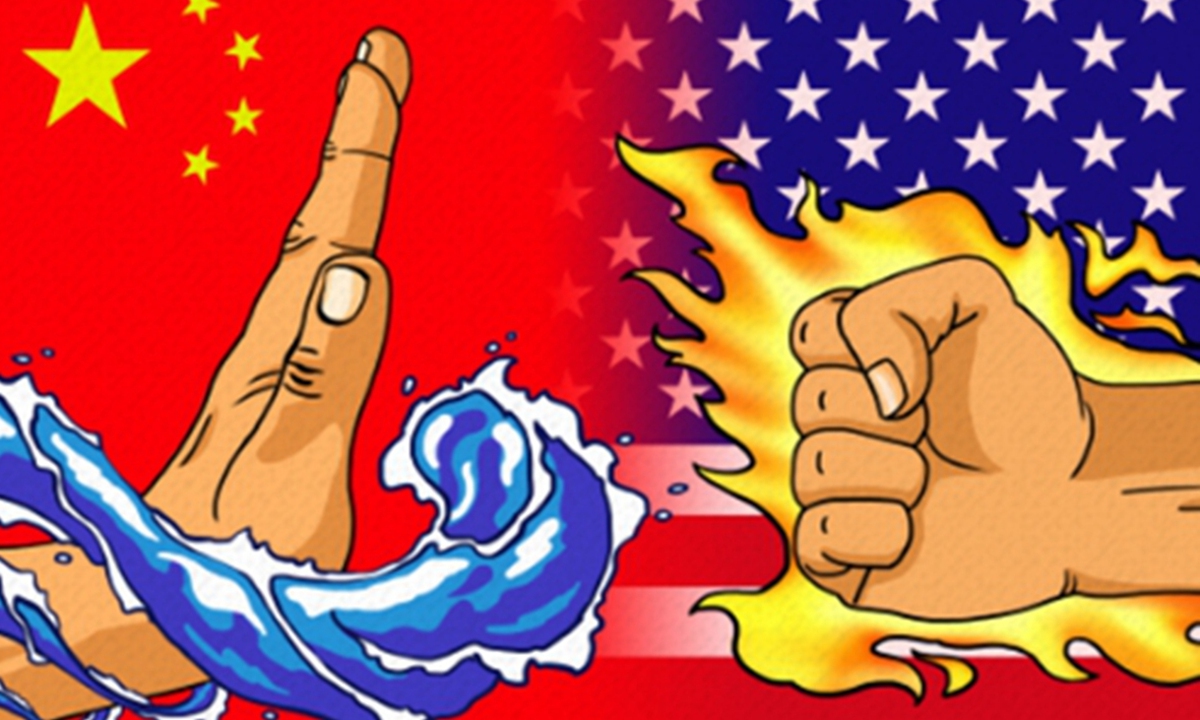
China US Illustration: Liu Rui/GT
More worrying is how close this report sits to official Washington. CNAS was founded in 2007 by figures including Kurt Campbell, later the White House coordinator for Indo-Pacific affairs, and has long advised the US government on defense, the "Indo-Pacific Strategy," and China policy. The report's lead author, Jacob Stokes, deputy director of CNAS's Indo-Pacific Security Program and a former White House official, has drawn media attention for that résumé. Speaking on the report on Thursday local time, he said the task was to "work backwards from the science to the policy implications" - a frank admission that "policy impact" was the point from the start. It is not unthinkable that some of these extreme ideas could later pass through the revolving door into official policy.
China and the US are nuclear powers. What it means to advocate "military strikes on Chinese data centers" needs no elaboration. Stokes himself conceded that such options could create severe geopolitical tensions and raises the danger of military escalation. Analysts inside the US have already warned that attacking Chinese data centers would be a wager on a shooting war between two nuclear-armed states. China will not let this fantasy succeed.
The report is evidence of something larger: technology containment of China has slipped from a contest over rules into fantasies of force. It is an attempt to keep political space open for the most dangerous option - an extreme distortion of US' tech-hegemony mindset, and a preview of how terrifying US tech pressure on China could become if it pushes to the limit. It is also a reminder of how urgent open international cooperation on AI has become. Once any country's supercomputers, chip plants, power grids, or communications hubs can be labeled a "strategic threat," the global digital order will face collapse.
Washington itself should be wary of the people and think tanks whose minds have been warped by Cold War fantasy - those who wrap delirium in the language of research and peddle it around the policy community. We note that mainstream US media have largely looked the other way. That silence amounts to indulging and feeding war fever. They pounce whenever China is said to have used "harsh language." Why, then, do the most extreme voices at home become a blind spot?