


US envoys seek to revive Russia-Ukraine talks; Chinese experts note all parties increasingly aware of rising political costs, broader damage as conflict drags on
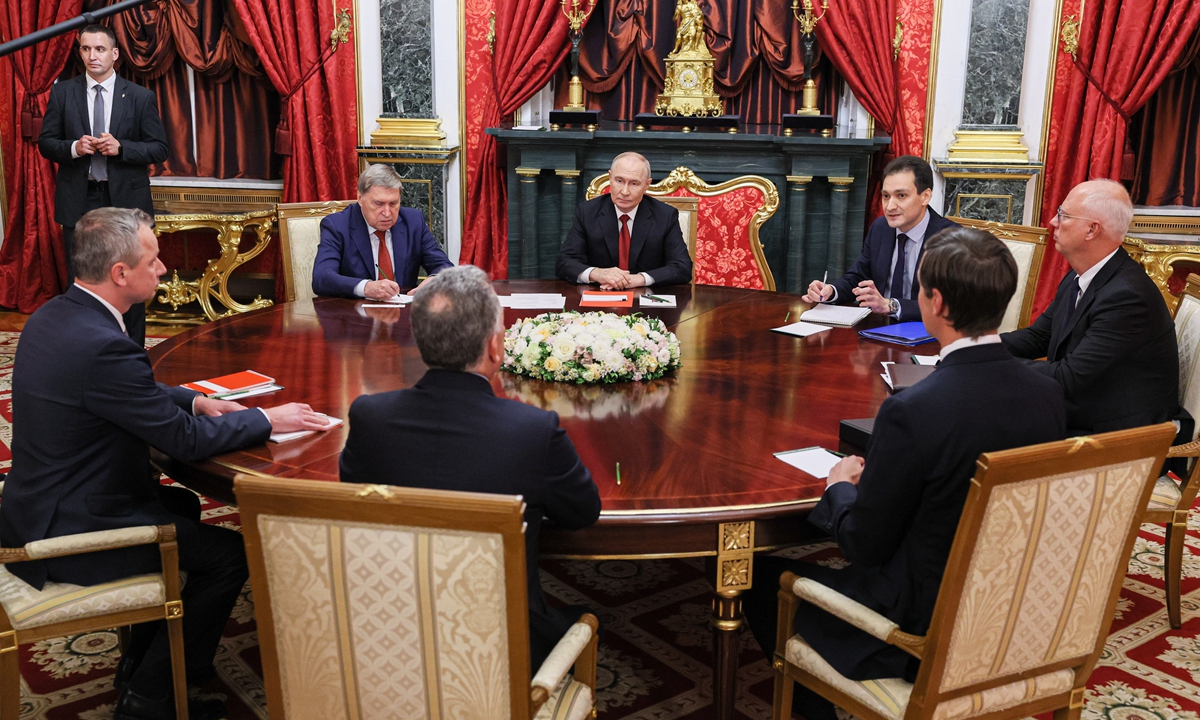
Russia's President Vladimir Putin, US businessman Jared Kushner and US Special Presidential Envoy Steve Witkoff are seen during a meeting at the Moscow Kremlin on September 5, 2026. (Photo: VCG)
Russian President Vladimir Putin held more than three hours of "highly useful" talks on Saturday with two US envoys seeking a deal to end the Ukraine war, Reuters reported, citing a Kremlin aide who, however, gave no indication of any breakthrough. Some Chinese experts said on Sunday that the main objectives of the US envoys' visits to Moscow and Kiev remain to mitigate the risk of the conflict spilling over.
The stalemate on the Russia-Ukraine battlefield is likely to persist for some time, while "fighting while negotiating" could also become the new normal, they noted.
During the meeting between Putin and two US envoy - Steve Witkoff and Jared Kushner, Putin told that Russia was making "real progress" on the battlefield, was confident of achieving its goals, and stressed the necessity of addressing "all the root causes of the conflict," Yuri Ushakov, the Kremlin aide said, according to Reuters.
The two US envoys also outlined a number of ideas regarding possible avenues for a settlement, Reuters said.
The US envoys were scheduled to visit Kiev on Sunday, which would be their first visit to Ukrainian capital since the conflict began, according to some US media reports.
Russia and Ukraine vowed not to strike each other's capitals for three days during the negotiations, as Washington tries to revive US-led talks to end the Russia-Ukraine conflict, the Guardian said.
The visit came as US President Donald Trump suggested on Friday a new proposal to end the war, without providing any details on what his new plan might be, the Guardian noted. The US President made ending the war a priority early in his second term, but little has changed so far, the media report said.
"Since January, Washington shifted much of its attention to the Middle East, and the Russia-Ukraine peace process was effectively put on hold. But as the war has dragged on, all sides have become increasingly aware of the political costs and broader damage caused by the conflict," Zhang Hong, a research fellow at the Institute of Russian, Eastern European and Central Asian Studies at the Chinese Academy of Social Sciences, told the Global Times on Sunday.
"There is also growing concern about the risk of the conflict spilling over. I believe CIA Director John Ratcliffe's recent visit to Moscow was driven largely by these concerns," Zhang said, noting that if the US continues to stay on the sidelines while remaining focused on the Middle East, the Russia-Ukraine conflict could eventually trigger greater security friction between Russia and Europe, potentially creating risks for NATO's collective security.
"That is perhaps why Washington has to re-engage and push to get the Russia-Ukraine peace process moving again," the Chinese expert said.
CIA Director John Ratcliffe recently made a so-called surprise visit to Moscow to deliver a message to Russia not to attack NATO countries, the Wall Street Journal (WSJ) reported on August 26.
Reuters report said "a vast gulf remains between Russia and Ukraine on how to end the war."
The Al Jazeera, citing some analysts, said the "expectation in the Kremlin for this particular visit of the US envoys is actually less pessimistic, because previous trips by Witkoff and Kushner have not led to any progress, and Putin believes that Russia holds a military advantage on the battlefield."
Some Chinese analysts pointed out that the battlefield has essentially settled into a new balance recently, as although the US has significantly reduced its military assistance to Ukraine this year, European countries have stepped up their support, while defense cooperation between Europe and Ukraine has become increasingly institutionalized and long-term.
"That has helped sustain Ukraine's ability to fight and, in turn, contributed to the continued stalemate on the battlefield," Zhao Huirong, an Eastern European studies expert from the Chinese Academy of Social Sciences, told the Global Times on Sunday.
Meanwhile, neither Russia nor Ukraine has lost its willingness or ability to fight. As long as both sides believe they can continue the war, neither has much incentive to make major concessions at this stage, Zhao noted.
Some US media like the New York Times (NYT) noted that the Russia-Ukraine conflict appears "far away from any resolution."
Speaking on Friday, Dmitri S. Peskov, the Kremlin's spokesman, praised "the good will of the Americans" who, he said, "are ready to continue their mediation efforts." But he said Russia would keep insisting that Ukraine withdraw troops from the eastern Donetsk and Luhansk regions before any cease-fire could occur — a demand that Ukraine has rejected, the NYT reported.
Other major obstacle to the peace talk is that the core issues in dispute such as territory, NATO membership and security guarantee, go directly to the fundamental interests of both countries, Zhao said, noting that that makes compromise extremely difficult.
"So far, the signals from both Moscow and Kiev remain very firm, with neither side showing any fundamental change in its objectives or position on the conflict," she said.
"At this point, it is difficult to see what fundamentally new proposal the US can put on the table. The problem is that we are dealing with a deadlock rooted in structural contradictions. And structural contradictions are extremely difficult to resolve through a single round of talks," Zhang added.