


The US-Venezuela oil deal: neo-Monroe Doctrine in action
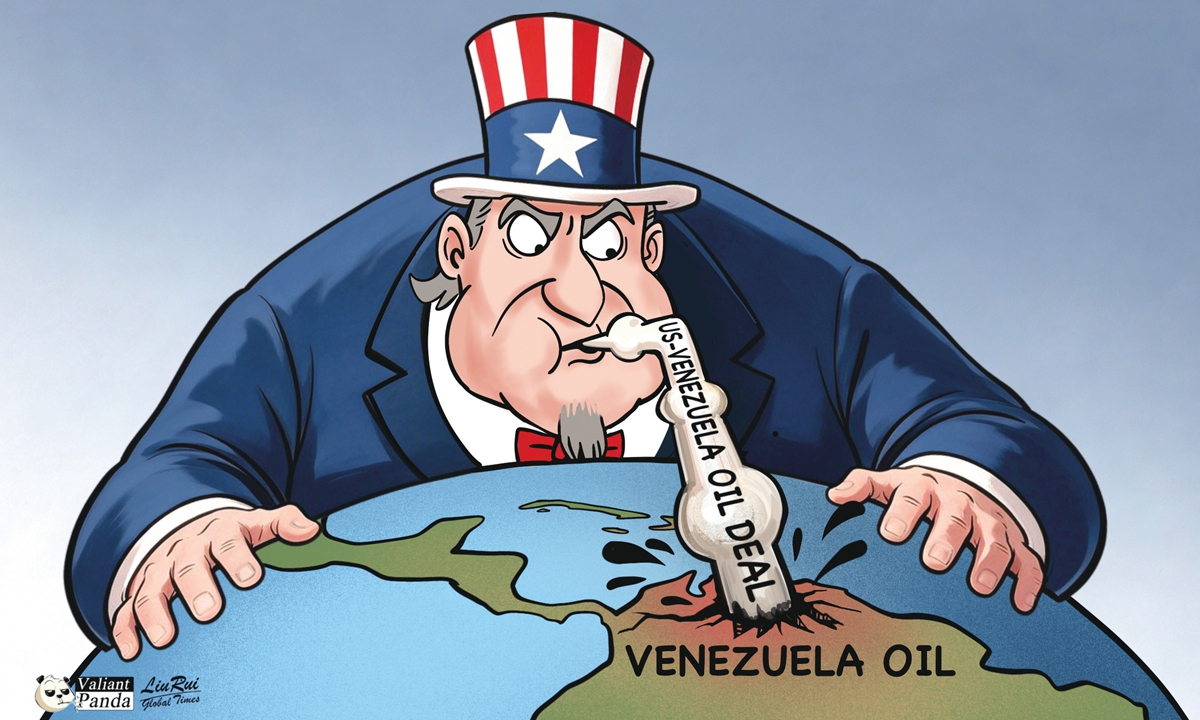
US Venezuela oil deal. Illustration: Liu Rui/GT
Almost nine months after the US deposed Venezuelan leader Nicolas Maduro, it struck a deal with Venezuela that would give the US a key role in the oil industry of Venezuela. The deal grants the US government majority control over 65 billion barrels of proven oil reserves in Venezuela. This represents more than 20 percent of the country's proven oil reserves.
The White House presented the agreement as "the biggest oil deal in world history" because, according to sources, it secures the US' energy dominance for the next century. The White House did not even hide to speak of the deal having "re-established the Monroe Doctrine," a 19th-century principle exerting US power across South America.
The agreement focuses on the US-backed North American Blue Energy Partners (NABEP), Venezuela's second-largest private oil company after Chevron. Headquartered in Barbados, NABEP has been granted 100-year concessions for 17 oil fields with proven reserves of approximately 65 billion barrels. NABEP has transferred 35 percent of its equity stake to the Office of Strategic Capital within the US Department of War. The US State Department has the right to purchase 20 percent of oil output at production cost and the right of first refusal on the remaining production.
NABEP states that it will invest up to $100 billion in new oil infrastructure in Venezuela. This would yield about $209 billion in royalties and taxes over its course at a $65 reference price, an estimate of roughly $200 billion over 25 years.
It should be noted that, should any tax revenue be collected under the NABEP agreement, such revenue may not be used by the Venezuelan government. This is because the US' Executive Order 14,373 went into effect on January 9, 2026. Under the order, the US Treasury assumes the role of custodian of Venezuelan oil revenues, arguing that control over them is necessary for both Venezuela's stability and US security. The US Treasury also reserves the right to decide their final use. In other words, by means of an executive order, a country can be stripped of its wealth and its income, and in Venezuela's case, of more than 90 percent of its foreign exchange earnings.
In fact, in the first half of the year alone, the US sold more than $13 billion worth of Venezuelan oil, of which the Venezuelan government received only $300 million.
In short, this measure not only jeopardizes the Venezuelan state's ability to function in the face of an imminent shortage of fiscal resources but also compromises national sovereignty to an extent unprecedented in Venezuela's republican history. In practice, it entails the surrender of strategic reserves, the transfer of control over oil revenues and the handing over of these funds to the US Treasury, all without an institutional counterweight to safeguard the interests of Venezuela and its people.
Former Venezuelan oil minister Rafael Ramírez questioned the agreement, explaining that the projected $200 billion in revenue represents a royalty rate of just 3.7 percent. This means the actual revenue will be $3.35 per barrel, with investments ranging from $15 to $20. Ramírez noted that this figure is lower than that obtained during the Juan Vicente Gómez era (1908-35) and is drastically lower than the revenue achieved during his tenure.
This agreement undoubtedly marks a shift in Venezuelan oil policy. Throughout the 21st century, Venezuela pursued a strategy of market diversification toward Asia. This strategy involved reversing the privatization of the oil industry, promoting the international defense of oil prices and strengthening OPEC. The goal was to reduce medium- and long-term trade dependence on the US government and its companies.
However, since 2014, the Venezuelan energy sector has been subject to a systematic regime of US sanctions that have limited its production and export capacity, plunging the Venezuelan oil industry into a structural crisis.
Simply put, the US announces the largest oil deal in history in an attempt to alleviate the domestic fuel crisis, ignoring the technical characteristics of Venezuelan oil and setting a production timeline of two to three years. The agreement is not merely an oil deal, but a direct intervention in Venezuela's domestic politics. This is the neo-Monroe Doctrine in action: treating the Western Hemisphere as its private backyard, Latin American oil as its strategic reserve, and Venezuelan sovereignty as a mere footnote in a US Treasury spreadsheet.
The author is director at the Venezuelan Center of Studies on China. opinion@globaltimes.com.cn