


US‑Israel strikes against Iran have systematically undermined human rights
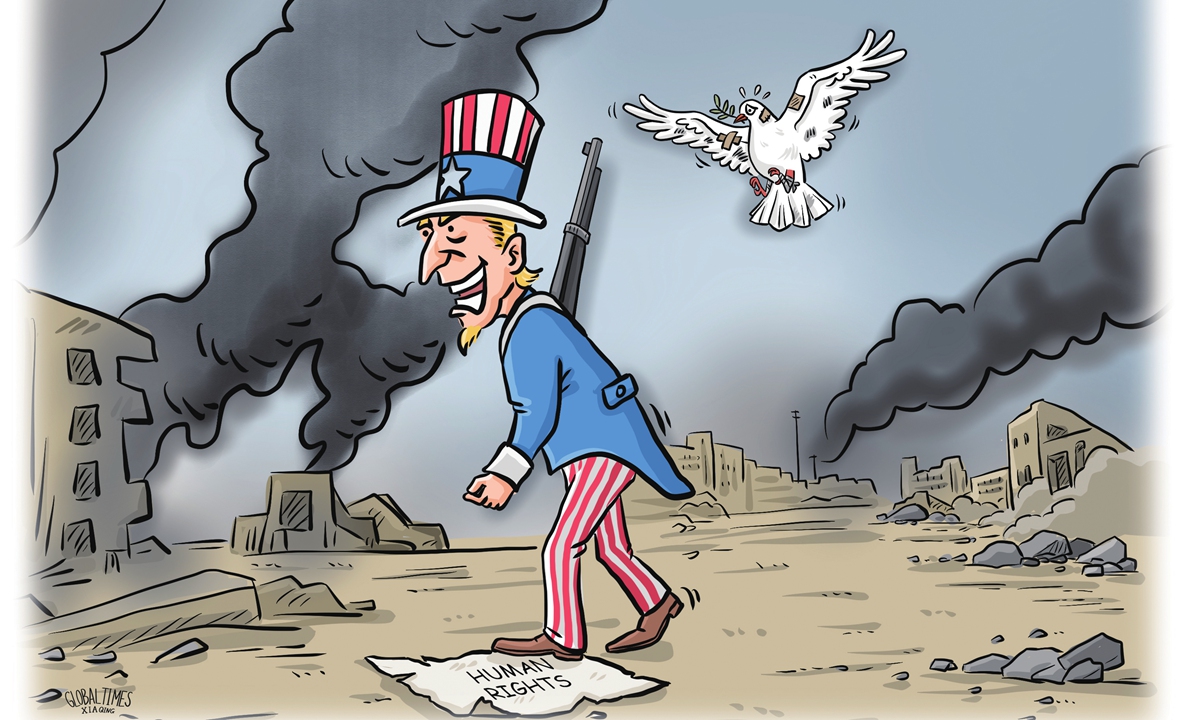
US-Israel strikes against Iran Illustration: Xia Qing/GT
In February 2026, the US and Israel launched large-scale joint military strikes against Iran. This blatant military operation, conducted without authorization from the UN Security Council, drew strong condemnation from the international community. The fighting has ebbed and flowed, and negotiations have been fraught with setbacks. After more than half a year of conflict, reportedly over 3,750 Iranian civilians have been killed and more than 33,000 wounded; regional countries have also suffered collateral damage, and strategic corridors have been repeatedly blocked. UN Secretary-General António Guterres lamented that the war is inflicting immense human suffering.
One may well ask: How can the US - which has long styled itself as a "beacon of human rights" and frequently used human rights as a pretext to criticize other nations - so flagrantly trample on the human rights of the Iranian people? Here are some shocking facts.
Attacking civilians, killing women and children - violations of the right to life. Women and children are the most vulnerable in war, and they pay the heaviest price. UN data show that among Iranian civilian casualties, approximately 500 are women and over 2,500 are children. Just recently, a heavy bomb dropped by US forces on July 30 over a civilian residential area in southern Iran hit a family of five, instantly killing a couple and their two-year-old child. On the very day the US-Israel forces started their airstrikes, a missile struck a girls' elementary school, killing all 168 students - a tragedy that shocked the world.
Carrying out assassinations and attempting regime change - violations of the right to self-determination. The Universal Declaration of Human Rights states that the will of the people shall be the basis of the authority of government. A nation's future and destiny can only be decided by that nation itself; bombs and threats can never replace the choice of the people. The US and Israel have carried out successive "decapitation" strikes against Iran's supreme leader and other senior political and military officials. This is a classic case of extrajudicial execution. Even UN human rights experts, who have long been critical of Iran's human rights record, have clearly stated that international law does not accept extrajudicial "justice," and have urged the US to respect the Iranian people's right to self-determination.
Destroying homes and turning people into refugees - violations of economic, social and cultural rights, and the right to development. According to reports, the US-Israel military operations have so far destroyed over 125,000 civilian facilities in Iran, including 339 hospitals, 857 schools and 32 universities. Since the latest escalation of the Middle East crisis, over 4.1 million people in countries such as Iran and Lebanon have become displaced, and about 117,000 have fled to other countries seeking asylum. War is tearing families apart and creating an unprecedented humanitarian crisis. Homes may be rebuilt, but lost lives, shattered childhoods and missed educational opportunities cannot be recovered.
Poisoning the air and cutting off water supplies - violations of environmental and health rights. As multiple oil depots in Iran were hit and set ablaze, toxic pollutants were released into the air, even causing toxic rain in some places. This has led to breathing difficulties and illness or disability among local residents. In a separate incident, US forces struck a desalination plant on Qeshm Island, affecting the water supply to 30 villages. The World Health Organization has issued warnings that "black rain" and acid rain pose a real danger to the Iranian people. The environmental damage caused by just a few months of war may take decades to repair.
Damaging cultural heritage and desecrating religious sites - violations of freedom of belief and cultural rights. Persian civilization is a shared treasure of humanity. However, US and Israeli bombing has already damaged at least 149 historical landmarks and museums across 20 Iranian provinces, including five UNESCO World Heritage sites. UNESCO has expressed deep concern and called for all necessary measures to protect both people and cultural heritage sites. As Iranian Deputy Foreign Minister Kazem Gharibabadi pointed out, "Iran's cultural heritage is not merely the national asset of Iranians; it is part of the shared memory of humanity." Destroying cultural heritage means destroying the collective memory of humankind - it is cultural genocide.
The use of force by the US and Israel against Iran shows the world that the international rule of law is taking the heaviest blow, that human rights and humanitarian principles are being most deeply trampled on, and that the moral decay of US "neo-imperialism" is being most starkly exposed. The military operations have not only ruthlessly stripped the Iranian people of their basic human rights, but also pushed the entire Middle East toward a humanitarian abyss, shaking the very foundation of world peace. Every bomb dropped on schools, hospitals, residential neighborhoods and millennia‑old monuments is a heavy blow to human rights values and the bottom line of humanity.
Without peace, human rights are just empty words. Only by upholding peaceful dialogue and abandoning the obsession with the use of force, by adhering to multilateralism and rejecting unilateralism and hegemonism, can we save lives from the terror of war and prevent civilization from being swallowed by the flames of conflict. This is the enduring pursuit of the international human rights cause and the deepest aspiration of humanity as we work to build a community with a shared future.