


China-Africa cooperation experience a living laboratory
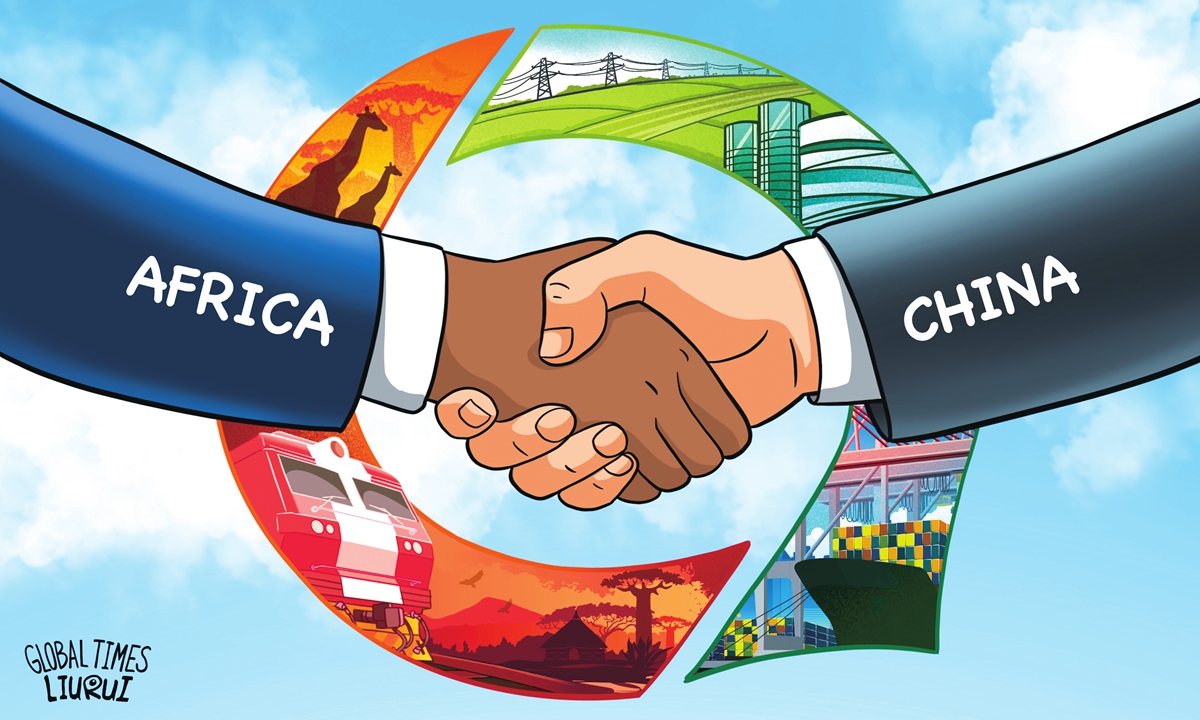
Closer cooperation. (Illustration: Liu Rui/GT)
As more African countries join BRICS, the China-Africa partnership stands out as a practical South-South framework. Two elements deserve close attention as the grouping seeks deeper economic integration: China's zero-tariff treatment for African countries with diplomatic ties with China and the growing network of special economic zones (SEZs) that are quietly advancing industrialization.
China's zero-tariff program, effective May 1, 2026, is the first time a major economy has removed import duties across almost the entire continent. The two-year measure aims to create new opportunities for Africa to boost exports and industrialization amid the global headwinds of protectionism. Early results are clear. In the first two months, China's imports from Africa reached a record $29 billion - up from $23 billion in the same window of 2025 and higher than any of the preceding five years.
Yet tariff removal alone cannot close a structural gap. The full-year 2025 deficit hit a record $102 billion. Africa still ships mostly primary commodities while importing higher-value manufactures. Removing the toll booth does not change what is inside the truck. From my years as secretary general of the Ethiopian Chamber of Commerce and earlier as head of the Textile and Garment Manufacturers' Association, I saw this daily: Factories struggled not only with duties but with power shortages, logistics bottlenecks and limited product upgrading. Tariff relief is welcome; infrastructure and skills are decisive.
This is where SEZs matter. Chinese firms have helped build or operate zones in Ethiopia, Nigeria, Zambia, Djibouti, Kenya, Mauritius, Egypt and beyond. In Ethiopia alone - where dozens of public and private zones now operate - China has acted as financier, developer and operator. The Eastern Industrial Zone and Bole Lemi, subjects of my own master's thesis and PhD research at Peking University, illustrate both progress and hard lessons. Textiles and garments took root; copper processing advanced in Zambia's Chambishi zone; Mauritius Jinfei moved into machinery and higher-tech lines. By 2023, Africa hosted more than 230 zones across 43 countries. Not all are Chinese-linked, yet China's early financing and model transfer catalyzed the concept itself.
The model is evolving. Ethiopia's 2024 formal shift from "industrial parks" to a broader SEZ framework reflected lessons on the ground. In 2025, the Democratic Republic of Congo launched the 900-hectare Musompo SEZ in Lualaba Province, focused on battery and electric-vehicle value chains rather than raw cobalt. That step is the trajectory African economies need. Data showed that nearly one-third of more than 10,000 Chinese firms in Africa were in manufacturing and accounted for over 12 percent of the continent's industrial output. Most were private, mid-sized enterprises serving African consumers rather than pure export platforms. During my time as state minister for planning and development, I watched this private-sector shift gather pace; it is more sustainable than earlier state-led experiments.
Together, zero tariffs and SEZs function as twin engines. Market access creates incentives to upgrade quality and scale. Zones supply the power, logistics and regulatory predictability that make upgrading possible. China's state-backed instruments, including the China-Africa Development Fund, have helped provide the long-horizon capital that commercial banks often withhold. Private Chinese manufacturers in places such as the Eastern Industrial Park and George Shoe Industrial Park now demonstrate commercial viability rather than mere political symbolism.
Three transferable lessons emerge for BRICS+. First, market access outweighs aid volume; it turns recipients into competitors. Second, industrial infrastructure demands patient financing for power, transport and clear rules - precisely the package China has delivered in successive FOCAC (Forum on China-Africa Cooperation) cycles. Third, private-sector participation decides longevity. The move from state-owned dominance toward privately driven manufacturing is the clearest sign of maturity.
As leaders gather in New Delhi, Africa's projected population of 2.5 billion by 2050 and its expanding consumer market make the stakes plain. The African Continental Free Trade Area under Agenda 2063 opens space for complementary contributions from all BRICS+ partners.
Having spent years linking Ethiopian private-sector bodies with Chinese counterparts, advising on cross-border investment and studying industrial-park performance at Peking University, I see the China-Africa experience less as a finished template than as a living laboratory. Scale, institutional depth and a willingness to learn from both success and setbacks are already present. The demand is large; the opportunity is shared.