


Five years of GDI: How BRICS is turning global development commitments into practice
For some families in South Africa, access to clean, safe drinking water is far from a given.
In six local municipalities in South Africa's North West and Limpopo provinces, people face severe water shortages, as current demand outstrips supply by more than 40 percent.
To help address the problem, the New Development Bank (NDB), which acts as the financial arm created by the BRICS nations to fund infrastructure and sustainable development projects, has approved $205 million to extend pipeline networks, enhance the capacity of existing pipelines, and expand water treatment facilities to provide sustainable access to drinking water for two million people in the region.
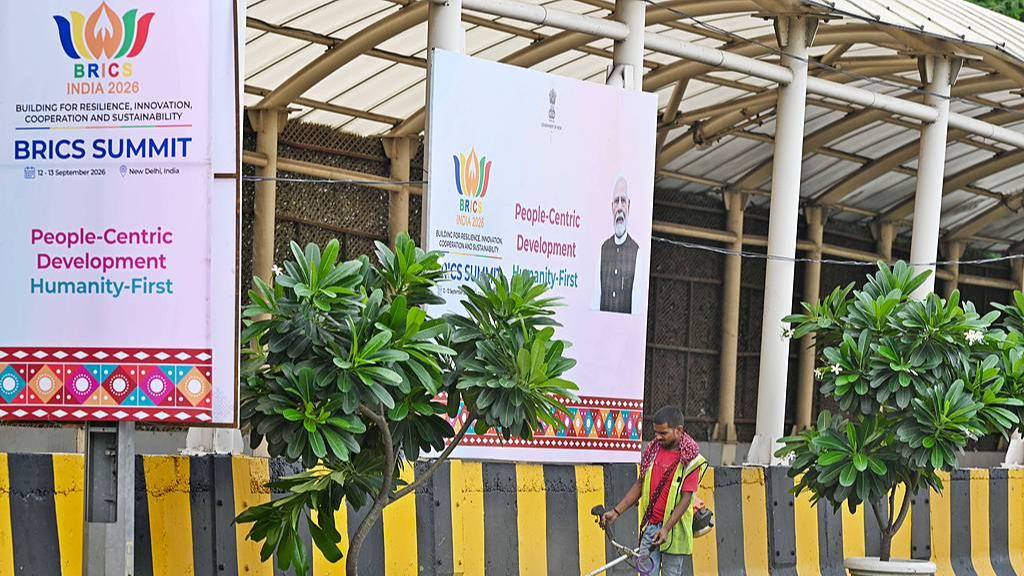
A worker carries out preparation work near Bharat Mandapam, where the upcoming BRICS Summit will be held in New Delhi, India, September 6, 2026. (Photos: VCG)
But solving the water shortage problem is not just about meeting people's basic needs. It also lays the groundwork for the country's future development, as clean water is a crucial prerequisite for public health, agricultural and industrial development, and long-term economic activity.
From water supply projects in South Africa to projects that support other countries' transition to clean energy, transport infrastructure, and beyond, the NDB demonstrates its commitment to fostering the development of BRICS member countries, who will soon convene at the 18th BRICS Summit in New Delhi, India.
GDI: From global vision to local action
By addressing basic needs and supporting the long-term socioeconomic development of local people, the NDB and other multilateral collaboration mechanisms closely align with the Global Development Initiative (GDI) proposed by Chinese President Xi Jinping in 2021.
In his address at the General Debate of the 76th Session of the United Nations General Assembly in September 2021, Xi put forward the GDI against the background of uneven development, growing global uncertainty and delayed implementation of the United Nations 2030 Agenda for Sustainable Development.
Since its establishment, the GDI has led a new wave of global efforts that put development first. In the past five years, the initiative has mobilized over $23 billion and supported more than 1,800 grassroots projects across 120 nations, directly improving local livelihoods.
Beyond promoting global growth, the GDI also represents a paradigmatic shift away from a flawed framework.
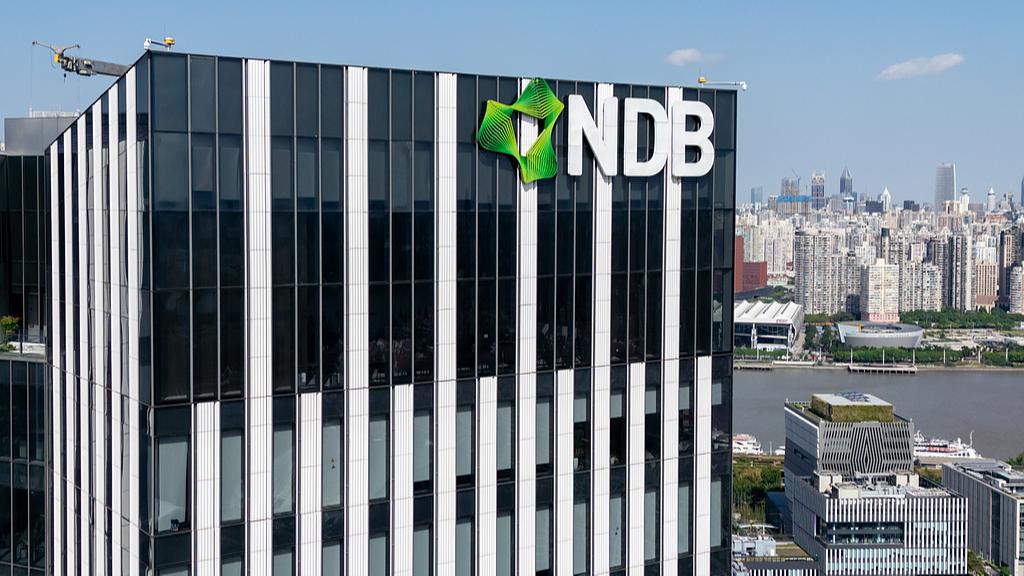
The New Development Bank headquarters in Shanghai, China.
Joseph Olivier Mendo'o, head of the African Youth Delegation in China, noted in a commentary that "the core flaw hobbling the 2030 Agenda over the past decade is its one-size-fits-all, donor-centric implementation logic, which prioritizes short-term charity over long-term self-sufficiency and sidelines Global South voices in global economic governance. "
The GDI is different. It stresses long-term development and sharing growth benefits, regardless of a country's size or level of development.
By prioritizing development that improves national self-reliance and respect for sovereign equality, the GDI differs in that it "not only provides financial support and technological empowerment but also establishes a pragmatic platform for sharing experience and building capacity," Amakobe Sande, the UNICEF Representative to China, said in an interview.
In other words, development guided by the GDI is not about applying a quick-fix bandage to a complex problem. It aims to treat the underlying cause to prepare each country for further prosperity.
BRICS turns the GDI into practice
BRICS' focus on the development of the Global South makes it a natural platform to turn the GDI commitment into practice.
Since its establishment in 2014, the NDB, a flagship BRICS program, has approved $42.9 billion in funding across 139 projects. Official figures show that once completed, these initiatives will construct 35,000 housing units, build or upgrade over 1,400 kilometers of water infrastructure, and cut carbon dioxide emissions by 14.7 million tonnes annually.
Covering every key aspect of global welfare, NDB-funded projects include clean energy, transport infrastructure, water and sanitation, environmental protection, social infrastructure, and digital infrastructure.
For instance, in India, the Kohima Town Water Supply Augmentation Project is advancing plans to deliver clean water to the locals. According to the latest reports by the local government, the initiative will tap the Teupuiki/Dzupfu River to build raw water transmission lines, citywide distribution networks, and a 22 million liters per day (MLD) water treatment plant in Khonoma village.
This year, the NDB also funded the first Smart Public Hospital in Sao Paulo, Brazil. Backed by a $320 million investment, the project will build a 120,000-square-meter facility with 250 emergency beds, 350 ICU beds, and 25 operating rooms. The hospital, which is expected to open as early as 2029, will immediately alleviate medical resource shortages in Brazil.
At its core, the GDI and the NDB share the same vision: to prioritize development. As BRICS now expands to include 11 members, representing 40% of global GDP, the impact of development for BRICS countries is set to radiate well beyond the Global South.