


Iran says talks with Oman on Hormuz Strait reach final stage
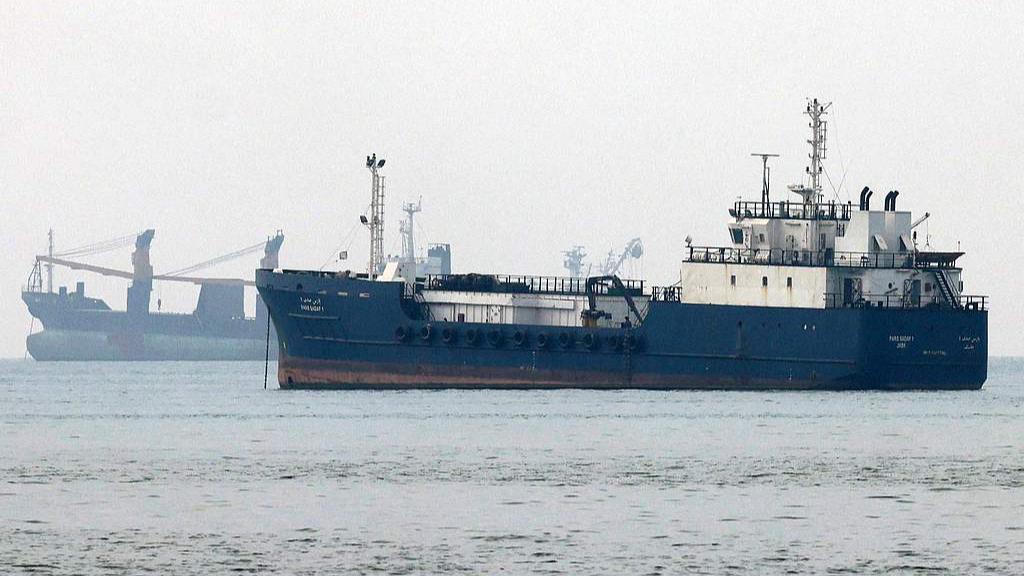
Vessels transit the Hormuz Strait off the coast of Iran's southern port city of Bandar Abbas, September 7, 2026. (Photo: VCG)
Iranian Foreign Ministry spokesman Esmaeil Baghaei said on Monday that Iran-Oman negotiations on the designation of a temporary route for safe passage through the Strait of Hormuz have reached their final stage.
The understanding between the two countries regarding the route's designation would likely be registered with the International Maritime Organization in the coming days, Baghaei said at a weekly press conference in Tehran.
The insecurity in the waterway is a consequence of the US-Israeli "military aggression" against Iran, he said, noting that "vessels will not be able to travel this route with confidence and a sense of security as long as this situation continues."
Responding to a question about a Sunday visit by a Qatari delegation to Iran, Baghaei said it took place as part of Qatar's efforts to de-escalate tensions in the region.
He said contacts between Iran and certain other regional countries that have long been trying to help reduce tensions "is an ongoing process."
In a joint statement late last month, Iran and Oman announced they had exchanged views on a proposed phased framework that includes establishing a temporary joint shipping corridor in the Strait of Hormuz and an agreement to implement a joint project to demine the waterway.
Technical talks between the two countries will continue to address the designation of a permanent shipping corridor, the future administration of the strait, and a mechanism for information exchange, traffic management and security arrangements in the waterway, the statement added.
Meanwhile, tensions surrounding the Strait of Hormuz continue to escalate, with diplomatic efforts to secure maritime passage unfolding alongside growing military confrontation and economic disruptions. Here are the latest developments:
Iran warns South Korea against military involvement in Hormuz Strait
Iranian Foreign Ministry spokesman Esmaeil Baghaei on Monday warned South Korea against maintaining a military presence or participating in operations in the Strait of Hormuz.
Baghaei issued the warning in a post on X after Seoul said on Friday that it was reviewing options, including military measures, to support "freedom of navigation" in the Strait of Hormuz.
He said that the relationship between Iran and South Korea has a history spanning more than 64 years, and that bilateral ties have consistently developed on the basis of mutual respect while Iran attaches great importance to its friendly relations with South Korea.
He noted that the Iranian people were currently defending themselves against US "aggressive actions."
"At a time when the Iranian people are resolutely responding to America's war crimes against women and children, any other country maintaining a military presence or participating in operations in the Persian Gulf and the Strait of Hormuz can only be regarded as directly supporting the perpetrators of the aggression, and it will lead to serious consequences," he said.
In another post on X early Monday, Baghaei said the Strait of Hormuz had been "wide open" until February 28, when the United States and Israel attacked Iran.
He said Washington had "unleashed an unlawful and savage war on the region and disrupted the normal flow of commercial shipping," with tankers halted, trade disrupted and energy prices soaring.
Iranian Deputy Economy Minister Morteza Zamanian said on Sunday that the country's Economy Ministry has set up an "economic war" command center to coordinate and speed up efforts to address economic challenges arising from the conflict.
The center will initially concentrate on issues affecting businesses, trade and financing that fall within the ministry's remit, while drawing on government economic agencies to coordinate responses across different departments, he added.
US says it has redirected 94 vessels amid naval blockade of Iran
US forces have redirected 94 vessels since the resumption of the naval blockade of Iranian ports, US Central Command (CENTCOM) reported.
"As of September 7, CENTCOM forces have redirected 94 commercial vessels, disabled 3 and boarded 2," the command stated on X.
The US military "permanently disabled" the IRGC crude oil carriers M/T Downy off the coast of Kharg Island and M/T Stark 1 near Jask, and "completely destroyed" the unladen crude oil carrier M/T Kylo in the Gulf of Oman, according to CENTCOM.
The statement noted that the Kylo was struck at multiple critical locations to render it inoperable after its crew was directed to abandon ship.
CENTCOM also reported that Iran's Islamic Revolutionary Guard Corps (IRGC) fired ballistic missiles towards two US Navy warships patrolling regional waters, adding that no American personnel were harmed.