


Can the EU get rid of 'double illusion' in its green transition?
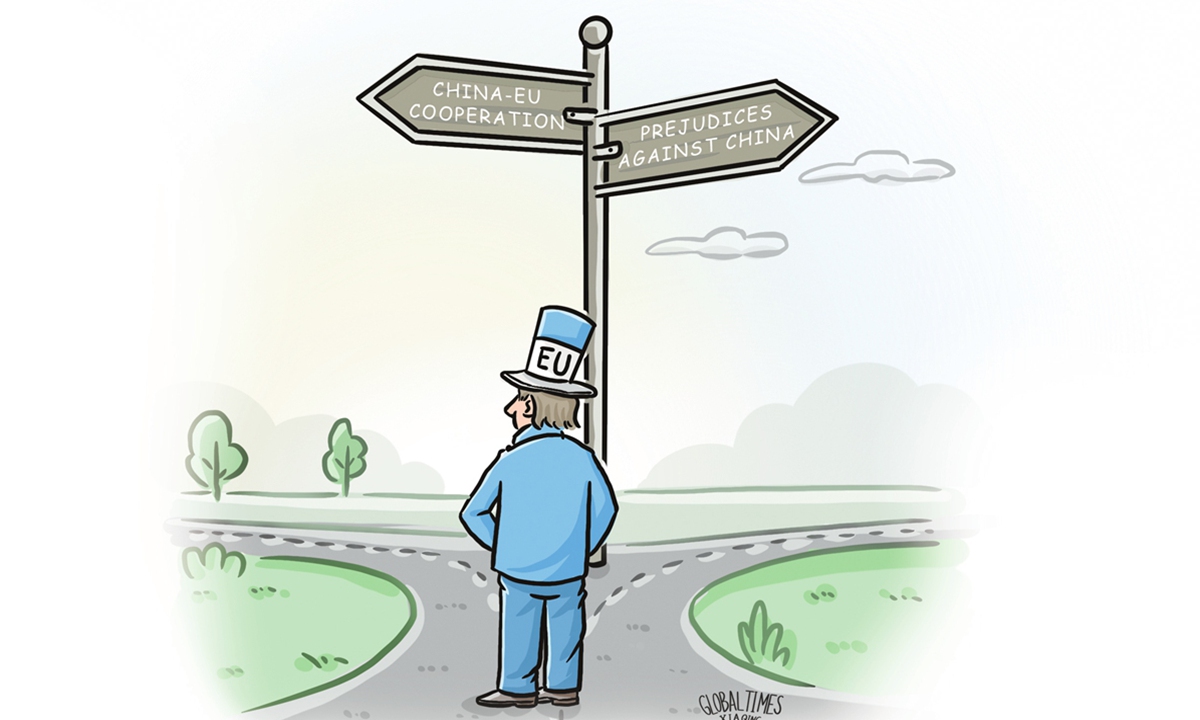
Illustration: Xia Qing/GT
EU Climate Action Commissioner Wopke Hoekstra recently said in an interview that Europe must accept higher short-term costs to "reduce its dependence on China for clean-energy technologies," describing the current situation as a "dangerous and uncomfortable" vulnerability. While such remarks might catch the eye, they fail to address a fundamental logical dilemma: Europe needs China to accelerate its green transition, yet simultaneously seeks to shut China out of its industrial development. The two objectives of being a "climate pioneer" and "decoupling from China" are fundamentally contradictory.
First, some of Hoekstra's arguments violate basic common sense - such as comparing the EU's "dependence" on China's clean tech to its reliance on Russia's cheap energy. China's competitiveness in the green industry stems from the combined effects of its industrial scale, technological iteration and market competition. This is fundamentally on a completely different dimension from the natural distribution of resources. From the perspective of economic security, prioritizing supply chain diversification and resilience is justified, but labeling technological leadership as a geopolitical threat clearly misreads the basic logic of a market economy.
Hoekstra argued that Europe must bear higher short-term costs. Granted, the green transition requires a heavy price, but the real question is where this bill originates and who will foot it. Amid the lingering fallout from the Ukraine crisis and conflicts in the Middle East, global energy prices remain high, and the US continues to sell liquefied natural gas to Europe at higher prices. If Europe, under the banner of "energy security," doubles down on protectionism, the outcome can only be a surge in domestic electricity prices.
Moreover, are the "short-term costs" mentioned by Hoekstra really short-term? China has spent decades on continuous investment, technological refinement and scaled manufacturing to build the world's most complete, efficient and cost-optimized supply chain. Replicating equivalent industrial capacity within Europe requires astronomical public subsidies and lengthy construction cycles.
Thus, Europe's green transition is trapped in a fundamental dilemma: Accelerating the transition requires Chinese technology and products, while rebuilding domestic manufacturing capacity demands slowing down the pace of the green transition.
The vast majority of Europe's solar panels and critical components remain import-dependent, with about 90 percent coming from Chinese supply chains. Meanwhile, however, the EU's Net-Zero Industry Act proposes that domestic clean tech manufacturing should cover at least 40 percent of annual deployment needs by 2030, and the Industrial Accelerator Act goes even further by prioritizing "Made in EU" products in public procurement. Yet, some EU officials candidly admit that it could force European companies to purchase pricier European components, resulting in annual losses exceeding 10 billion euros ($11.6 billion). This reveals the gaping chasm between ideals and reality.
If Europe continues to bog itself down in this paradox, the consequences will be far more severe. First, it risks falling into a "high-cost green" trap. Inflating the deployment costs of clean energy amounts to self-inflicted harm; more expensive solar panels will drive up wholesale electricity prices, ripple through downstream industries and undermine overall industrial competitiveness.
Second, the green transition itself risks being dragged down. Climate change will not pause while Europe completes its domestic capacity building. Every portion of solar deployment forgone today translates directly to delayed emission reductions. Compared to who manufactures the equipment, the immediate destructive reality of the climate crisis itself is arguably the most urgent threat.
Therefore, what Europe needs is not political barriers replacing market choices, but rather the management of dependency risks through supply chain diversification, deepened technological cooperation and enhanced self-competitiveness.
At a time when the climate crisis is growing increasingly pressing, instead of erecting trade walls, Europe should return to pragmatism - harnessing the premium supplies of the global market remains the right path to solving the problem.