


In Gaza, journalists document a war that has reshaped their own lives
GAZA, Sept. 8 (Xinhua) -- Every time Nisreen Thabet leaves her tent to cover the war in Gaza, she carries two fears: one for the people she is going to report on and another for the children waiting for her to return.
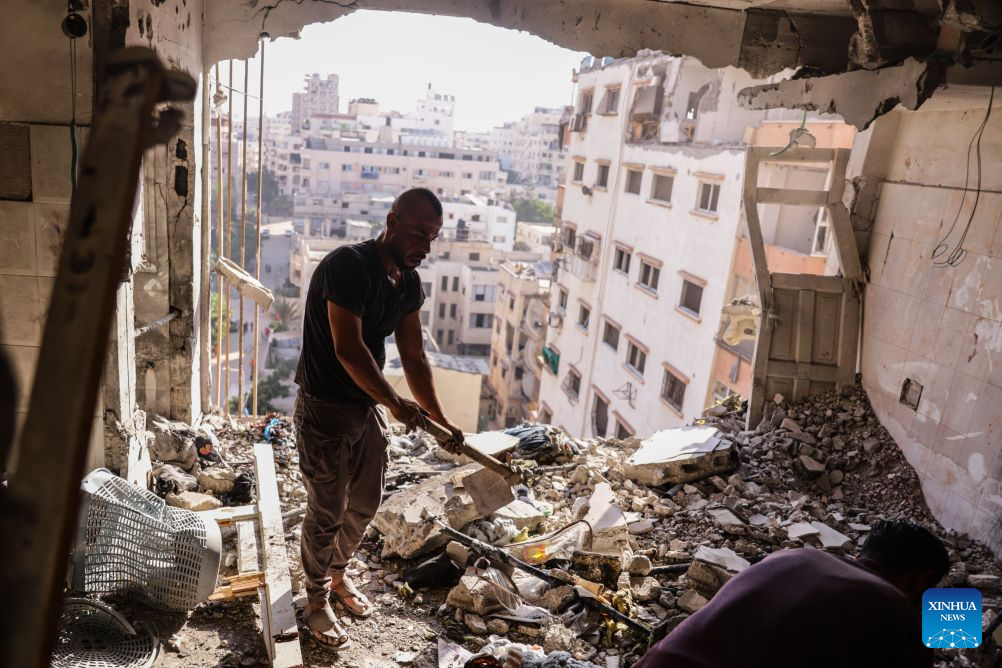
Palestinians check the ruins after an Israeli airstrike hit an apartment in Gaza City, on Aug 2, 2026. (Photo: Xinhua)
For Thabet, a 40-year-old journalist and mother of two, journalism and motherhood have become inseparable since the latest round of the Palestinian-Israeli conflict began in October 2023.
Her children, Majd and Ahmed, lost their father during the conflict and now depend entirely on her.
"I don't have the luxury of choosing between my role as a mother and my duty as a journalist," Thabet said. "Many times, I had to take my children with me to the field. Other times, I left them with my mother and walked long distances to work amid bombardment and a lack of transportation."
"I worked with a double burden: fear for them and fear for myself, because I know they have no one else in this world but me after their father's death," she added.
Her husband, Haider al-Masdar, a writer and researcher in political and media affairs, was killed in July 2024 in an Israeli airstrike targeting a tent housing journalists inside a hospital in central Gaza.
After her husband's death, Thabet considered abandoning journalism. She watched colleagues leave their homes, change their phone numbers or withdraw from the field.
Yet she chose to continue, describing journalism as "the last line of defense for the truth."
Today, she and her children live in a tent. Repeated displacement has left her constantly prepared to flee, keeping essential belongings nearby and monitoring reports of strikes and evacuation orders.
At the tent, she tries to create fragments of normal life for her children, supporting their education and speaking to them about school, home and the future she hopes awaits them when the war ends.
For Amer Sultan, the war also transformed journalism into a painful separation from family.
Sultan, 32, has worked as a photojournalist since 2014, driven by a desire to document events in Gaza, particularly nighttime incidents that often received little coverage.
"From the beginning of my career, I saw the camera as a means to document what happens to people," he said. "I wanted there to be a picture, a testimony to what is happening."
On Oct. 7, 2023, Sultan left his home in Jabalia refugee camp for Gaza City to cover the escalating events. His family remained in the north as he was later displaced in the southern Gaza Strip. Since then, he had never seen them.
"I was waiting for a ceasefire, counting the hours and days, not only because I wanted the bombing to stop, but because I wanted to return north and see my family," he recalled.
On Jan. 16, 2025, that hope was shattered. At around 10 p.m., Sultan learned that 13 members of his family had been killed inside their home, including his mother.
"The shock was immense," he said. "Throughout the war, I photographed the victims and thought about my family, asking myself: Could the same thing happen to them? Then came the day when my family became the victims."
The following day, he returned to work. "I made it a point to never put down my camera, my pen, or my phone," he said.
Fuel shortages, destroyed roads and a lack of transportation have forced Sultan to walk long distances to cover events. Amid the hardships, he chose to stay despite offers to leave Gaza.
"For me, journalism isn't just a job," Sultan said. "It's a responsibility toward the people living through this war. I want to convey their lives and suffering to the world, not just show them as numbers."
Thabet and Sultan are among more than 1,500 Palestinian journalists whose lives have been transformed by the war, according to Tahseen al-Astal, deputy head of the Palestinian Journalists Syndicate in Gaza.
"With restrictions on the entry of foreign journalists into Gaza, Palestinian journalists have found themselves on the front lines of coverage," al-Astal said. "They work amid bombardment, displacement, shortages of fuel, electricity and internet access, and difficulties reaching events and sources."
He said more than 250 journalists had been killed during the war, while dozens were injured, some more than once.
More than 150 local, Arab and international media outlets and production offices have also been destroyed or damaged, he added.