


Two ancient civilizations, two modern journeys
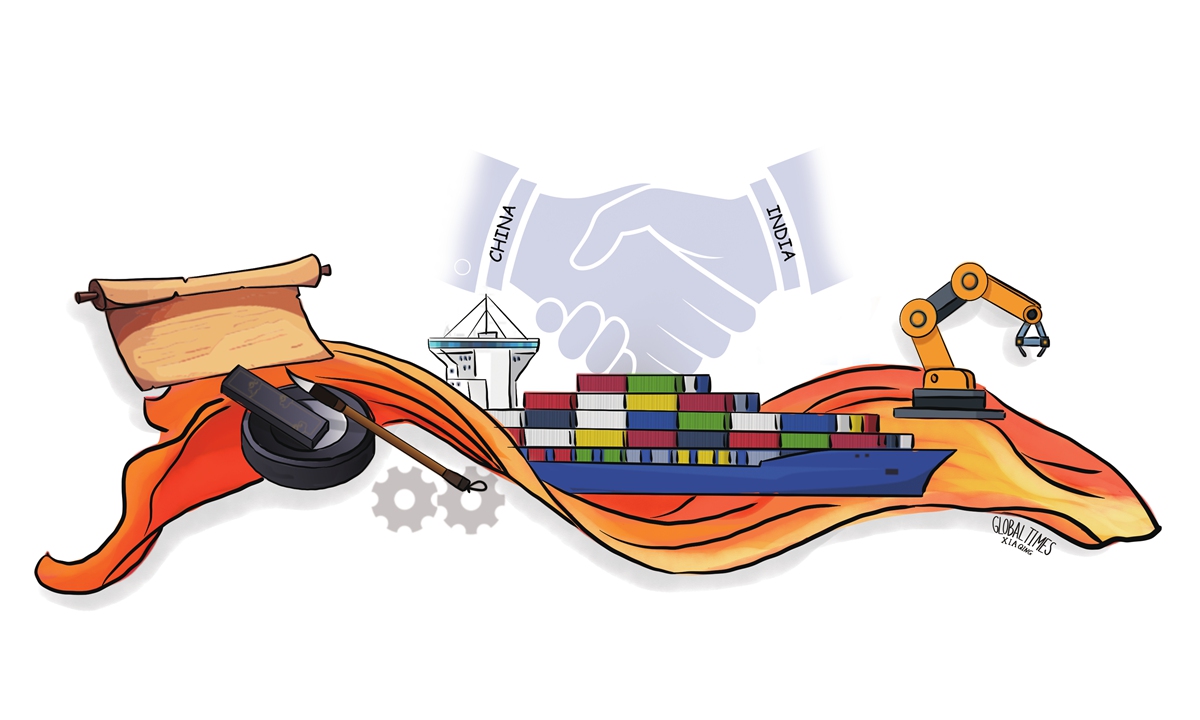
China, India Illustration: Xia Qing/GT
India marked 79 years as an independent modern nation on August 15. This is a moment not only for national reflection, but also for revisiting the extraordinary and parallel journeys of two of the world's oldest civilizations. India and China both began their modern nation-building endeavors within years of one another in the mid-20th century. As we mark this milestone, it is worth pausing to consider what our two ancient societies have built, what we have learned from one another and what possibilities lie ahead as both nations continue to rise.
Long before the modern age, India and China were already connected, through the movement of ideas, trade and scholarship. With contact over the ages came understanding and the mutuality of benefit: philosophy, medicine and astronomy. Even everyday goods such as sugar, spices, paper and ink travelled across these ancient networks, creating new bridges of contact between our peoples. That tradition of learning from each other's civilizations continued through the 19th and early 20th centuries, as we made our respective journeys toward national liberation and freedom.
When India gained independence in 1947, it inherited a society scarred by the trauma of partition and colonial exploitation. Some 90 percent of India's 340 million people at the time lived below the poverty line, literacy stood under 16 percent, and life expectancy was around 31 years. Even in that adversity, India's founders chose a path grounded in constitutional democracy and pluralism for all citizens, regardless of race, religion or gender. And unlike most other countries that chose such a path after becoming prosperous societies, we did so in the most challenging conditions. China, too, has undertaken a remarkable transformation over a comparable period, lifting hundreds of millions out of poverty. While our developmental paths have differed, both our nations have shared a common conviction that the well-being of our peoples must remain at the heart of nation-building, and that it is for the people of each nation to decide on the system that best suits their circumstances.
Today, like China, India is a country of rapid transformation. India is among the fastest-growing major economies in the world, sustaining growth of around 7 percent. This transformation has also been underpinned by political stability and a growing degree of policy continuity, providing greater predictability for businesses and investors. Under the leadership of Prime Minister Narendra Modi, in a decade, among the more remarkable achievements of India are the fact that electricity has reached 100 percent of rural and urban India, and that the proportion of Indians with bank accounts has risen from around 40 to over 80 percent. Today, much like in China, India has all but obviated the need for cash. India is also a space-capable nation with end-to-end launch capability, the world's second-largest smartphone market, and among the fastest-growing populations of internet users, at some of the lowest data costs anywhere. This dynamism is carried forward by the world's largest youthful workforce, with several hundred million Indians under the age of 30, and by a vibrant startup and innovation ecosystem.
As two of the world's most populous emerging economies, a stable, predictable and amicable relationship between India and China is not only in the interest of our 2.8 billion people, but is also a significant factor for peace, stability and prosperity in Asia and the wider world. As Asia and the wider international landscape become increasingly multipolar, India and China both have a stake in ensuring that global governance structures evolve to reflect the aspirations and interests of the developing world. This shared interest finds concrete expression in platforms such as BRICS, which is an important voice for emerging economies on issues ranging from sustainable development and financial architecture to technology cooperation and people-centric growth. As we look toward the upcoming BRICS summit hosted by India, there is a valuable opportunity to deepen China-India cooperation on issues of mutual concern, from trade and connectivity to climate action, public health and the digital economy, while contributing constructively to a more balanced, inclusive and equitable global order.
Last year, President Xi Jinping told Prime Minister Modi that China and India are cooperation partners, not rivals, and that the two countries are each other's development opportunities rather than threats. This perspective is in keeping with the long history of mutually beneficial contact between our two civilizations. Peace and tranquility in the China-India border areas provide an essential foundation for this partnership. We must build on that foundation, guided by mutual respect, mutual sensitivity and mutual interest, while ensuring that differences, which are natural between nations, do not become disputes. In doing so, our partnership can contribute to the well-being of our two peoples and to a more stable, peaceful and prosperous world.