


Glacier collapse shows why zero-sum geopolitics fails the Himalayas
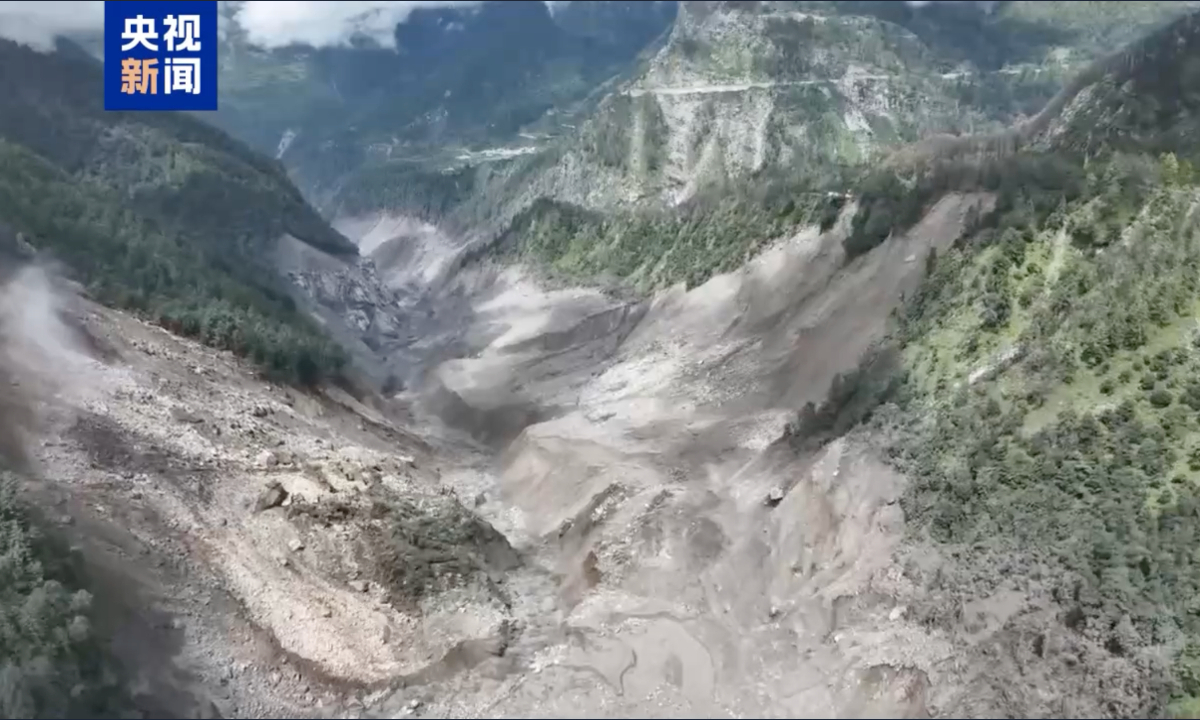
Photo: Screenshot from CCTV
On August 26, a glacier on Nepal's Langtang Lirung peak fractured at approximately 5,200 meters above sea level. An estimated 1 million cubic meters of ice and rock plunged downward, triggering a massive debris flow that raced at 50 meters per second for about 22 kilometers along the valley floor, devastating approximately 0.7 square kilometers of infrastructure at the China-Nepal border port of Gyirong. As of early September, the disaster has left more than 6,000 people dead or missing across both countries.
This was no ordinary landslide. There was no rainfall in the area that day. The event was classified as a cryosphere-bedrock coupling failure triggered without external water sources. Experts noted that the ice avalanche occurred on the Nepali side and represented a typical cascading hazard.
Yet some Indian media outlets have sought to shift blame toward China, alleging that "reckless construction" in Xizang exacerbated the disaster. Such claims are scientifically unfounded - the US Geological Survey has confirmed that the source of the disaster was entirely within Nepal.
Politicizing a natural disaster disrespects the victims and obscures the deeper questions that truly demand our attention.
This tragedy is not an anomaly. It is the latest and most devastating eruption of a long-accumulating crisis. Since the 1950s, the Qinghai-Xizang plateau has lost approximately 18 percent of its glaciers. Hazards once considered rare are now occurring with significantly greater frequency. High-altitude regions are warming considerably faster than the global average - a phenomenon known as "elevation-dependent warming." Glacier collapses can now occur without rainfall, without warning signs and without precedent.
This is precisely what Alexander E. Davis, a scholar at the University of Western Australia, identifies as "slow violence" in his 2023 book The Geopolitics of Melting Mountains. Glacier retreat, permafrost thaw and the weakening of ice-rock bonds unfold gradually and imperceptibly - yet they can unleash devastation in a single catastrophic collapse.
When a region's ecological foundation is crumbling, any discourse centered on "sovereignty," "borders," or "strategic advantage" can be upended by a single unanticipated glacier collapse.
What is also needed is the establishment of a region-wide cooperative mechanism for glacier monitoring, early warning, and risk assessment. To its credit, China's Foreign Ministry has stated that it will "continue to work with the international community to strengthen exchanges and cooperation and effectively prevent and mitigate the negative impact of climate change."
But cooperation must go beyond post-disaster data sharing. It requires forward-looking joint risk assessments, cross-border early warning systems and regionally coordinated standards for infrastructure siting.
China and Nepal are now working side by side in disaster relief. China has shared satellite imagery and hydrological data with Nepal, and tunnel experts have arrived to assist in rescue efforts. This is the right approach to cross-border solidarity. Looking ahead, not only post-disaster response is needed, but also cross-border risk governance built on shared responsibility.
The glacier collapse in Nepal is not just a local tragedy - it is a global warning. On this mountain range, with its elevation differential of over 3,000 meters, no geopolitical calculation outweighs the weight of a single block of ice. Zero-sum geopolitics assumes that controlling more water or securing more territory equals a strategic advantage. But when the ice itself is disappearing, there is nothing left to control - the very object of the competition is melting away.
When Asia's water tower is teetering, what truly matters is not who gains the upper hand in the court of public opinion, but whether we can set aside zero-sum logic and confront a predicament from which no one can opt out.
If, in the wake of such a tragedy, and if, when the next, even more violent glacier collapse arrives, humanity still cannot bridge its differences and act collectively, then we might not get another chance to get it right. That, perhaps, is the most tragic part of all: that we will have seen it coming.