


The UK feels boomerang effect? Time for some in the West to end double standards
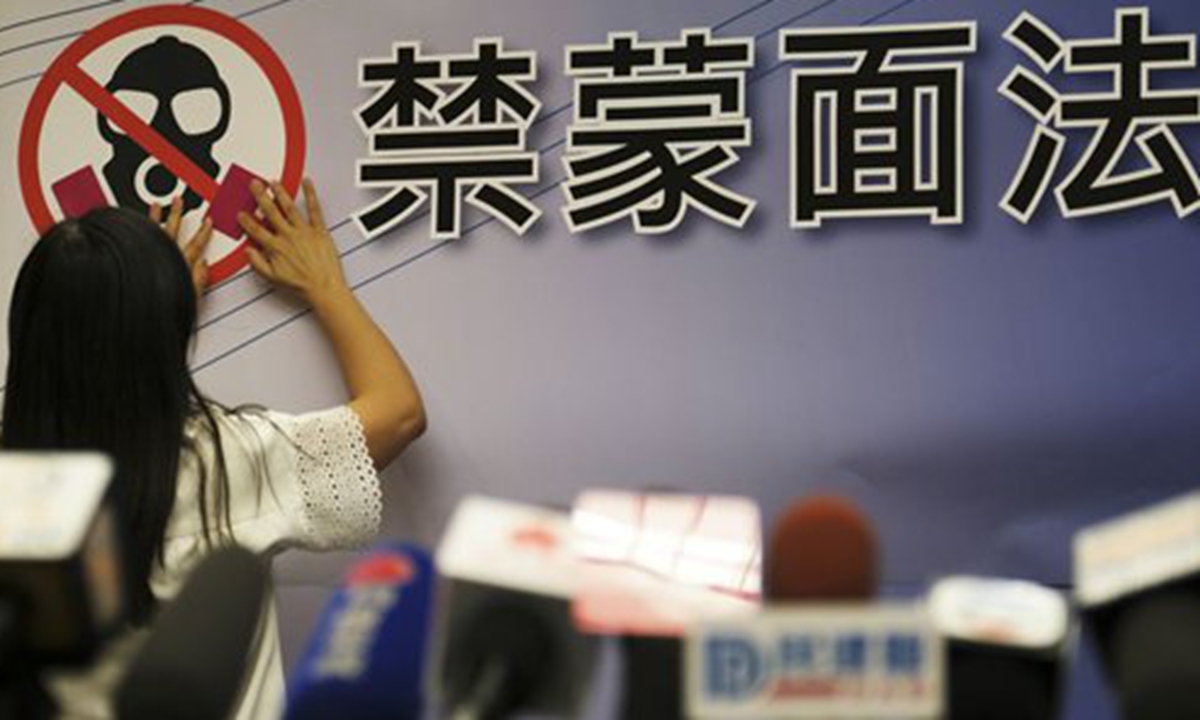
An advocate group urges the Hong Kong Special Administrative Region government to ban face masks in unauthorized rallies on October 3, 2019. (Photo: Xinhua)
Is Britain also moving toward a ban on face coverings? Recently, British Home Secretary Shabana Mahmood urged police to "make full use of powers" to deal robustly with anti-immigration protests, including banning protesters from covering their faces. Mahmood said the protesters, who are "dressed in black wearing balaclavas," are fundamentally different from other demonstrators, and "there is a fear factor and obvious malign intent being communicated to our residents."
Under the Crime and Policing Act 2026, which formally took effect in April, UK police have the power to designate areas as face-covering-free zones, and wearing or using an item to conceal a person's identity within a designated area or specific time will constitute a criminal offense.
Britain, face coverings, crime, policing - these keywords may sound familiar to Chinese people. During the 2019 Hong Kong unrest triggered by the proposed amendments to an extradition law, rioters were also "dressed in black wearing balaclavas" while brazenly engaging in vandalism, looting and arson on the streets of Hong Kong and attacking and assaulting police officers and ordinary residents. Yet when the Hong Kong government introduced the Prohibition on Face Covering Regulation under the Emergency Regulation Ordinance, then-British foreign secretary Dominic Raab publicly opposed the measure, claiming that authorities "must avoid aggravating and instead reduce tensions." Chris Patten, the last British governor of Hong Kong, went even further, denouncing it as "madness." British politicians, so-called human rights groups and Western media outlets also joined in, piling pressure on China.
The same ban on face coverings - "madness" in Hong Kong, but a measure to "maintain order" in London? This inevitably calls to mind the starkly different labels applied by US politicians and media after the Capitol riot in Washington. Those who stormed the US Capitol were uniformly branded "rioters" and "criminals," while those who stormed Hong Kong's Legislative Council were portrayed as "pro-democracy" activists.
Time and again, the boomerang has come back to hit these countries, exposing the double standards behind their approach to the same rules. For some in the West, only conduct that serves their own political interests is worthy of being called "freedom;" anything that does not is labeled a "human rights violation." Violence taking place on someone else's doorstep can be portrayed as a "beautiful sight to behold," but when unrest reaches their own backyard, they waste no time showing their power to "maintain order."
The hypocritical façade of the West's "universal values" has long been riddled with cracks. What is happening in Britain today offers another lesson for the West: When double standards haunt those who practice them, every disguise is torn away on the spot, and the "values" built upon them begin to crumble with it.