


Not politicizing the disaster, but building a new foundation for China-Nepal cooperation
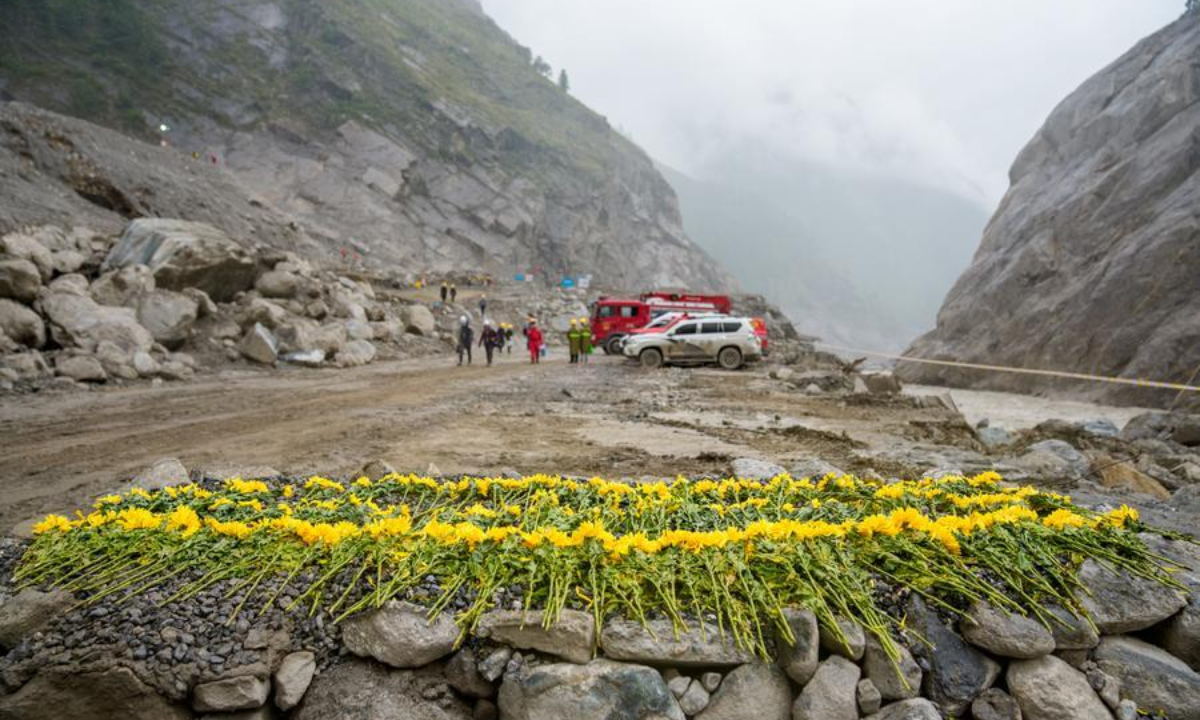
Flowers are laid at the core affected zone of the mudslide-hit Gyirong Port in Southwest China's Xizang Autonomous Region on September 6, 2026. (Photo: Xinhua/Tenzin Nyida)
In late August, a fast-moving chain mudslide, triggered by a high-altitude glacier collapse in Nepal, caused significant loss of life and extensive damage to property and infrastructure in both China and Nepal. The mudslide struck the Gyirong Port on the China-Nepal border in Southwest China's Xizang Autonomous Region, causing severe damage to the port.
China and Nepal stood by each other amid the disaster. The timely information provided by China offered Nepal much-needed technical support, helping its authorities carry out rescue and emergency response efforts, evacuate residents in a timely manner and reduce casualties, while some Chinese people also have been rescued by Nepali security forces.
The disaster has been devastating for two nations connected by the Himalayas. The floodwaters moved rapidly downstream, reaching communities further along the river within a short period of time. Although there was information and warnings, the extreme speed and intensity of the flood, combined with the very limited warning time, made it impossible to prevent the heavy loss of life.
This does not mean that the existing information-sharing system was adequate. Rather, the incident demonstrates that the speed, reach and effectiveness of early-warning systems - and the mechanisms for delivering warnings to communities at risk - must be significantly improved.
Experts have long warned that Nepal's northern regions are highly vulnerable to earthquakes. These risks are compounded by climate change, glacial lakes, extreme rainfall, landslides and sudden changes in river systems.
Disaster management cannot be viewed simply as a matter of providing relief after a disaster has occurred. China and Nepal need greater cooperation in joint risk assessments, scientific data-sharing, early-warning systems, emergency preparedness, rescue exercises and emergency communication mechanisms.
Such cooperation should not be limited to government agencies. Scientists, hydrologists, meteorologists, technical institutions and local governments should also be directly involved.
International and regional media outlets have been actively covering the devastating floods and landslides along the China-Nepal border, with reporting coming not only from local Nepali and Chinese media, but also from countries such as Pakistan, India, Bangladesh, and some Western countries.
Most reports have consistently highlighted the large-scale destruction caused by the disaster. At the same time, some coverage has also emphasized moments of cross-border solidarity, including the efforts of Chinese and Nepali rescue teams working side by side, as well as the mutual assistance and close ties between the two countries during the crisis.
However, alongside these factual and humanitarian-focused reports, some Western media narratives have also drawn criticism for politicizing aspects of the disaster, creating a contrast with coverage that focuses primarily on rescue efforts and human impact.
This demonstrates that the scale of the destruction and the suffering of affected communities are being reported to the international community. At the same time, disaster reporting must remain fact-based. Giving a natural disaster an unnecessary political or geopolitical dimension can risk overshadowing the actual suffering of victims. During a disaster, the priority should not be political blame, but saving human lives and establishing the facts.
It is also worth noting that some foreign media outlets have sought to drive a wedge between China and Nepal, or to question China's rescue efforts, in the aftermath of the landslides.
Yet their presence on the ground may serve a different purpose: By reporting from the field, they can see for themselves the enormous difficulties of post-disaster reconstruction, the concrete efforts China has made, and the enduring friendship between the two peoples. In this sense, firsthand reporting, if it remains fact-based, can help correct misperceptions.
Natural disasters do not recognize borders. Rivers do not recognize borders. Landslides do not recognize borders, and neither do earthquakes. Therefore, preparations to confront such disasters must also go beyond national boundaries.
The tragedy now confronting China and Nepal offers a clear lesson: In the Himalayas, unilateral efforts are not enough; cooperation is the strongest form of security. The priority now should not simply be to find someone to blame, but to identify weaknesses, correct them and build systems capable of minimizing loss of life when disasters of a similar nature strike in the future.