


UAE tourism and aviation sectors join forces to accelerate recovery
Dubai (People's Daily) - The 33rd Arabian Travel Market (ATM) is taking place at Dubai World Trade Centre from Monday to Thursday. The event has brought together more than 2,800 exhibitors, including tourism authorities, airlines, hotel groups and travel companies.
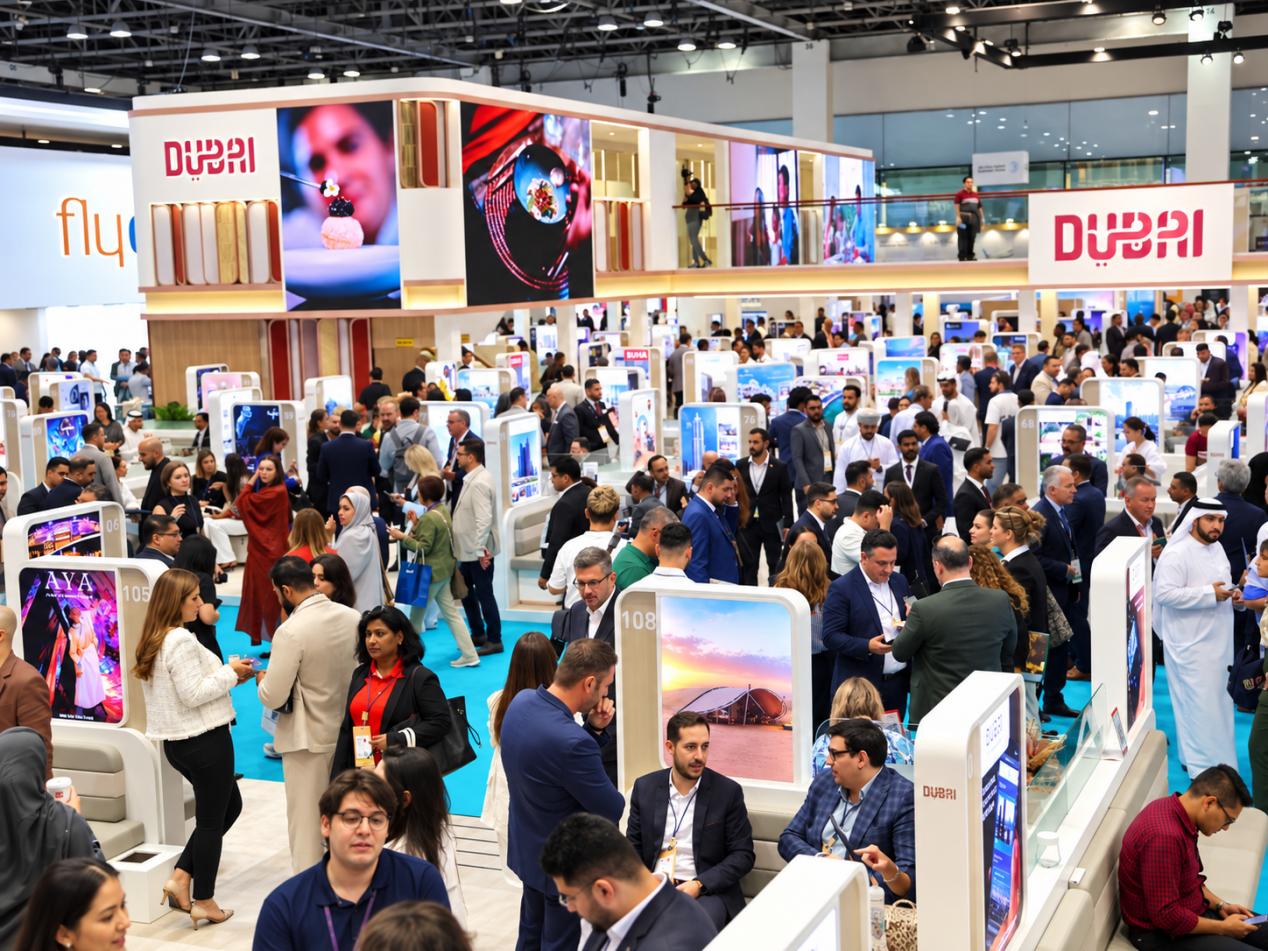
People explore the 33rd Arabian Travel Market (ATM) in Dubai. (Photo:WangXuchen)
This year's event comes at an important moment for the UAE's tourism industry. Dubai International Airport (DXB) welcomed a record 95.2 million passengers in 2025 and had initially expected traffic to approach 100 million in 2026. Regional conflict and airspace restrictions, however, caused widespread flight cancellations and rerouting during the first half of the year.
DXB handled 31.5 million passengers in the first six months of 2026, down 31.3 percent from the same period in 2025. Dubai Airports now expects annual traffic to reach around 70 million passengers, while saying that demand and airline capacity have continued to recover.
Tourism figures also show signs of improvement. Dubai received 6.97 million international overnight visitors between January and August, including 869,000 in August, its strongest monthly result since February. The figures remain below the previous year's level, but the steady increase in recent months points to a gradual recovery in visitor confidence.
At the opening of ATM, UAE Vice President, Prime Minister and Ruler of Dubai Sheikh Mohammed bin Rashid Al Maktoum said the UAE has continued to strengthen its position as a global hub for travel and tourism, while Dubai is reinforcing its role as a destination helping shape the future of the sector.
Issam Kazim, CEO of the Dubai Corporation for Tourism and Commerce Marketing, said close coordination between the government and the private sector was essential to sustaining confidence and creating new opportunities for growth. He said Dubai's priority was to restore connectivity and demand rather than pursue a short-term quarterly target.
Airlines are central to that recovery. Dubai-based carrier flydubai currently serves more than 125 destinations in 56 countries. Houda Al-Kaissi, public relations manager at flydubai, told the People's Daily that expanding the airline's network gave more passengers access to Dubai at competitive prices.
The airline is also expanding and upgrading its fleet. It plans to take delivery of 11 additional Boeing 737 MAX aircraft in 2026—seven Boeing 737-9s and four Boeing 737-8s—taking its fleet beyond 100 aircraft. A new retrofit program will introduce more lie-flat business class seats and larger overhead storage bins across part of its Boeing 737 MAX fleet.
Flydubai has resumed services to Aleppo in Syria and Benghazi in Libya and increased flights to Bangkok. It will also launch daily flights to Pokhara on September 23, making the Nepalese city its second destination in the country after Kathmandu.
Emirates is likewise rebuilding capacity and using its international network to support tourism cooperation. At ATM, the airline signed agreements with seven tourism bodies representing destinations including the Seychelles, Mauritius, Madagascar, Malaysia, Finland, Norway and Sharjah. The agreements cover joint marketing, travel-trade programs and familiarization visits intended to stimulate visitor demand.
Adnan Kazim, Emirates' deputy president and chief commercial officer, said the airline's summer traffic had recovered faster than expected, with more than 8.6 million passengers carried in July and August. He said demand on routes between Dubai and China had been particularly strong. Emirates currently serves five destinations in the Chinese mainland: Beijing, Shanghai, Guangzhou, Shenzhen and Hangzhou.
The recovery effort extends beyond airlines. Etihad Airways and Etihad Rail signed a memorandum of understanding at ATM to explore a more integrated air-and-rail travel experience across the UAE. The two companies will study dedicated shuttle links between Zayed International Airport and the Mohammed Bin Zayed City Passenger Station, as well as integrated booking and station-based passenger services.
Arik De, chief revenue and commercial officer at Etihad Airways, said the partnership could connect air passengers more easily with destinations across the UAE, supporting tourism growth and Abu Dhabi's long-term economic development.
Dubai is also studying a proposed 55-kilometer Airport Express Line linking DXB with Al Maktoum International Airport. The planned route would include five stations, although the project remains under study and no opening date has been confirmed.
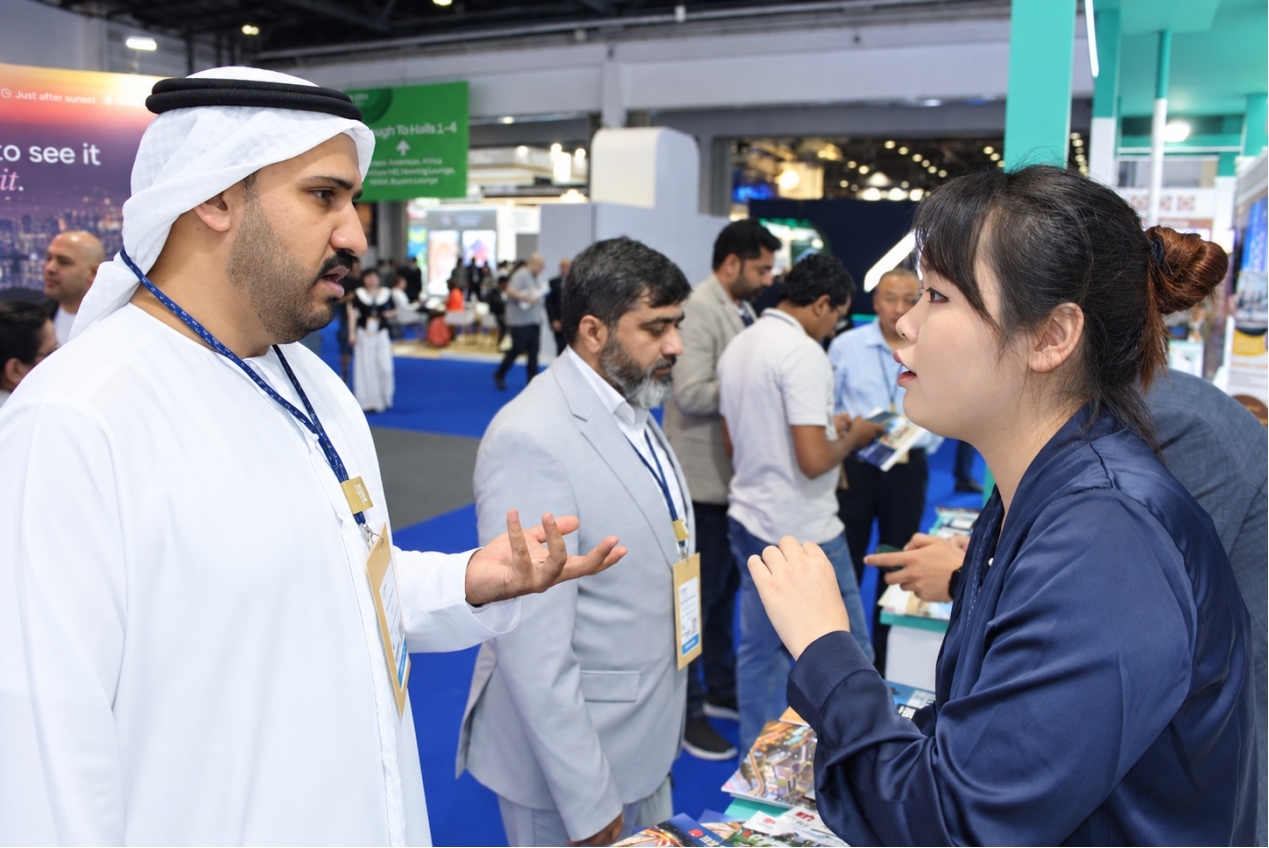
Local visitors explore the China Pavilion. (Photo: Gérard Al-Fil)
The UAE's recovery is supported by the close relationship between aviation and tourism. A study commissioned by Emirates and Dubai Airports found that the aviation sector, including tourism facilitated by air travel, supported 27 percent of Dubai's GDP in 2023.
The initiatives announced around ATM show how government agencies, airlines, tourism authorities and transport operators are working together to restore connectivity and rebuild demand. While the effects of the regional conflict have not fully receded, improving passenger and visitor figures suggest that the recovery is gaining momentum.