


Saudi, Houthis trade strikes as fighting deepens near Bab al-Mandab
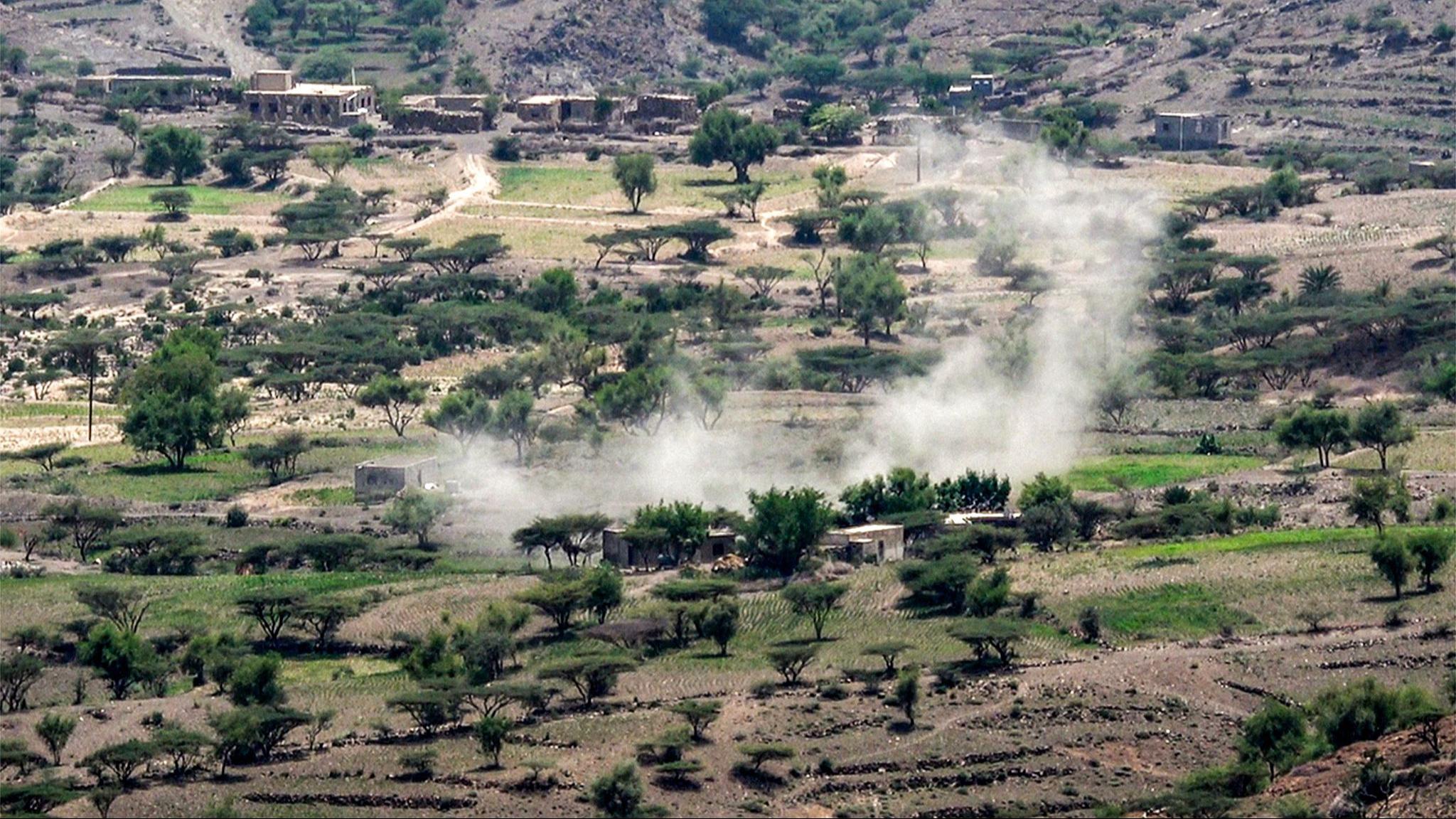
Smoke rises following strikes during ongoing fighting between Houthi and Saudi-backed Yemeni government forces along the frontlines in al-Kadha, west of Taiz in western Yemen, September 16, 2026. (Photo: VCG)
Saudi warplanes pounded Yemen and Houthi fighters launched drones and missiles at Saudi cities, the Iran-backed movement said on Wednesday, after a lightning advance that has extended Tehran's reach in the Middle East war.
In a sign of the worsening conflict in a new theater, the United States tightened its travel warning for Saudi Arabia, banning government employees from travelling within 20 miles of the Yemen border.
The Houthis, who since last week have swept through Yemeni towns along the Red Sea coast and seized islands in the Bab al-Mandab Strait at its mouth, released battlefield video overnight of fighters seizing armored vehicles from Saudi-backed forces. Warplanes flew overhead and huge explosions billowed into the sky from desert dunes, the video showed.
Houthi military spokesman Yahya Saree said the group had launched fresh drone and missile strikes on the major Saudi Red Sea oil port of Yanbu, and at a southern Saudi airbase at Khamis Mushait. He did not say when the strikes had taken place. Both cities were among a wide range of locations where Saudi Arabia announced alerts on Tuesday, although there were no similar announcements on Wednesday.
Earlier, Saree said the Houthis had also shot down a Saudi F-15 fighter jet. No immediate evidence was presented of that incident.
Saree said the Saudis had carried out as many as 450 air strikes on Yemen this week. Officials in the Saudi-backed government that controls southern Yemen have acknowledged that their forces and those of Saudi Arabia were conducting air strikes on Houthi positions, though Riyadh itself has not confirmed them.
The Houthis have fired repeatedly into Saudi Arabia over the past week, causing alarms over cities in the south and west. An attack blamed on Iran-aligned fighters in Iraq last week also knocked out Saudi Arabia's East-West Pipeline, the main route used to divert oil exports from the blockaded Strait of Hormuz.
Riyadh said its air defenses had shot down a Houthi drone south of Mecca on Tuesday before it entered prohibited airspace over the holy city, an attack it said crossed a "red line" of threatening shrines sacred to all Muslims. Houthi spokesperson Saree denied the group had targeted Mecca, and said the Saudi reports were a set-up for propaganda purposes.
Sources told Reuters that US officials had held a meeting with the Houthis over the weekend in Oman, at which the group said it had no intention of attacking American vessels and was committed to a ceasefire reached with the US last year.
Clashes intensify near strategic Bab al-Mandab Strait
Fighting also intensified between Yemen's government forces and the Houthi group in rugged terrain overlooking the strategic Bab al-Mandab Strait on Wednesday, as both sides rushed reinforcements to the front lines, a Yemeni military official told Xinhua.
The official, speaking on condition of anonymity, said fierce clashes erupted in the Kahbub mountain range in southern Yemen's Lahj province after Houthi fighters launched an attempt to break through government defensive positions.
Government forces repelled the advance and launched a counterattack, recapturing several heights overlooking approaches to the strait after hours of fighting that left fighters on both sides killed, the official said. Government forces also shot down a Houthi reconnaissance drone over the front line, he added.
Both sides have deployed additional fighters and military equipment to the area as clashes continue across the mountainous frontline, according to the official.
The Kahbub heights are strategically significant due to their proximity to Bab al-Mandab, a narrow waterway linking the Red Sea and the Gulf of Aden that has become a key battleground in Yemen's conflict.
The Houthis have recently made major advances along Yemen's Red Sea coast, capturing the port city of Mocha on September 10 and Mayun Island in the Bab al-Mandab Strait on September 11.
Danger of global energy supply shortage worsening
The extension of the war into Yemen threatens to worsen the global energy supply shortage caused by the six-month-old US-Israeli war on Iran, which has disrupted shipping through the Strait of Hormuz.
The price of Brent crude hovered around $108 a barrel on Wednesday, close to its highest levels since May. The politically sensitive average retail price of diesel fuel in the United States hit another all-time high above $6.30 a gallon for the first time.
Traders say a prolonged closure of Saudi Arabia's East-West Pipeline could cut off as much as 4% of global oil supply. Saudi Arabia has not said when operations might resume, but US Energy Secretary Chris Wright told CNBC on Tuesday that crude oil should be flowing through the pipeline within days.
Saudi Arabia has led a coalition battling the Houthis since 2015. The conflict had largely quietened under a ceasefire in recent years, but reignited when the Houthis declared a naval blockade against Saudi Arabia in July and fired at southern areas in the kingdom. Violence has intensified sharply this month when the militant group pushed back forces aligned with the Saudi-backed internationally recognized Yemeni government.
Saudi Arabia's Crown Prince Mohammed bin Salman phoned US President Donald Trump last week seeking military support, which so far has been limited to intelligence aid.
The United States bombed the Houthis for two months in 2025, but halted that campaign after reaching what President Donald Trump described as a ceasefire that would halt attacks on ships.
Trump now faces a dilemma of whether to stand by and risk the Houthi advance worsening the global energy crisis or provide more direct military support to the Saudis and risk extending the costly US intervention to another theater.