


US consecutive space militarization moves expose hegemonic ambitions, widen governance deficit: experts
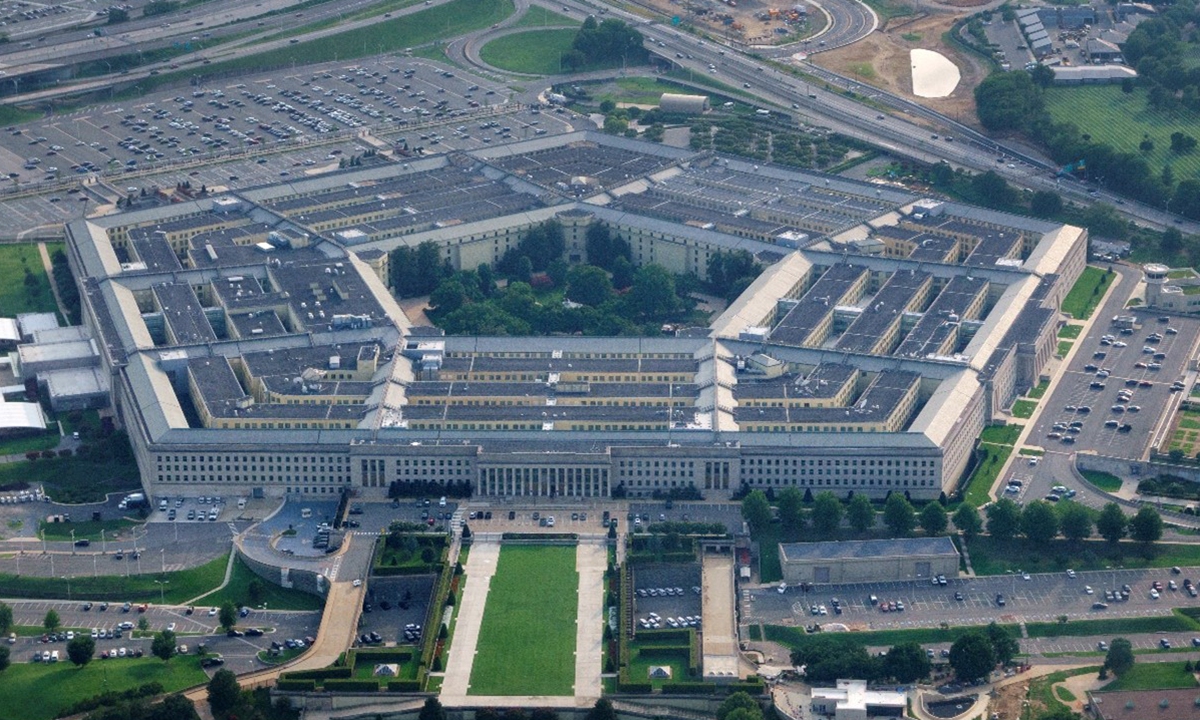
This file photo taken on December 26, 2011 shows the Pentagon building in Washington, DC, US. (File photo: VCG)
Days after Washington made its most direct acknowledgment yet that it had deployed weapons in orbit, a senior US military official claimed that American forces must prepare to fight around the Moon, indicating an accelerating shift toward space warfare. Chinese experts noted that these actions reflected Washington's attempt to seek unilateral space hegemony and risked fueling an arms race, strategic miscalculations and a widening deficit in global space governance, ultimately undermining humanity's shared interest in the peaceful and secure use of outer space.
General Dan Caine, chairman of the Joint Chiefs of Staff, told service members and industry figures at the Air, Space and Cyber Conference outside Washington on Wednesday that the US military should adapt now so it "is prepared to fight, endure and win ... from the seabed to cislunar space," according to a report from the Associated Press (AP) on Wednesday.
Space Force, the newest military service, which was created by US President Donald Trump in 2019, is preparing to fight in space and around the moon because "humanity is advancing deeper into space — the Space Force's job is to help be prepared to defend US interests," Lieutenant General Gregory Gagnon, head of the force's Combat Forces Command, told reporters separately, per AP.
On September 14, also at the Air, Space and Cyber Conference, US Air Force Secretary Troy Meink revealed that the Space Force currently has "space control weapons" in orbit—the Pentagon's most direct acknowledgment to date that the US is operating offensive capabilities in space, according to Air & Space Forces Magazine.
The US military has recently sent out a flurry of signals regarding the deployment of space control weapons in orbit and operations in cislunar space, driven by both strategic and practical considerations, said Zhang Junshe, a Chinese military affairs expert, noting that against the backdrop of its protracted military operations against Iran, Washington seeks to showcase its space-based capabilities, deter what it perceives as potential adversaries and shape their strategic calculations.
The expert noted that the messaging may also be intended to divert domestic attention and build political momentum ahead of the midterm elections.
More broadly, the US is incorporating cislunar space into its military planning to secure an early advantage in future competition around the Moon and in deep space, said Zhang.
"In anticipation of future competition over military resources and strategic influence around the Moon, the US is building its military capabilities in advance to preserve its dominance in space," Zhang told the Global Times.
The AP reported that, despite long-standing international understandings that have held outer space as only to be used peacefully and remain non-militarized, several countries—including the US — have demonstrated the ability to destroy satellites in Earth orbit.
Gagnon claimed that the intelligence community "has been clear that potential adversaries have been seeking to extend warfare into space, and that the US military needs to react." He mentioned China as among "potential adversaries" that are "actively pursuing activities in the system, in parts of space," per AP.
In the Air & Space Forces Magazine report on Air Force Secretary Meink's remarks about US space weapons, the magazine also singled out China and Russia, claiming they continued to conduct "aggressive maneuvers" and to develop and demonstrate space weapons of their own.
The US is hyping China's peaceful space activities as a "threat" to justify its own military expansion in out space. By promoting this narrative, Washington seeks to rally its allies, shape space-security rules and preserve its space-control operations, said Zhang.
The expert noted that recent US statements signal heighted US attempt to treating the outer space as a battlefield, reflecting Washington's pursuit of unilateral dominance at the expense of global strategic stability and the international community's shared interests.
Li Bin, a visiting fellow at Tsinghua University's Center for International Security and Strategy and a professor in its Department of International Relations, told the Global Times that the US move would undoubtedly worsen the global security environment. "This goes beyond the militarization of space—it is the blatant weaponization of space," he noted.
In response to the US deployment of weapons in space, Chinese Foreign Ministry spokesperson Guo Jiakun said at a press conference on Tuesday that China stands for peaceful use of outer space and keeping it safe, and opposes any arms race in outer space or as any attempt to weaponize it and turn it into a warzone.
"We urge the US to stop expanding its military build-up in outer space and uphold global strategic stability with concrete actions," Guo said.
Russia's Foreign Ministry said on Tuesday the US acknowledgement that Washington had deployed orbital weapons ignored the possible consequences of a conflict and threatened long-term stability in space-based activity. "In pursuit of its narrow self-interests, Washington is ready to completely ignore the catastrophic consequences for humanity of any armed conflict in orbit," ministry spokeswoman Maria Zakharova said in a commentary on the ministry website, according to Reuters.
By weaponizing outer space and turning it into a battlefield, the US is widening the global space-governance deficit, eroding international legal restraints and undermining strategic stability, said Zhang. He noted that "its deployment of orbital weapons and development of the Golden Dome system could threaten other countries' space assets and nuclear deterrence capabilities, fueling a spiraling arms race."
"The secrecy and ambiguity surrounding space weapons make routine orbital activities more likely to be misread as hostile acts, increasing the risk of strategic miscalculation or even direct conflict," Zhang continued, adding that US-led military alliances in space could further deepen geopolitical divisions, undermine international cooperation and make it harder for the world to prevent conflict in outer space.