


What is behind Takaichi's LDP executive, cabinet reshuffles?
TOKYO, Sept. 18 (Xinhua) -- Japanese Prime Minister Sanae Takaichi, who also heads the ruling Liberal Democratic Party (LDP), revamped the party's executive team on Wednesday and reshuffled her cabinet on Thursday.
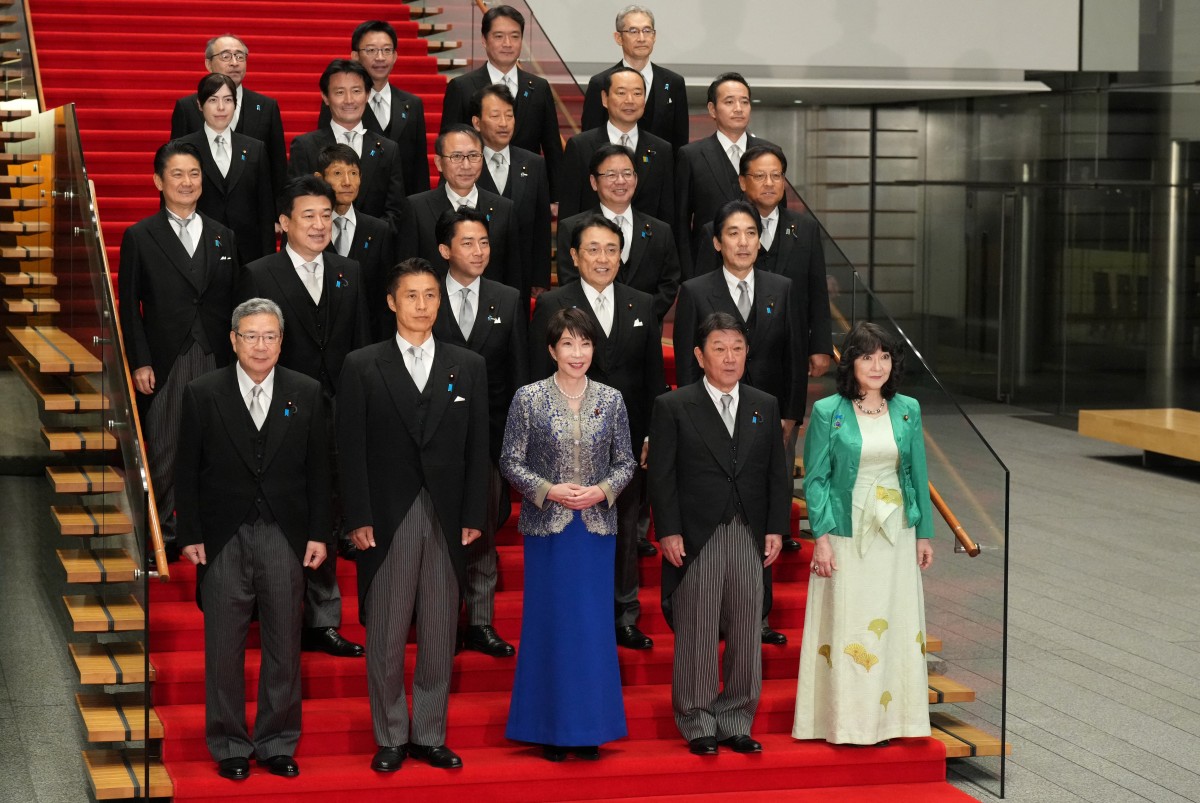
Japan's Prime Minister Sanae Takaichi (C, front) and members of her reshuffled Cabinet pose for a photo at the prime minister's office in Tokyo on September 17, 2026. (Photo: AFP)
In the new lineups, most key posts were left unchanged, while a member of the right-wing Japan Innovation Party (JIP), the LDP's junior ruling partner, was named to the cabinet for the first time.
Analysts said Takaichi's latest personnel changes target next year's LDP presidential election, in which she seeks to secure another term as party leader, adding that the hawkish conservative leader is likely to accelerate her right-wing policy agenda. However, the reshuffles are seen as unlikely to address longstanding problems facing Japan and could bring new trouble.
TWO CHARACTERISTICS
Japanese public opinion holds that Takaichi's latest personnel arrangement has two main characteristics.
First, it preserved the "core framework" of the administration. In the LDP executive revamp, most key posts, including vice president, secretary general, and posts in charge of policy and election, remain unchanged.
The main change was Hiroshi Kajiyama, who replaced Haruko Arimura as head of the LDP's decision-making General Council, while Hideki Murai became Diet affairs committee chief.
In the cabinet, eight of the 18 ministers other than Takaichi herself remained in their posts, including core posts of chief cabinet secretary, foreign and defense ministers, as well as finance minister.
Masaya Inoue, a professor at Japan's Keio University, said that the retention of these key ministers indicates that there will be no major shift in the Takaichi government's foreign and security policies, and that she will continue pursuing an expansionary fiscal stance.
Second, cooperation between the LDP and the JIP moved from "outside the cabinet" to "within the cabinet."
The JIP had not sent any of its members to join the cabinet since forming a ruling coalition with the LDP last October, until the latest reshuffle, in which Hiroshi Nakatsuka, formerly secretary general of the JIP, assumed the post of minister in charge of regulatory reform.
Some analysts said the JIP's previous decision was to maintain flexibility and avoid being too closely tied to the LDP, which at the time was mired in a "double minority" in both houses of the Diet, Japan's parliament.
Over the past year or so, however, Takaichi has worked hard to win the JIP over, pushing ahead with a number of policies under the coalition agreement with the party.
She also led the LDP to win the House of Representatives election in February this year, consolidating the foundation of her administration. As a result, the JIP shifted its stance to in-cabinet cooperation.
Shigeaki Koga, a former official at Japan's Ministry of Economy, Trade and Industry, said the JIP holds largely the same position as Takaichi on foreign and security policies, and is even more hawkish than her in some respects, meaning it could step on the "accelerator" as Takaichi pushes ahead with hawkish policies.
Just as Takaichi was carrying out the latest personnel reshuffles, Japan's main opposition party, the Centrist Reform Alliance, which formed in January by lower house lawmakers from the major opposition Constitutional Democratic Party of Japan and the Komeito party, formally split on Wednesday.
Given the continuing divisions among the opposition parties, Hiroshi Shiratori, a professor at Japan's Hosei University, said that the opposition would struggle to effectively counter Takaichi's moves toward military expansion and constitutional revision, and that Takaichi would likely pursue tougher security policies going forward.
SEEKING RE-ELECTION
In Japanese politics, prime ministers often try to create "surprises" through cabinet and party personnel changes to boost their approval ratings.
However, Hiroshi Onishi, professor emeritus at Keio University, pointed out that experience suggests only sweeping shake-ups can achieve such an effect.
Given the limited scale of Takaichi's reshuffles, he said, they are unlikely to significantly budge her approval ratings.
Japanese media widely believe that Takaichi's latest move is primarily aimed at next autumn's LDP presidential election, intended to shore up her administration's power base and secure her re-election.
Generally speaking, an LDP politician holding a senior post within the current administration is seen as a supporter of that administration, with no reason to oppose the incumbent prime minister and party president seeking re-election.
The Asahi Shimbun reported that by retaining her rivals in key government positions, including the posts of foreign and defense ministers, Takaichi is seeking to nip any emerging "anti-Takaichi bloc" in the bud.
The newspaper quoted a senior LDP lawmaker as saying that Takaichi's top priority is to secure her re-election as party president, and that this latest personnel arrangement is meant to lay the groundwork for that goal.
A Yomiuri Shimbun analysis noted that as the sole remaining faction within the LDP, the faction of Taro Aso has about 60 lawmakers and remains one of the most organized intraparty political forces.
Aso's support was key to Takaichi's victory in last October's party leadership race. Her decision to retain Aso as LDP vice president and his brother-in-law as the party's secretary general clearly appears to be part of her preparations for next year's LDP presidential election, the newspaper said.
OLD PROBLEMS, NEW TROUBLE
Analysts said Takaichi's latest personnel reshuffles could create new challenges for her administration going forward.
The Asahi Shimbun reported that in this round of changes in the LDP executive lineup, Takaichi took into account, to some extent, the views of Aso, who is seen as the "guardian" of the administration, but did not accept his preferences in full.
Aso had hoped that Kajiyama would remain as Diet affairs chief, but Takaichi insisted on promoting Murai to the post instead.
The report said that for Takaichi, whose base within the party remains relatively weak, the discontent over this personnel arrangement could become a political liability for her administration in the future.
At the same time, the entry of a JIP member into the cabinet could deepen the party's friction with the LDP.
Although the two parties share much common ground on foreign and security policies, they also diverge on a range of other issues.
The JIP's push to cut the number of seats in the House of Representatives faced wide criticism from opposition parties because it is deemed disadvantageous to smaller parties. The proposal has also drawn considerable dissent within the LDP.
The JIP, however, remains firm on the issue and is seeking to have a bill to cut lower house seats passed during the extraordinary Diet session this autumn.
Shiratori said that the JIP's entry into the cabinet could give the administration a stronger JIP imprint, which could in turn spark a backlash within the LDP.
In addition, the latest personnel reshuffles signal that Takaichi will press ahead with military expansion while sticking to a proactive fiscal policy.
Whether procuring weapons and equipment or cutting the consumption tax, each requires substantial fiscal funding.
With the Japanese government already grappling with a mounting debt burden, market confidence in Japanese government bonds has notably weakened, sending bond yields sharply higher. This means Takaichi will continue to face the longstanding problem of insufficient fiscal resources.
Koga said that if Takaichi fails to address the country's fiscal and economic challenges effectively, she will not be able to sustain her current approval ratings.