


Austrian parliament speaker calls for mutual learning, fair cooperation between Europe, China
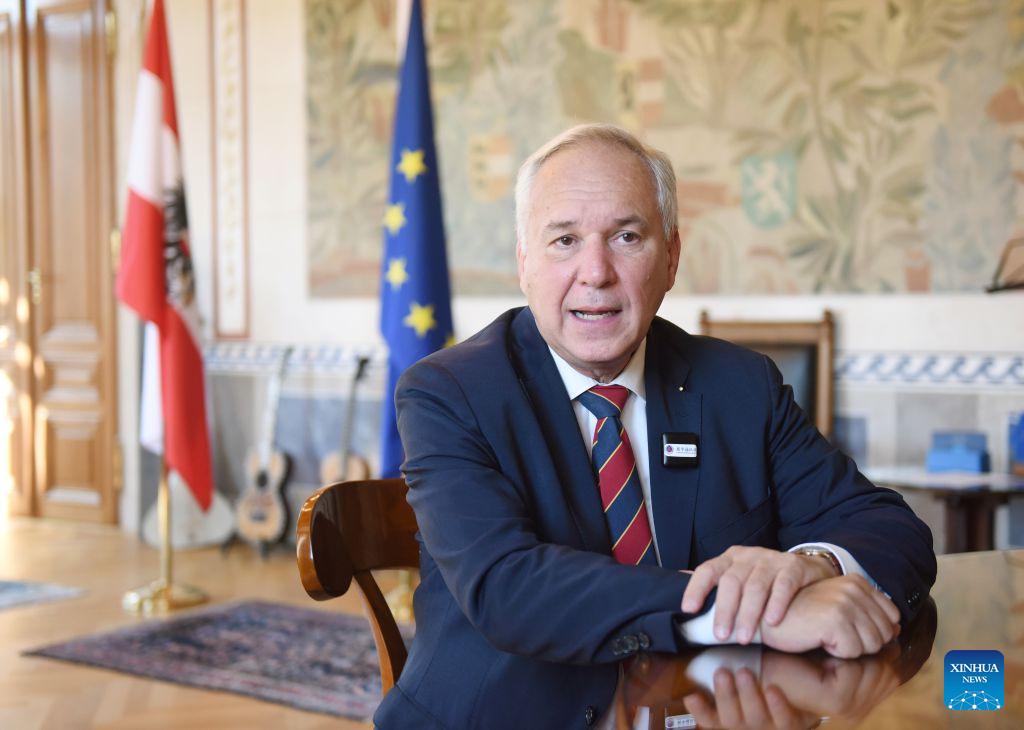
Walter Rosenkranz, president of Austria's National Council, or the lower house of Parliament, speaks during an interview with Xinhua in Vienna, Austria, Sept. 15, 2026. (Xinhua/He Canling)
VIENNA, Sept. 19 (Xinhua) -- Europe should abandon an anxious mindset toward China's development and instead pursue mutual learning and fair cooperation, said Walter Rosenkranz, president of Austria's National Council, or the lower house of Parliament.
In an interview with Xinhua, Rosenkranz said China has achieved leaps and bounds in many fields, notably in renewable energy. "The EU and China must continue to deepen their cooperation while operating within a framework of fair rules," he said.
European national legislatures, he said, should take the initiative to build fair and reasonable frameworks for cooperation, helping various sectors in Europe and China eliminate perceptual biases, deepen practical cooperation, and achieve complementary strengths and common development.
Noting that he recently led a delegation to China, which was his first visit to the country since taking office as president of the National Council, Rosenkranz said Austrian political parties share broad consensus and a strong willingness to deepen exchanges with China.
During the visit, the delegation not only experienced China's long and profound history and culture, but also witnessed the vitality of China's modernization drive, he said.
This year marks the 55th anniversary of the establishment of diplomatic relations between China and Austria. Rosenkranz said friendship between the two countries has been deepening since the establishment of diplomatic ties.
Since the 1990s, there have been more than 60 exchanges between the national legislative bodies, Rosenkranz said.
Looking back on the 55-year history of exchanges, Rosenkranz said Austria and China cherish peace, consistently uphold multilateralism and the norms of international law, and remain committed to promoting peace through cooperation and pursuing development through win-win outcomes.
The two countries share compatible development concepts and have long worked together under the framework of the United Nations to contribute to world peace and development, while deepening cooperation in multiple fields, including the economy and culture, with fruitful results, he said.
More than 650 Austrian companies are currently operating in China, fully demonstrating the strong vitality of Austria-China cooperation, he added.
Rosenkranz said the current international situation is marked by intertwined changes and turbulence, with challenges such as climate change, artificial intelligence governance and regional conflicts emerging one after another. The legislative bodies of Austria and China could further deepen dialogue and cooperation, build consensus on governance, improve cooperation rules, and contribute wisdom and strength to addressing global issues.
Looking to the future, Rosenkranz regards young people as the main force of future cooperation and the inheritors and promoters of friendship between the two countries.
Deeper youth and cultural exchanges, he added, could strengthen the foundation of people-to-people ties and give the friendly strategic partnership between the two countries fresh momentum.