


UN General Assembly begins general debate
UNITED NATIONS, Sept. 22 (Xinhua) -- The General Debate of the 81st session of the UN General Assembly opened at the UN headquarters in New York on Tuesday.
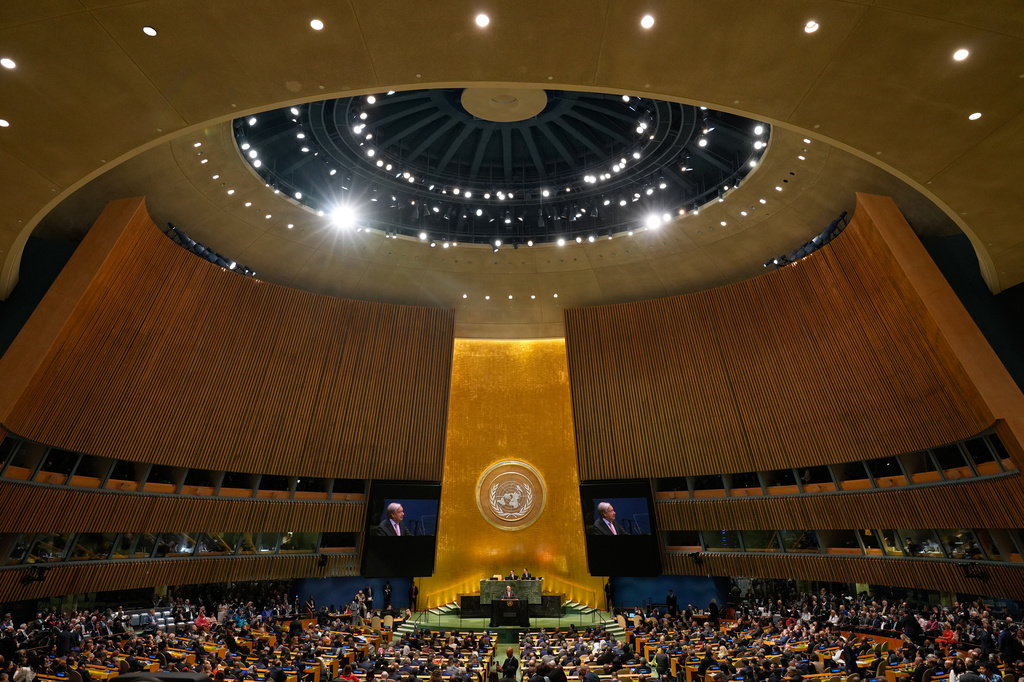
United Nations Secretary-General Antonio Guterres speaks during the 81st session of the United Nations General Assembly at United Nations headquarters, Tuesday, Sept. 22, 2026. (Photo: AP)
Khalilur Rahman, president of the 81st session of the General Assembly, presided over the opening of the debate, which is themed "Restoring trust, managing transformation: a United Nations that delivers for all."
In his opening speech, Rahman stressed the importance of rebuilding trust.
"Trust is not given. It is earned. And we earn trust, I believe, in three ways: first, by being unapologetically realistic about where we are falling behind; second, by taking a foundational look at the reforms of the UN to deliver better; and third, by making our work more inclusive and engaging all relevant stakeholders, from all parts of our society," he said.
Rahman said UN member states have an opportunity in this session to show that they have learned from what works, that they are prepared to confront what does not, and that they can build a United Nations capable not simply of surviving change, but of shaping change.
"To seize that opportunity, we must be realistic enough to confront hard truths, bold enough to reform, and inclusive enough to bring the right people to the table," he said. "That is how, in my view, we will renew trust in our organization and make it fit for future."
In his "state-of-the-world" report right before the opening of this year's General Debate, UN Secretary-General Antonio Guterres called for a networked multipolar world, instead of one of fragmentation and transactionalism.
"We are clearly moving towards a multipolar world. And that movement is irreversible. But there are different ways that multipolarity can take shape," Guterres said.
"One possibility is a world of fragmentation and transactionalism. A world of rising tensions and deepening mistrust. Of fractured markets and weakened institutions. Of shrinking cooperation and zero-sum calculations. In many respects, that is the trajectory we are on today," he said.
But there is another path -- a path toward networked multipolarity. A world built on interdependence, and sustained by a dense web of economic, political, social and technological connections; a world in which multiple centers of influence coexist within a common framework of international law and shared rules, said the UN chief.
"Such a world can help us avoid hegemonic tendencies and also what I have called the Great Fracture: the division of the world into two rival blocs with separate economic, technological and security systems," he said. "A networked world recognizes that no power can solve today's challenges alone."
A networked multipolar world can create the conditions for more balanced and representative global problem-solving, but it requires a multilateral system centered in the United Nations that is balanced and representative -- strong, effective institutions that reflect the realities and the progressively changing relative weight of countries and economies in today's world, not the power arrangements of 80 years ago, said Guterres.
"Fortunately, we are not starting from scratch. We already have a binding foundation: the Charter of the United Nations. And the principles that give it life. The primacy of international law. Upholding human dignity. And the pursuit of justice in all its dimensions. These are the backbone for the effective, legitimate and responsible exercise of power in the 21st century," he said.