


Trump rejects Iran's 'seven-day' peace proposal to reopen Strait of Hormuz
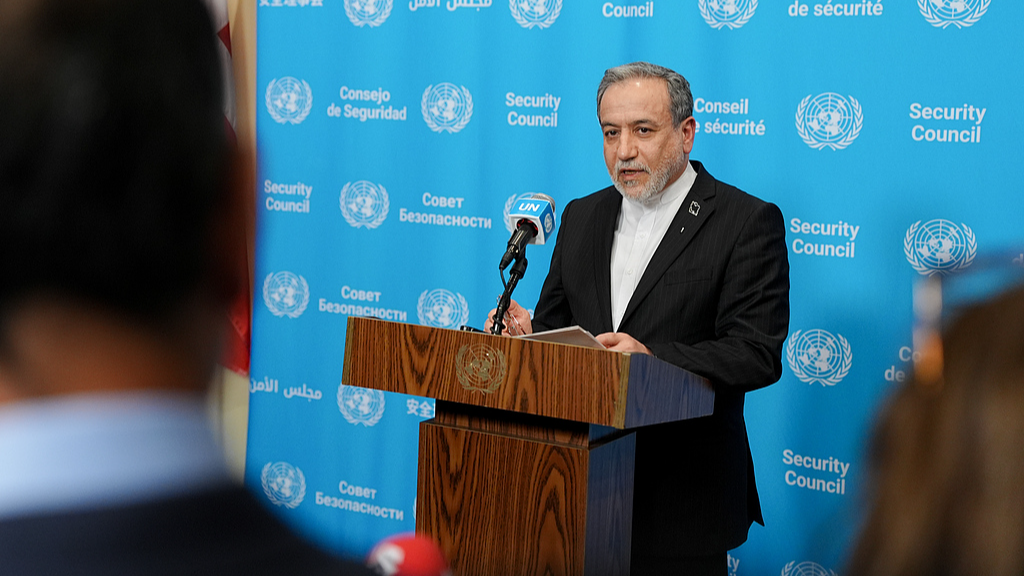
Iran's Foreign Minister Seyed Abbas Araghchi speaks to members of the media during the United Nations General Assembly in New York, US, September 25, 2026. (Photo: VCG)
US President Donald Trump has rejected Iran's proposal to reopen the Strait of Hormuz and halt regional fighting within seven days, and told aides he expects to resume bombing after November congressional elections, the Wall Street Journal reported on Friday, citing unnamed US officials.
Iran's Foreign Minister Seyed Abbas Araghchi had told reporters at the United Nations on Friday that Iran has conveyed "a concrete seven-day plan" to the United States through Qatar. The seven-day timeline will start as soon as Washington accepts it, Araghchi said.
Under the plan, the United States would need to take certain actions that Iran believes may take four or five days, said Araghchi, adding that on day six, the strait would be open. "And on day seven, the talks with the US will be started for the final deal on mutually agreed subjects."
"I can tell you if there is seriousness in the US side to come to a deal and reopen the Strait of Hormuz, everything is now prepared," said Araghchi.
"The choice now rests with the United States," he said. "Iran does not accept coercion, threats, or intimidation, and Iran will not surrender its sovereign rights under pressure."
Earlier on Thursday, Iranian President Masoud Pezeshkian reaffirmed his country's commitment to dialogue and diplomacy while accusing the United States of repeatedly disrupting the negotiation process.
A US official had told Reuters that the US and Iran were having "positive and constructive discussions through the mediators," but Trump was privately skeptical that Iran would meet his demands, the Wall Street Journal report said.
He has told his staff that he sees a renewed bombing campaign as likely, the Wall Street Journal said.
Diplomatic efforts surrounding the UN General Assembly in New York underscored the global stakes of the seven-month-old conflict, which has disrupted oil flows through one of the world's most critical shipping lanes and drawn in regional and world powers.
Return to diplomacy?
The Iranian seven-day proposal comes after previous attempts at diplomacy have failed to end the war, which began on February 28 with US and Israeli strikes.
Since then the war has alternated between pauses and renewed strikes, killing thousands while degrading Iran's conventional forces and damaging Iran's already ailing economy.
Iran and its allies have retaliated by extending the conflict throughout the region. Iran has struck US allies in the Gulf with drones and missiles while its Houthi allies in Yemen have targeted Saudi interests. Iranian-aligned militias in Iraq were blamed for a pipeline attack that temporarily took more Saudi oil off the market. All the while, Iranian-backed Hezbollah has been engaged with Israeli forces in Lebanon.
With the Saudi-backed, internationally recognized Yemeni government under assault from Yemen's Houthi fighters, and Houthi missiles striking inside Saudi Arabia, allies of the kingdom have united to show support.
Defense officials of Türkiye and Pakistan, both partners in a joint defense pact with Saudi Arabia, met in Riyadh on Friday to review the security situation and discuss intelligence cooperation, military coordination, and integrating forces, the Saudi defense ministry said in a statement.
The statement came a day after Saudi, Pakistani and Turkish foreign ministers met within the framework of the Mecca Joint Defense Agreement.
The violence in Yemen has prompted a new humanitarian crisis, the United Nations children's agency said on Friday, reporting a rise in acute malnutrition among children.